Jiawei Deng, Wenhao Li, Rui Zeng, Jiali Song, Senke Tan, Lixuan Kan, Zhao Qin, Yan Zhao, Feng Liu, Yanming Sun
{"title":"Acceptor Crystallinity Engineering Enables >20% Efficiency Binary Organic Solar Cells with 83.0% Fill Factor","authors":"Jiawei Deng, Wenhao Li, Rui Zeng, Jiali Song, Senke Tan, Lixuan Kan, Zhao Qin, Yan Zhao, Feng Liu, Yanming Sun","doi":"10.1002/adma.202501243","DOIUrl":null,"url":null,"abstract":"<p>For spontaneously crystallized organic photovoltaic materials, morphology optimization remains a challenge due to the disparity in crystallinity between the donor and acceptor components. Imperfections in the crystalline phases result in significant trap-assisted recombination, which emerges as a critical factor limiting the fill factor (FF) of organic solar cells (OSCs). Herein, a method is introduced for precise regulation of the acceptor crystallinity, utilizing a novel upper-layer acceptor processing solvent, trichloroethylene (TCE), to improve the state and vertical morphology of the active layer. The TCE solvent synergistically optimizes intermolecular interactions among acceptor molecules and balances the film-forming process, thereby increasing the proportion of transport phases and forming high-speed channels for electron transport, which subsequently reduces trap-assisted charge recombination. As a result, the photovoltaic efficiency of binary organic solar cells reaches 20.05%. More importantly, an unprecedented FF of 83.0% is obtained, representing the highest FF value for OSCs. This facile and effective approach offers a promising means for constructing efficient charge transport networks and fabricating high-efficiency and morphologically stable OSCs.</p>","PeriodicalId":114,"journal":{"name":"Advanced Materials","volume":"37 24","pages":""},"PeriodicalIF":26.8000,"publicationDate":"2025-04-07","publicationTypes":"Journal Article","fieldsOfStudy":null,"isOpenAccess":false,"openAccessPdf":"","citationCount":"0","resultStr":null,"platform":"Semanticscholar","paperid":null,"PeriodicalName":"Advanced Materials","FirstCategoryId":"88","ListUrlMain":"https://advanced.onlinelibrary.wiley.com/doi/10.1002/adma.202501243","RegionNum":1,"RegionCategory":"材料科学","ArticlePicture":[],"TitleCN":null,"AbstractTextCN":null,"PMCID":null,"EPubDate":"","PubModel":"","JCR":"Q1","JCRName":"CHEMISTRY, MULTIDISCIPLINARY","Score":null,"Total":0}
引用次数: 0
Abstract
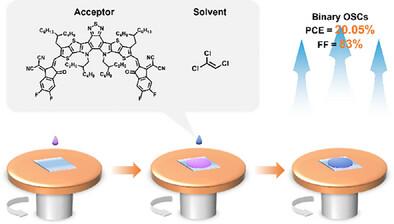
For spontaneously crystallized organic photovoltaic materials, morphology optimization remains a challenge due to the disparity in crystallinity between the donor and acceptor components. Imperfections in the crystalline phases result in significant trap-assisted recombination, which emerges as a critical factor limiting the fill factor (FF) of organic solar cells (OSCs). Herein, a method is introduced for precise regulation of the acceptor crystallinity, utilizing a novel upper-layer acceptor processing solvent, trichloroethylene (TCE), to improve the state and vertical morphology of the active layer. The TCE solvent synergistically optimizes intermolecular interactions among acceptor molecules and balances the film-forming process, thereby increasing the proportion of transport phases and forming high-speed channels for electron transport, which subsequently reduces trap-assisted charge recombination. As a result, the photovoltaic efficiency of binary organic solar cells reaches 20.05%. More importantly, an unprecedented FF of 83.0% is obtained, representing the highest FF value for OSCs. This facile and effective approach offers a promising means for constructing efficient charge transport networks and fabricating high-efficiency and morphologically stable OSCs.
期刊介绍:
Advanced Materials, one of the world's most prestigious journals and the foundation of the Advanced portfolio, is the home of choice for best-in-class materials science for more than 30 years. Following this fast-growing and interdisciplinary field, we are considering and publishing the most important discoveries on any and all materials from materials scientists, chemists, physicists, engineers as well as health and life scientists and bringing you the latest results and trends in modern materials-related research every week.



 京公网安备 11010802042870号
京ICP备2023020795号-1
京公网安备 11010802042870号
京ICP备2023020795号-1

 分享
分享
 求助内容:
求助内容: 应助结果提醒方式:
 扫码关注我们
