Jian Sun, Zezhuang Liu, Fan Xia, Yilu Gu, Xiaofeng Gao, Sha Lu, Yang Xu, Feidan Meng, Qian Zhang, Tao Zhou
{"title":"Uncovering the Impacts of 2D and 3D Urbanization on Urban Heat Islands in 384 Chinese Cities","authors":"Jian Sun, Zezhuang Liu, Fan Xia, Yilu Gu, Xiaofeng Gao, Sha Lu, Yang Xu, Feidan Meng, Qian Zhang, Tao Zhou","doi":"10.1021/acs.est.4c12689","DOIUrl":null,"url":null,"abstract":"Rapid urbanization in China has exacerbated the urban heat island (UHI) effect, posing considerable challenges to urban sustainability and public health. Most UHI studies have focused on the impacts of two-dimensional (2D) urbanization, which involves outward city expansion and increased built-up area. However, as cities mature, they typically transition from horizontal expansion to vertical densification (3D urbanization), leading to increased material stock density. The implications of this shift for the UHI effect remain underexplored. This study compared the 2D and 3D urbanization–induced impacts on UHI across 384 Chinese cities from 2000 to 2020, using impervious surface and gridded material stocks. Our results surprisingly indicated that 2D urbanization lost explanatory power of the UHI intensity when the impervious surface area percentage exceeded 87%. Relative importance analysis utilizing a random forest algorithm revealed that the population, vegetation abundance, and precipitation significantly moderated the effects of 3D urbanization, emphasizing the crucial role of urban green spaces in mitigating thermal stress. This study examined the spatiotemporal dynamics of the UHI effect in China, emphasizing the key role of 3D urbanization. Our findings highlight the urgent need to incorporate 3D urbanization characteristics when devising UHI mitigation strategies.","PeriodicalId":36,"journal":{"name":"环境科学与技术","volume":"108 1","pages":""},"PeriodicalIF":11.3000,"publicationDate":"2025-04-07","publicationTypes":"Journal Article","fieldsOfStudy":null,"isOpenAccess":false,"openAccessPdf":"","citationCount":"0","resultStr":null,"platform":"Semanticscholar","paperid":null,"PeriodicalName":"环境科学与技术","FirstCategoryId":"1","ListUrlMain":"https://doi.org/10.1021/acs.est.4c12689","RegionNum":1,"RegionCategory":"环境科学与生态学","ArticlePicture":[],"TitleCN":null,"AbstractTextCN":null,"PMCID":null,"EPubDate":"","PubModel":"","JCR":"Q1","JCRName":"ENGINEERING, ENVIRONMENTAL","Score":null,"Total":0}
引用次数: 0
Abstract
Rapid urbanization in China has exacerbated the urban heat island (UHI) effect, posing considerable challenges to urban sustainability and public health. Most UHI studies have focused on the impacts of two-dimensional (2D) urbanization, which involves outward city expansion and increased built-up area. However, as cities mature, they typically transition from horizontal expansion to vertical densification (3D urbanization), leading to increased material stock density. The implications of this shift for the UHI effect remain underexplored. This study compared the 2D and 3D urbanization–induced impacts on UHI across 384 Chinese cities from 2000 to 2020, using impervious surface and gridded material stocks. Our results surprisingly indicated that 2D urbanization lost explanatory power of the UHI intensity when the impervious surface area percentage exceeded 87%. Relative importance analysis utilizing a random forest algorithm revealed that the population, vegetation abundance, and precipitation significantly moderated the effects of 3D urbanization, emphasizing the crucial role of urban green spaces in mitigating thermal stress. This study examined the spatiotemporal dynamics of the UHI effect in China, emphasizing the key role of 3D urbanization. Our findings highlight the urgent need to incorporate 3D urbanization characteristics when devising UHI mitigation strategies.
期刊介绍:
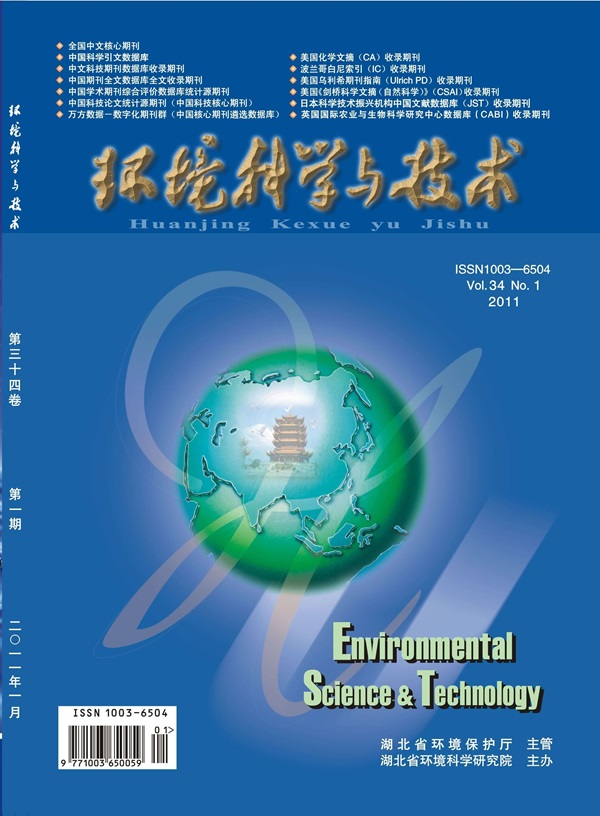
Environmental Science & Technology (ES&T) is a co-sponsored academic and technical magazine by the Hubei Provincial Environmental Protection Bureau and the Hubei Provincial Academy of Environmental Sciences.
Environmental Science & Technology (ES&T) holds the status of Chinese core journals, scientific papers source journals of China, Chinese Science Citation Database source journals, and Chinese Academic Journal Comprehensive Evaluation Database source journals. This publication focuses on the academic field of environmental protection, featuring articles related to environmental protection and technical advancements.




 京公网安备 11010802042870号
京ICP备2023020795号-1
京公网安备 11010802042870号
京ICP备2023020795号-1

 分享
分享
 求助内容:
求助内容: 应助结果提醒方式:
 扫码关注我们
