{"title":"New perspectives on bacterial chlorine resistance: Phages encoding chlorine resistance genes improve bacterial adaptation","authors":"Jia Wang, Yibo Zhang, Qiyue Meng, Ziyu Hu, Jie Fu, Chenyuan Dang","doi":"10.1016/j.watres.2025.123607","DOIUrl":null,"url":null,"abstract":"<div><div>Bacterial resistance to chlorine disinfectant reduces its effectiveness in killing pathogenic bacteria and poses a severe threat to environmental and health safety. The interaction between bacteria and phages is the most frequent biological activity in Earth's biosphere, but little is known about what role and mechanism phages play in the resistance of bacterial communities to chlorine disinfectants. Here, we investigated the changes in the abundance, activity and function of the bacterial-phage community under the effect of chlorine disinfectants in a 92-day running anaerobic-anoxic-oxic system, using metagenomics and metatranscriptomics sequencing. We found that transcriptional activities of both bacteria and phage are highly sensitive to chlorine disinfectants, although their relative abundance was not obviously altered. The increase in both phage diversity and the ratio of temperate to lytic phages’ average activity indicated phages, especially temperate, could play a crucial role in the response to chlorine disinfectants. Interestingly, the phages that carry chlorine resistance genes (CRGs) were the drivers of the phage and microbial community when chlorine disinfectants were present, but they followed the dynamics of community in the absence of chlorine disinfectants. Based on the association bipartite network, we further found that phages directly mediated the horizontal transfer of CRGs among bacteria, facilitating the spread of CRGs in the bacterial community. Moreover, the 4 CRGs related to cell wall repair, redox balance regulation, and efflux pumps that were carried by the phages but lacking in the hosts suggest the potential compensatory effects of the phage for the chlorine resistance of their hosts. Our findings reveal the important role of phages in improving the resistance of bacterial communities to chlorine disinfectants, providing a new perspective on the co-evolution of phages and bacteria to adapt to environments.</div></div>","PeriodicalId":443,"journal":{"name":"Water Research","volume":"282 ","pages":"Article 123607"},"PeriodicalIF":12.4000,"publicationDate":"2025-04-07","publicationTypes":"Journal Article","fieldsOfStudy":null,"isOpenAccess":false,"openAccessPdf":"","citationCount":"0","resultStr":null,"platform":"Semanticscholar","paperid":null,"PeriodicalName":"Water Research","FirstCategoryId":"93","ListUrlMain":"https://www.sciencedirect.com/science/article/pii/S0043135425005184","RegionNum":1,"RegionCategory":"环境科学与生态学","ArticlePicture":[],"TitleCN":null,"AbstractTextCN":null,"PMCID":null,"EPubDate":"","PubModel":"","JCR":"Q1","JCRName":"ENGINEERING, ENVIRONMENTAL","Score":null,"Total":0}
引用次数: 0
Abstract
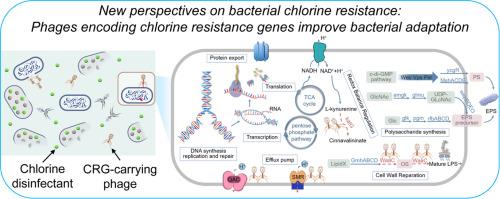
Bacterial resistance to chlorine disinfectant reduces its effectiveness in killing pathogenic bacteria and poses a severe threat to environmental and health safety. The interaction between bacteria and phages is the most frequent biological activity in Earth's biosphere, but little is known about what role and mechanism phages play in the resistance of bacterial communities to chlorine disinfectants. Here, we investigated the changes in the abundance, activity and function of the bacterial-phage community under the effect of chlorine disinfectants in a 92-day running anaerobic-anoxic-oxic system, using metagenomics and metatranscriptomics sequencing. We found that transcriptional activities of both bacteria and phage are highly sensitive to chlorine disinfectants, although their relative abundance was not obviously altered. The increase in both phage diversity and the ratio of temperate to lytic phages’ average activity indicated phages, especially temperate, could play a crucial role in the response to chlorine disinfectants. Interestingly, the phages that carry chlorine resistance genes (CRGs) were the drivers of the phage and microbial community when chlorine disinfectants were present, but they followed the dynamics of community in the absence of chlorine disinfectants. Based on the association bipartite network, we further found that phages directly mediated the horizontal transfer of CRGs among bacteria, facilitating the spread of CRGs in the bacterial community. Moreover, the 4 CRGs related to cell wall repair, redox balance regulation, and efflux pumps that were carried by the phages but lacking in the hosts suggest the potential compensatory effects of the phage for the chlorine resistance of their hosts. Our findings reveal the important role of phages in improving the resistance of bacterial communities to chlorine disinfectants, providing a new perspective on the co-evolution of phages and bacteria to adapt to environments.
期刊介绍:
Water Research, along with its open access companion journal Water Research X, serves as a platform for publishing original research papers covering various aspects of the science and technology related to the anthropogenic water cycle, water quality, and its management worldwide. The audience targeted by the journal comprises biologists, chemical engineers, chemists, civil engineers, environmental engineers, limnologists, and microbiologists. The scope of the journal include:
•Treatment processes for water and wastewaters (municipal, agricultural, industrial, and on-site treatment), including resource recovery and residuals management;
•Urban hydrology including sewer systems, stormwater management, and green infrastructure;
•Drinking water treatment and distribution;
•Potable and non-potable water reuse;
•Sanitation, public health, and risk assessment;
•Anaerobic digestion, solid and hazardous waste management, including source characterization and the effects and control of leachates and gaseous emissions;
•Contaminants (chemical, microbial, anthropogenic particles such as nanoparticles or microplastics) and related water quality sensing, monitoring, fate, and assessment;
•Anthropogenic impacts on inland, tidal, coastal and urban waters, focusing on surface and ground waters, and point and non-point sources of pollution;
•Environmental restoration, linked to surface water, groundwater and groundwater remediation;
•Analysis of the interfaces between sediments and water, and between water and atmosphere, focusing specifically on anthropogenic impacts;
•Mathematical modelling, systems analysis, machine learning, and beneficial use of big data related to the anthropogenic water cycle;
•Socio-economic, policy, and regulations studies.




 京公网安备 11010802042870号
京ICP备2023020795号-1
京公网安备 11010802042870号
京ICP备2023020795号-1

 分享
分享
 求助内容:
求助内容: 应助结果提醒方式:
 扫码关注我们
