{"title":"Modification of aged oily sludge (AOS) through pressure filtration and electro-dewatering methods under citric acid (CA) pretreatment","authors":"Junjie Hu, Miaomiao Zhao, Chen Li, Zhiyang Gong, Zeying Sun, Degang Ma","doi":"10.1016/j.watres.2025.123597","DOIUrl":null,"url":null,"abstract":"<div><div>Aged oily sludge (AOS) exhibits more challenging properties compared to ordinary oily sludge, making modification treatments essential for improving dewatering efficiency. This study innovatively employs citric acid (CA) as a pretreatment agent for AOS and combines pressure filtration (PF) and electro-dewatering (EDW) to conduct volume reduction experiments, while investigating the dewatering mechanism of CA pretreatment. Under a pressure of 75 kPa, the AOS moisture content decreased slightly from 80.12 % to 78.00 %, while the addition of 0.02 g CA/g AOS further reduced it to 71.69 %. Under conditions of 25 kPa and 25 V/cm, EDW lowered the moisture content to 47.36 %, achieving faster average dewatering rate of 0.086 g/s. This study investigated the oil and water distribution within sludge cake layers, analyzed their migration during EDW, and explained the anodic drying phenomenon. Engineering applicability was assessed through energy consumption and calorific value analyses. Mechanistic insights revealed oil component changes, highlighting the roles of surfactants, electric field forces, pH, and temperature. Formula-based calculations were also conducted for field-driven processes. This study presents an innovative deep dewatering technology for AOS, investigating the dewatering mechanism from various perspectives, including demulsification, electric field, pH, and thermal effects. Additionally, it evaluates the energy consumption and economic cost, providing a theoretical foundation for its engineering applicability and offering new perspectives for the treatment and disposal of AOS.</div></div>","PeriodicalId":443,"journal":{"name":"Water Research","volume":"282 ","pages":"Article 123597"},"PeriodicalIF":12.4000,"publicationDate":"2025-04-07","publicationTypes":"Journal Article","fieldsOfStudy":null,"isOpenAccess":false,"openAccessPdf":"","citationCount":"0","resultStr":null,"platform":"Semanticscholar","paperid":null,"PeriodicalName":"Water Research","FirstCategoryId":"93","ListUrlMain":"https://www.sciencedirect.com/science/article/pii/S0043135425005093","RegionNum":1,"RegionCategory":"环境科学与生态学","ArticlePicture":[],"TitleCN":null,"AbstractTextCN":null,"PMCID":null,"EPubDate":"","PubModel":"","JCR":"Q1","JCRName":"ENGINEERING, ENVIRONMENTAL","Score":null,"Total":0}
引用次数: 0
Abstract
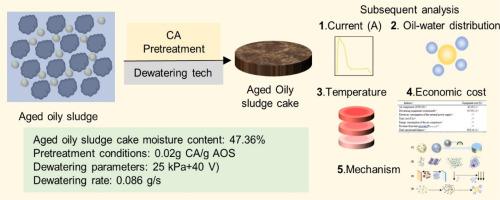
Aged oily sludge (AOS) exhibits more challenging properties compared to ordinary oily sludge, making modification treatments essential for improving dewatering efficiency. This study innovatively employs citric acid (CA) as a pretreatment agent for AOS and combines pressure filtration (PF) and electro-dewatering (EDW) to conduct volume reduction experiments, while investigating the dewatering mechanism of CA pretreatment. Under a pressure of 75 kPa, the AOS moisture content decreased slightly from 80.12 % to 78.00 %, while the addition of 0.02 g CA/g AOS further reduced it to 71.69 %. Under conditions of 25 kPa and 25 V/cm, EDW lowered the moisture content to 47.36 %, achieving faster average dewatering rate of 0.086 g/s. This study investigated the oil and water distribution within sludge cake layers, analyzed their migration during EDW, and explained the anodic drying phenomenon. Engineering applicability was assessed through energy consumption and calorific value analyses. Mechanistic insights revealed oil component changes, highlighting the roles of surfactants, electric field forces, pH, and temperature. Formula-based calculations were also conducted for field-driven processes. This study presents an innovative deep dewatering technology for AOS, investigating the dewatering mechanism from various perspectives, including demulsification, electric field, pH, and thermal effects. Additionally, it evaluates the energy consumption and economic cost, providing a theoretical foundation for its engineering applicability and offering new perspectives for the treatment and disposal of AOS.
期刊介绍:
Water Research, along with its open access companion journal Water Research X, serves as a platform for publishing original research papers covering various aspects of the science and technology related to the anthropogenic water cycle, water quality, and its management worldwide. The audience targeted by the journal comprises biologists, chemical engineers, chemists, civil engineers, environmental engineers, limnologists, and microbiologists. The scope of the journal include:
•Treatment processes for water and wastewaters (municipal, agricultural, industrial, and on-site treatment), including resource recovery and residuals management;
•Urban hydrology including sewer systems, stormwater management, and green infrastructure;
•Drinking water treatment and distribution;
•Potable and non-potable water reuse;
•Sanitation, public health, and risk assessment;
•Anaerobic digestion, solid and hazardous waste management, including source characterization and the effects and control of leachates and gaseous emissions;
•Contaminants (chemical, microbial, anthropogenic particles such as nanoparticles or microplastics) and related water quality sensing, monitoring, fate, and assessment;
•Anthropogenic impacts on inland, tidal, coastal and urban waters, focusing on surface and ground waters, and point and non-point sources of pollution;
•Environmental restoration, linked to surface water, groundwater and groundwater remediation;
•Analysis of the interfaces between sediments and water, and between water and atmosphere, focusing specifically on anthropogenic impacts;
•Mathematical modelling, systems analysis, machine learning, and beneficial use of big data related to the anthropogenic water cycle;
•Socio-economic, policy, and regulations studies.




 京公网安备 11010802042870号
京ICP备2023020795号-1
京公网安备 11010802042870号
京ICP备2023020795号-1

 分享
分享
 求助内容:
求助内容: 应助结果提醒方式:
 扫码关注我们
