Laura Fablet, Mathieu Pédrot, Fadi Choueikani, Isabelle Kieffer, Olivier Proux, Anne-Catherine Pierson-Wickmann, Vyria Cagniart, Takumi Yomogida and Rémi Marsac
{"title":"Nickel binding with magnetite nanoparticles†","authors":"Laura Fablet, Mathieu Pédrot, Fadi Choueikani, Isabelle Kieffer, Olivier Proux, Anne-Catherine Pierson-Wickmann, Vyria Cagniart, Takumi Yomogida and Rémi Marsac","doi":"10.1039/D4EN01114G","DOIUrl":null,"url":null,"abstract":"<p >Nickel is generally found in trace amounts in the environment and can be beneficial to living organisms, but it is also an environmental contaminant of high concern, primarily due to anthropogenic releases. Fe oxides play a significant role in the behavior and fate of Ni in the environment, as they can interact with metal cations. However, the interactions between magnetite (Fe<small><sub>3</sub></small>O<small><sub>4</sub></small>) and Ni are not well described, and in particular the effect of magnetite stoichiometry (Fe(<small>II</small>)/Fe(<small>III</small>) = <em>R</em>) is not well considered. Ni sorption experiments were performed on stoichiometric (R0.5) and oxidized (R0.1) magnetite as a function of Ni concentration and pH under anaerobic conditions. Samples were analyzed by transmission electron microscopy, X-ray absorption spectroscopy (XAS) and magnetic circular dichroism at the Ni L<small><sub>2,3</sub></small>-edges and XAS at the Ni K-edge. At high Ni concentrations, Ni precipitates as Ni(OH)<small><sub>2</sub></small> on the magnetite surface, but also as distinct sheet-like particles. At low Ni concentrations, high energy resolution fluorescence detection (HERFD) XAS analyses at the Ni K-edge revealed Ni incorporation into R0.5 magnetite and surface adsorption of Ni onto R0.1 magnetite. The present results were compared with those previously published for Co, which revealed an unexpected distinct behavior of Ni and Co. This element-specific binding mechanism highlights the unique properties of magnetite compared to other naturally occurring iron oxides (<em>e.g.</em> goethite, hematite), for which Ni and Co binding mechanisms are similar. Taken together, these results will help not only to predict the behavior and fate of Ni under environmental conditions in the presence of magnetite but also to synthesize magnetite nanoparticles doped by the addition of Ni with interesting magnetic properties.</p>","PeriodicalId":73,"journal":{"name":"Environmental Science: Nano","volume":" 5","pages":" 2815-2827"},"PeriodicalIF":5.1000,"publicationDate":"2025-04-07","publicationTypes":"Journal Article","fieldsOfStudy":null,"isOpenAccess":false,"openAccessPdf":"","citationCount":"0","resultStr":null,"platform":"Semanticscholar","paperid":null,"PeriodicalName":"Environmental Science: Nano","FirstCategoryId":"6","ListUrlMain":"https://pubs.rsc.org/en/content/articlelanding/2025/en/d4en01114g","RegionNum":2,"RegionCategory":"环境科学与生态学","ArticlePicture":[],"TitleCN":null,"AbstractTextCN":null,"PMCID":null,"EPubDate":"","PubModel":"","JCR":"Q1","JCRName":"CHEMISTRY, MULTIDISCIPLINARY","Score":null,"Total":0}
引用次数: 0
Abstract
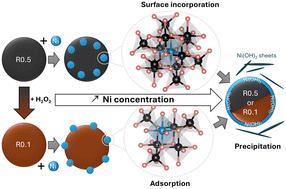
Nickel is generally found in trace amounts in the environment and can be beneficial to living organisms, but it is also an environmental contaminant of high concern, primarily due to anthropogenic releases. Fe oxides play a significant role in the behavior and fate of Ni in the environment, as they can interact with metal cations. However, the interactions between magnetite (Fe3O4) and Ni are not well described, and in particular the effect of magnetite stoichiometry (Fe(II)/Fe(III) = R) is not well considered. Ni sorption experiments were performed on stoichiometric (R0.5) and oxidized (R0.1) magnetite as a function of Ni concentration and pH under anaerobic conditions. Samples were analyzed by transmission electron microscopy, X-ray absorption spectroscopy (XAS) and magnetic circular dichroism at the Ni L2,3-edges and XAS at the Ni K-edge. At high Ni concentrations, Ni precipitates as Ni(OH)2 on the magnetite surface, but also as distinct sheet-like particles. At low Ni concentrations, high energy resolution fluorescence detection (HERFD) XAS analyses at the Ni K-edge revealed Ni incorporation into R0.5 magnetite and surface adsorption of Ni onto R0.1 magnetite. The present results were compared with those previously published for Co, which revealed an unexpected distinct behavior of Ni and Co. This element-specific binding mechanism highlights the unique properties of magnetite compared to other naturally occurring iron oxides (e.g. goethite, hematite), for which Ni and Co binding mechanisms are similar. Taken together, these results will help not only to predict the behavior and fate of Ni under environmental conditions in the presence of magnetite but also to synthesize magnetite nanoparticles doped by the addition of Ni with interesting magnetic properties.
期刊介绍:
Environmental Science: Nano serves as a comprehensive and high-impact peer-reviewed source of information on the design and demonstration of engineered nanomaterials for environment-based applications. It also covers the interactions between engineered, natural, and incidental nanomaterials with biological and environmental systems. This scope includes, but is not limited to, the following topic areas:
Novel nanomaterial-based applications for water, air, soil, food, and energy sustainability
Nanomaterial interactions with biological systems and nanotoxicology
Environmental fate, reactivity, and transformations of nanoscale materials
Nanoscale processes in the environment
Sustainable nanotechnology including rational nanomaterial design, life cycle assessment, risk/benefit analysis



 京公网安备 11010802042870号
京ICP备2023020795号-1
京公网安备 11010802042870号
京ICP备2023020795号-1

 分享
分享
 求助内容:
求助内容: 应助结果提醒方式:
 扫码关注我们
