Tianqi Du, Xing Su, Yuan Zhu, Gege Zhao, Miao Zhang, Chengcheng Li, Zaisheng Cai and Yaping Zhao*,
{"title":"Efficient Fabrication of Highly Elastic, Self-Adhesive MXene-Doped Lignin-Based Conductive Hydrogels for Flexible Strain Sensing Applications","authors":"Tianqi Du, Xing Su, Yuan Zhu, Gege Zhao, Miao Zhang, Chengcheng Li, Zaisheng Cai and Yaping Zhao*, ","doi":"10.1021/acsaelm.5c00036","DOIUrl":null,"url":null,"abstract":"<p >Conductive hydrogels are used in a wide variety of applications, including human motion detection, conversion, and storage of energy and self-powered wearable devices. However, their poor mechanical properties or poor adhesion to various materials has seriously hindered their prospects in the direction of flexible wearable electronic devices. Herein, alkali lignin was sulfonated to disperse silica nanoparticles (LSNs) as a mechanical reinforcing agent. Subsequently, the sulfonated lignin can form a self-catalytic system (LSNs–Fe<sup>3+</sup>) with iron ions to efficiently prepare conductive hydrogels at room temperature. This preparation strategy of “one-stone-two-birds” endows the hydrogel with excellent high elasticity and self-adhesiveness. In addition, the doping of MXene endows the hydrogel with a superior conductivity. Specifically, the prepared hydrogels containing 1.5 wt % LSNs have excellent tensile properties (∼700% elongation and ∼76.0 kPa tensile strength) and nice adhesion properties (∼19.9 kPa self-adhesion). In addition, the assembled hydrogel sensor has a high sensitivity and cyclic stability and can monitor human movement in real time. In conclusion, the conductive hydrogel designed in this study was expected to be an excellent candidate for flexible, wearable electronics.</p>","PeriodicalId":3,"journal":{"name":"ACS Applied Electronic Materials","volume":"7 7","pages":"2862–2872 2862–2872"},"PeriodicalIF":4.7000,"publicationDate":"2025-03-20","publicationTypes":"Journal Article","fieldsOfStudy":null,"isOpenAccess":false,"openAccessPdf":"","citationCount":"0","resultStr":null,"platform":"Semanticscholar","paperid":null,"PeriodicalName":"ACS Applied Electronic Materials","FirstCategoryId":"88","ListUrlMain":"https://pubs.acs.org/doi/10.1021/acsaelm.5c00036","RegionNum":3,"RegionCategory":"材料科学","ArticlePicture":[],"TitleCN":null,"AbstractTextCN":null,"PMCID":null,"EPubDate":"","PubModel":"","JCR":"Q1","JCRName":"ENGINEERING, ELECTRICAL & ELECTRONIC","Score":null,"Total":0}
引用次数: 0
Abstract
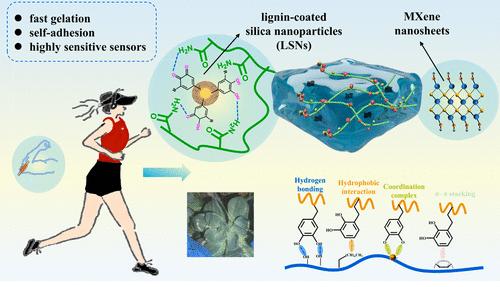
Conductive hydrogels are used in a wide variety of applications, including human motion detection, conversion, and storage of energy and self-powered wearable devices. However, their poor mechanical properties or poor adhesion to various materials has seriously hindered their prospects in the direction of flexible wearable electronic devices. Herein, alkali lignin was sulfonated to disperse silica nanoparticles (LSNs) as a mechanical reinforcing agent. Subsequently, the sulfonated lignin can form a self-catalytic system (LSNs–Fe3+) with iron ions to efficiently prepare conductive hydrogels at room temperature. This preparation strategy of “one-stone-two-birds” endows the hydrogel with excellent high elasticity and self-adhesiveness. In addition, the doping of MXene endows the hydrogel with a superior conductivity. Specifically, the prepared hydrogels containing 1.5 wt % LSNs have excellent tensile properties (∼700% elongation and ∼76.0 kPa tensile strength) and nice adhesion properties (∼19.9 kPa self-adhesion). In addition, the assembled hydrogel sensor has a high sensitivity and cyclic stability and can monitor human movement in real time. In conclusion, the conductive hydrogel designed in this study was expected to be an excellent candidate for flexible, wearable electronics.
期刊介绍:
ACS Applied Electronic Materials is an interdisciplinary journal publishing original research covering all aspects of electronic materials. The journal is devoted to reports of new and original experimental and theoretical research of an applied nature that integrate knowledge in the areas of materials science, engineering, optics, physics, and chemistry into important applications of electronic materials. Sample research topics that span the journal's scope are inorganic, organic, ionic and polymeric materials with properties that include conducting, semiconducting, superconducting, insulating, dielectric, magnetic, optoelectronic, piezoelectric, ferroelectric and thermoelectric.
Indexed/Abstracted:
Web of Science SCIE
Scopus
CAS
INSPEC
Portico




 京公网安备 11010802042870号
京ICP备2023020795号-1
京公网安备 11010802042870号
京ICP备2023020795号-1

 分享
分享
 求助内容:
求助内容: 应助结果提醒方式:
 扫码关注我们
