Sajid Farooq , Muhammad Habib , Olavo Cardozo , Kaleem Ullah , A.K. Pandey , Zafar Said
{"title":"Exploring the impact of particle stability, size, and morphology on nanofluid thermal conductivity: A comprehensive review for energy applications","authors":"Sajid Farooq , Muhammad Habib , Olavo Cardozo , Kaleem Ullah , A.K. Pandey , Zafar Said","doi":"10.1016/j.cis.2025.103495","DOIUrl":null,"url":null,"abstract":"<div><div>Recent advancements enhance the efficiency of energy conversion processes and leverage nanofluids—novel thermal fluids with nanoparticles (under 100 nm) suspended in conventional fluids. These nanofluids significantly alter thermophysical properties, notably thermal conductivity, which is crucial for evaluating their thermal performance. Despite three decades of intensive research, disagreements persist due to a lack of comprehensive data on how particle size, shape, stability, and others influence thermal conductivity. This review tries to fill this literature gap by critically reviewing how the characteristics that distinguish nanofluids from their micrometer-sized counterparts affect the stability and convective heat transfer. The study compares experimental results in a systemic way that addresses the reported inconsistencies and provides a general summary of the thermal behavior of nanofluids in energy systems. It has also pointed out the lack of reliable hybrid models considering all parameters affecting thermal conductivity. The current study assembles data from different analyses showing that a particle size within the 10-50 nm range may enhance thermal conductivity, depending on the base-fluid used. Likewise, the morphological options available, namely, spherical, ellipsoid, platelet, and blade-like, all have given promise for enhancing thermal conductivity, hence considering morphological issues. Finally, stability, defined by the zeta potential analyses, forms a vital criterion for the long-term sustainability of these enhancements. By consolidating experimental results across different research groups, this review highlights the variability and sometimes contradictory findings in thermal conductivity enhancements, ranging from negligible increases to over 50% improvement in specific nanofluids systems. The absence of reliable hybrid models encapsulating all influencing parameters for predicting thermal conductivity is critically addressed. It is concluded by identifying the main challenges in the field and offering recommendations for standardizing measurement techniques, which include the need for a unified model capable of predicting thermal conductivity enhancements with an accuracy of <span><math><mo>±</mo></math></span>5%.</div></div>","PeriodicalId":239,"journal":{"name":"Advances in Colloid and Interface Science","volume":"341 ","pages":"Article 103495"},"PeriodicalIF":19.3000,"publicationDate":"2025-07-01","publicationTypes":"Journal Article","fieldsOfStudy":null,"isOpenAccess":false,"openAccessPdf":"","citationCount":"0","resultStr":null,"platform":"Semanticscholar","paperid":null,"PeriodicalName":"Advances in Colloid and Interface Science","FirstCategoryId":"92","ListUrlMain":"https://www.sciencedirect.com/science/article/pii/S000186862500106X","RegionNum":1,"RegionCategory":"化学","ArticlePicture":[],"TitleCN":null,"AbstractTextCN":null,"PMCID":null,"EPubDate":"2025/3/28 0:00:00","PubModel":"Epub","JCR":"Q1","JCRName":"CHEMISTRY, PHYSICAL","Score":null,"Total":0}
引用次数: 0
Abstract
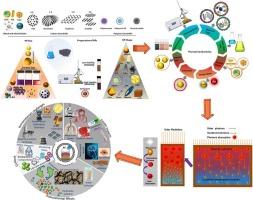
Recent advancements enhance the efficiency of energy conversion processes and leverage nanofluids—novel thermal fluids with nanoparticles (under 100 nm) suspended in conventional fluids. These nanofluids significantly alter thermophysical properties, notably thermal conductivity, which is crucial for evaluating their thermal performance. Despite three decades of intensive research, disagreements persist due to a lack of comprehensive data on how particle size, shape, stability, and others influence thermal conductivity. This review tries to fill this literature gap by critically reviewing how the characteristics that distinguish nanofluids from their micrometer-sized counterparts affect the stability and convective heat transfer. The study compares experimental results in a systemic way that addresses the reported inconsistencies and provides a general summary of the thermal behavior of nanofluids in energy systems. It has also pointed out the lack of reliable hybrid models considering all parameters affecting thermal conductivity. The current study assembles data from different analyses showing that a particle size within the 10-50 nm range may enhance thermal conductivity, depending on the base-fluid used. Likewise, the morphological options available, namely, spherical, ellipsoid, platelet, and blade-like, all have given promise for enhancing thermal conductivity, hence considering morphological issues. Finally, stability, defined by the zeta potential analyses, forms a vital criterion for the long-term sustainability of these enhancements. By consolidating experimental results across different research groups, this review highlights the variability and sometimes contradictory findings in thermal conductivity enhancements, ranging from negligible increases to over 50% improvement in specific nanofluids systems. The absence of reliable hybrid models encapsulating all influencing parameters for predicting thermal conductivity is critically addressed. It is concluded by identifying the main challenges in the field and offering recommendations for standardizing measurement techniques, which include the need for a unified model capable of predicting thermal conductivity enhancements with an accuracy of 5%.
期刊介绍:
"Advances in Colloid and Interface Science" is an international journal that focuses on experimental and theoretical developments in interfacial and colloidal phenomena. The journal covers a wide range of disciplines including biology, chemistry, physics, and technology.
The journal accepts review articles on any topic within the scope of colloid and interface science. These articles should provide an in-depth analysis of the subject matter, offering a critical review of the current state of the field. The author's informed opinion on the topic should also be included. The manuscript should compare and contrast ideas found in the reviewed literature and address the limitations of these ideas.
Typically, the articles published in this journal are written by recognized experts in the field.



 京公网安备 11010802042870号
京ICP备2023020795号-1
京公网安备 11010802042870号
京ICP备2023020795号-1

 分享
分享
 求助内容:
求助内容: 应助结果提醒方式:
 扫码关注我们
