{"title":"Hybrid wind energy and hydrogen system for direct CO2 air capture: A case study","authors":"Mohammed Daoudi","doi":"10.1016/j.renene.2025.123028","DOIUrl":null,"url":null,"abstract":"<div><div>This study addresses urgent environmental challenges by proposing an innovative hybrid system that integrates wind energy and green hydrogen production to power direct <em>CO</em><sub><em>2</em></sub> air capture <em>(DAC)</em> at three sites in northern Morocco. The novelty of this work lies in its scalable design, combining renewable energy with <em>DAC</em> technology to create a sustainable solution for carbon reduction. Wind potential was analyzed using the Weibull distribution to ensure statistical reliability for eight commercial turbines. Hydrogen production employed proton exchange membrane <em>(PEM)</em> electrolysis, recognized for its efficiency. Among the turbines, <em>T</em><sub><em>5</em></sub> demonstrated superior performance, producing 3971–7545 MWh/year with capacity factors from 29.5 % to 57.7 %. Hydrogen yields ranged from 53,575.02 to 101,793.90 kg, with storage volumes between 1413.79 and 2686.23 m<sup>3</sup>. A key strength of this study is its detailed techno-economic analysis, showing low costs of electricity <em>(LCOE)</em>, hydrogen <em>(LCOH)</em>, and <em>CO</em><sub><em>2</em></sub> capture <em>(LCOD)</em>. Additionally, <em>T</em><sub><em>6</em></sub> and <em>T</em><sub><em>8</em></sub> turbines were identified as competitive alternatives, while others were excluded due to higher costs. This study highlights the effectiveness of wind-hydrogen hybrid systems, with <em>CO</em><sub><em>2</em></sub> capture ranging from 1313.22 to 12,882.35 tons across the sites. It also demonstrates their economic feasibility, contributing to the goals of clean energy, sustainable cities, and climate action.</div></div>","PeriodicalId":419,"journal":{"name":"Renewable Energy","volume":"247 ","pages":"Article 123028"},"PeriodicalIF":9.1000,"publicationDate":"2025-07-01","publicationTypes":"Journal Article","fieldsOfStudy":null,"isOpenAccess":false,"openAccessPdf":"","citationCount":"0","resultStr":null,"platform":"Semanticscholar","paperid":null,"PeriodicalName":"Renewable Energy","FirstCategoryId":"5","ListUrlMain":"https://www.sciencedirect.com/science/article/pii/S0960148125006901","RegionNum":1,"RegionCategory":"工程技术","ArticlePicture":[],"TitleCN":null,"AbstractTextCN":null,"PMCID":null,"EPubDate":"2025/4/4 0:00:00","PubModel":"Epub","JCR":"Q1","JCRName":"ENERGY & FUELS","Score":null,"Total":0}
引用次数: 0
Abstract
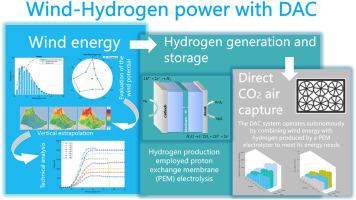
This study addresses urgent environmental challenges by proposing an innovative hybrid system that integrates wind energy and green hydrogen production to power direct CO2 air capture (DAC) at three sites in northern Morocco. The novelty of this work lies in its scalable design, combining renewable energy with DAC technology to create a sustainable solution for carbon reduction. Wind potential was analyzed using the Weibull distribution to ensure statistical reliability for eight commercial turbines. Hydrogen production employed proton exchange membrane (PEM) electrolysis, recognized for its efficiency. Among the turbines, T5 demonstrated superior performance, producing 3971–7545 MWh/year with capacity factors from 29.5 % to 57.7 %. Hydrogen yields ranged from 53,575.02 to 101,793.90 kg, with storage volumes between 1413.79 and 2686.23 m3. A key strength of this study is its detailed techno-economic analysis, showing low costs of electricity (LCOE), hydrogen (LCOH), and CO2 capture (LCOD). Additionally, T6 and T8 turbines were identified as competitive alternatives, while others were excluded due to higher costs. This study highlights the effectiveness of wind-hydrogen hybrid systems, with CO2 capture ranging from 1313.22 to 12,882.35 tons across the sites. It also demonstrates their economic feasibility, contributing to the goals of clean energy, sustainable cities, and climate action.
期刊介绍:
Renewable Energy journal is dedicated to advancing knowledge and disseminating insights on various topics and technologies within renewable energy systems and components. Our mission is to support researchers, engineers, economists, manufacturers, NGOs, associations, and societies in staying updated on new developments in their respective fields and applying alternative energy solutions to current practices.
As an international, multidisciplinary journal in renewable energy engineering and research, we strive to be a premier peer-reviewed platform and a trusted source of original research and reviews in the field of renewable energy. Join us in our endeavor to drive innovation and progress in sustainable energy solutions.



 京公网安备 11010802042870号
京ICP备2023020795号-1
京公网安备 11010802042870号
京ICP备2023020795号-1

 分享
分享
 求助内容:
求助内容: 应助结果提醒方式:
 扫码关注我们
