Gas radiation characteristics of non-premixed ammonia–oxygen–nitrogen turbulent jet flames and comparison with methane jet flames under oxygen-enriched conditions
{"title":"Gas radiation characteristics of non-premixed ammonia–oxygen–nitrogen turbulent jet flames and comparison with methane jet flames under oxygen-enriched conditions","authors":"Yu Xia , Daichi Matsumoto , Sophie Colson , Taku Kudo , Kai Tanji , Marina Kovaleva , Akihiro Hayakawa , Hideaki Kobayashi","doi":"10.1016/j.fuel.2025.135274","DOIUrl":null,"url":null,"abstract":"<div><div>Ammonia, a hydrogen energy carrier and carbon-free fuel, offers significant potential for industrial decarbonization. However, its combustion in air results in lower flame temperatures and weaker radiative heat transfer compared to hydrocarbon fuels. Oxygen-enriched ammonia combustion presents a promising solution, yet its radiation characteristics remain poorly understood. In this work, the radiation spectra and total radiation intensity of ammonia–oxygen–nitrogen and methane–oxygen–nitrogen non-premixed turbulent jet flames were experimentally measured and compared under various oxygen concentrations and heat output conditions up to 10 kW, with a unity global equivalence ratio. Additionally, the radiation spectra and total radiation intensity of ammonia and methane flames were theoretically calculated using HITRAN database and the optically thin model (OTM), respectively, considering the chemically equilibrium burnt gas condition of the mixture. The results demonstrate that water vapor is the predominant radiative gas species in ammonia flames, while water vapor and carbon dioxide are the primary radiative gas species in methane flames. Furthermore, the radiation spectral intensity and total radiation intensity of the flames increase with higher oxygen concentration in the oxidizer and greater heat output condition. The comparison between experimental results and OTM theoretical predictions of the flame total radiation intensity shows that OTM is a reasonable method for estimation of total radiation intensity in these flames. Notably, the total radiation intensity from methane flames is approximately twice that of ammonia flames under identical heat output and oxygen concentration conditions. Moreover, increasing the oxygen mole fraction in the oxidizer to 0.5 boosts the total radiation intensity of ammonia flames to levels comparable to those of methane–air flames. These findings support the potential application of ammonia in various energy facilities and contribute to decarbonization efforts in industrial sectors.</div></div>","PeriodicalId":325,"journal":{"name":"Fuel","volume":"396 ","pages":"Article 135274"},"PeriodicalIF":7.5000,"publicationDate":"2025-09-15","publicationTypes":"Journal Article","fieldsOfStudy":null,"isOpenAccess":false,"openAccessPdf":"","citationCount":"0","resultStr":null,"platform":"Semanticscholar","paperid":null,"PeriodicalName":"Fuel","FirstCategoryId":"5","ListUrlMain":"https://www.sciencedirect.com/science/article/pii/S0016236125009998","RegionNum":1,"RegionCategory":"工程技术","ArticlePicture":[],"TitleCN":null,"AbstractTextCN":null,"PMCID":null,"EPubDate":"2025/4/8 0:00:00","PubModel":"Epub","JCR":"Q2","JCRName":"ENERGY & FUELS","Score":null,"Total":0}
引用次数: 0
Abstract
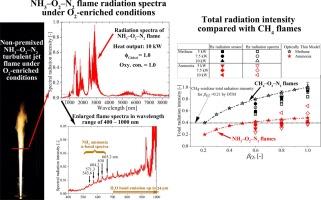
Ammonia, a hydrogen energy carrier and carbon-free fuel, offers significant potential for industrial decarbonization. However, its combustion in air results in lower flame temperatures and weaker radiative heat transfer compared to hydrocarbon fuels. Oxygen-enriched ammonia combustion presents a promising solution, yet its radiation characteristics remain poorly understood. In this work, the radiation spectra and total radiation intensity of ammonia–oxygen–nitrogen and methane–oxygen–nitrogen non-premixed turbulent jet flames were experimentally measured and compared under various oxygen concentrations and heat output conditions up to 10 kW, with a unity global equivalence ratio. Additionally, the radiation spectra and total radiation intensity of ammonia and methane flames were theoretically calculated using HITRAN database and the optically thin model (OTM), respectively, considering the chemically equilibrium burnt gas condition of the mixture. The results demonstrate that water vapor is the predominant radiative gas species in ammonia flames, while water vapor and carbon dioxide are the primary radiative gas species in methane flames. Furthermore, the radiation spectral intensity and total radiation intensity of the flames increase with higher oxygen concentration in the oxidizer and greater heat output condition. The comparison between experimental results and OTM theoretical predictions of the flame total radiation intensity shows that OTM is a reasonable method for estimation of total radiation intensity in these flames. Notably, the total radiation intensity from methane flames is approximately twice that of ammonia flames under identical heat output and oxygen concentration conditions. Moreover, increasing the oxygen mole fraction in the oxidizer to 0.5 boosts the total radiation intensity of ammonia flames to levels comparable to those of methane–air flames. These findings support the potential application of ammonia in various energy facilities and contribute to decarbonization efforts in industrial sectors.
期刊介绍:
The exploration of energy sources remains a critical matter of study. For the past nine decades, fuel has consistently held the forefront in primary research efforts within the field of energy science. This area of investigation encompasses a wide range of subjects, with a particular emphasis on emerging concerns like environmental factors and pollution.




 京公网安备 11010802042870号
京ICP备2023020795号-1
京公网安备 11010802042870号
京ICP备2023020795号-1

 分享
分享
 求助内容:
求助内容: 应助结果提醒方式:
 扫码关注我们
