Ranjan Muthukrishnan, Tara M. Smiley, Pascal O. Title, Adam M. Fudickar, Alex E. Jahn, Jennifer A. Lau
{"title":"Chasing the Niche: Escaping Climate Change Threats in Place, Time, and Space","authors":"Ranjan Muthukrishnan, Tara M. Smiley, Pascal O. Title, Adam M. Fudickar, Alex E. Jahn, Jennifer A. Lau","doi":"10.1111/gcb.70167","DOIUrl":null,"url":null,"abstract":"<div>\n \n <p>Climate change is creating mismatches between species' current environments and their historical niches. Locations that once had the abiotic and biotic conditions to support the persistence of a species may now be too warm, too dry, or simply too different, to meet their niche requirements. Changes in behaviors, altered phenology, and range shifts are common responses to climate change. Though these responses are often studied in isolation by scientists from disparate subfields of ecology, they all represent variants of the same solution—strategies to realign the conditions populations experience with their niche. Here, we aim to (1) identify the physiological and ecological effects, and potential alignment, of these three ecological responses: shifts in behavior, phenology, or ranges, (2) determine the circumstances under which each type of response may be more or less effective at mitigating the effects of climate change, and (3) consider how these strategies might interact with each other. Each response has been previously reviewed, but efforts to consider relationships between ecological (or with evolutionary) responses have been limited. A synthetic perspective that considers the similarities among ecological responses and how they interact with each other and with evolutionary responses offers a more robust view on species' resilience to climate change.</p>\n </div>","PeriodicalId":175,"journal":{"name":"Global Change Biology","volume":"31 4","pages":""},"PeriodicalIF":12.0000,"publicationDate":"2025-04-08","publicationTypes":"Journal Article","fieldsOfStudy":null,"isOpenAccess":false,"openAccessPdf":"","citationCount":"0","resultStr":null,"platform":"Semanticscholar","paperid":null,"PeriodicalName":"Global Change Biology","FirstCategoryId":"93","ListUrlMain":"https://onlinelibrary.wiley.com/doi/10.1111/gcb.70167","RegionNum":1,"RegionCategory":"环境科学与生态学","ArticlePicture":[],"TitleCN":null,"AbstractTextCN":null,"PMCID":null,"EPubDate":"","PubModel":"","JCR":"Q1","JCRName":"BIODIVERSITY CONSERVATION","Score":null,"Total":0}
引用次数: 0
Abstract
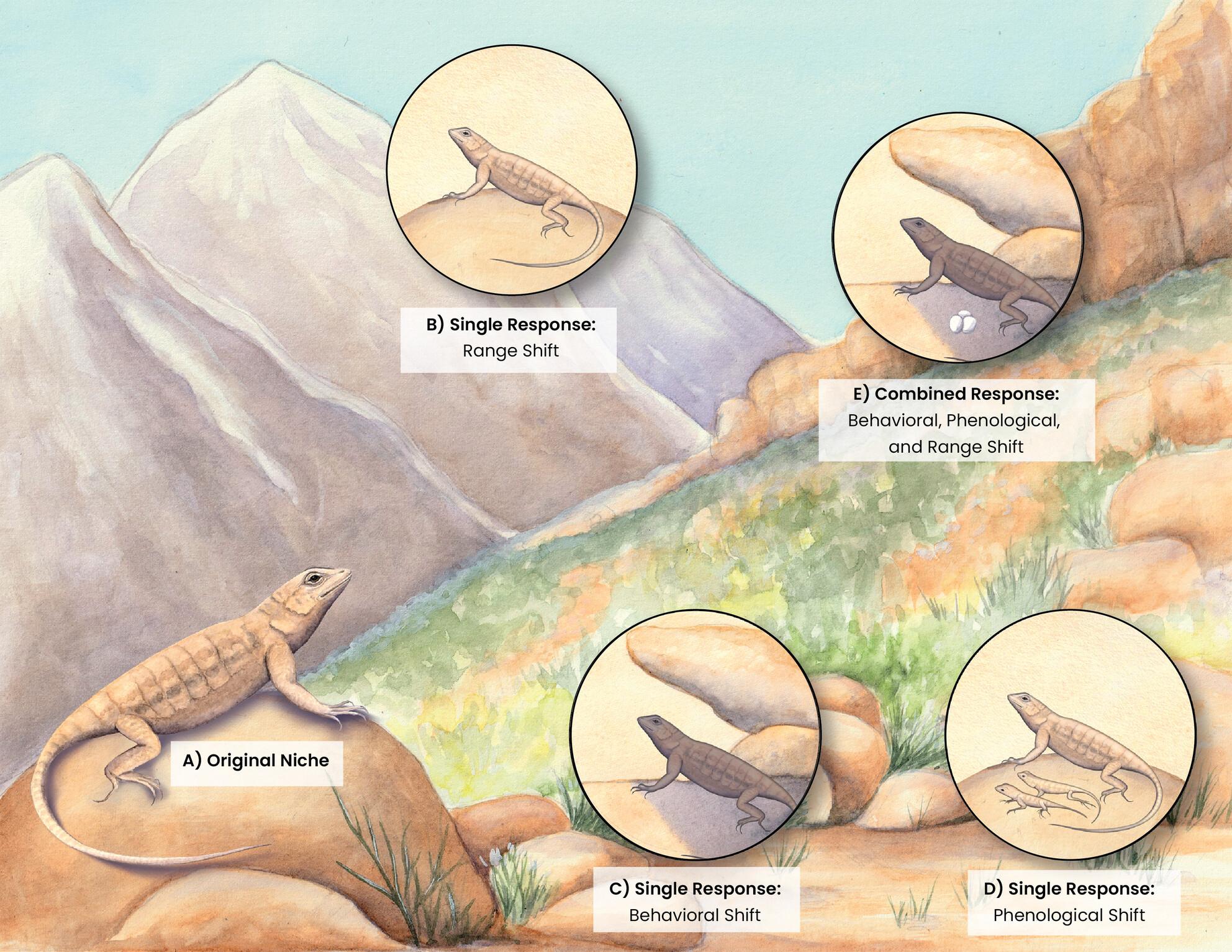
Climate change is creating mismatches between species' current environments and their historical niches. Locations that once had the abiotic and biotic conditions to support the persistence of a species may now be too warm, too dry, or simply too different, to meet their niche requirements. Changes in behaviors, altered phenology, and range shifts are common responses to climate change. Though these responses are often studied in isolation by scientists from disparate subfields of ecology, they all represent variants of the same solution—strategies to realign the conditions populations experience with their niche. Here, we aim to (1) identify the physiological and ecological effects, and potential alignment, of these three ecological responses: shifts in behavior, phenology, or ranges, (2) determine the circumstances under which each type of response may be more or less effective at mitigating the effects of climate change, and (3) consider how these strategies might interact with each other. Each response has been previously reviewed, but efforts to consider relationships between ecological (or with evolutionary) responses have been limited. A synthetic perspective that considers the similarities among ecological responses and how they interact with each other and with evolutionary responses offers a more robust view on species' resilience to climate change.
期刊介绍:
Global Change Biology is an environmental change journal committed to shaping the future and addressing the world's most pressing challenges, including sustainability, climate change, environmental protection, food and water safety, and global health.
Dedicated to fostering a profound understanding of the impacts of global change on biological systems and offering innovative solutions, the journal publishes a diverse range of content, including primary research articles, technical advances, research reviews, reports, opinions, perspectives, commentaries, and letters. Starting with the 2024 volume, Global Change Biology will transition to an online-only format, enhancing accessibility and contributing to the evolution of scholarly communication.



 京公网安备 11010802042870号
京ICP备2023020795号-1
京公网安备 11010802042870号
京ICP备2023020795号-1

 分享
分享
 求助内容:
求助内容: 应助结果提醒方式:
 扫码关注我们
