Insight into the effect of lactic acid fermentation on soy protein immunoreactivity: emphasizing the difference in epitope destruction of varied fermentation terminal pH levels during gastrointestinal digestion
Yaqiong Wang, Qiyuan Lu, Qiuqin Zhang, Runqiang Yang, Wei Li and Xin Rui
{"title":"Insight into the effect of lactic acid fermentation on soy protein immunoreactivity: emphasizing the difference in epitope destruction of varied fermentation terminal pH levels during gastrointestinal digestion","authors":"Yaqiong Wang, Qiyuan Lu, Qiuqin Zhang, Runqiang Yang, Wei Li and Xin Rui","doi":"10.1039/D4FO05304D","DOIUrl":null,"url":null,"abstract":"<p >This study delves into the immunoreactivity of lactic acid bacterium (LAB)-fermented soy protein isolates (FSPIs), with various structural features, during gastrointestinal digestion and absorption. Additionally, the structural breakdown and epitope degradation of major allergens were investigated for their gastrointestinal behavior. Allergenicity and IgE-binding capacity assays revealed that at the initial and middle stages of digestion, FSPI-5.0/4.0 exhibited greater ability to reduce immunoreactivity than FSPI-7.0/6.0 and reduced immunoreactivity by 1.9%–36.6%. Caco-2 model transport studies further suggested that FSPI-5.0/4.0 T-5 and T-30 samples decreased immunoreactivity by inducing Th1-dominant differentiation. Peptidomics and bioinformatics analyses corroborated these findings, revealing that FSPI-5.0/4.0 promoted the epitope destruction of basic 7S globulin, β-conglycinin, P34, and glycinin and was dominated by secondary structures consisting of α-helices and β-sheets. Therefore, structural control through LAB fermentation represents a promising strategy for regulating the degradation of allergen epitopes.</p>","PeriodicalId":77,"journal":{"name":"Food & Function","volume":" 11","pages":" 4291-4302"},"PeriodicalIF":5.4000,"publicationDate":"2025-03-26","publicationTypes":"Journal Article","fieldsOfStudy":null,"isOpenAccess":false,"openAccessPdf":"","citationCount":"0","resultStr":null,"platform":"Semanticscholar","paperid":null,"PeriodicalName":"Food & Function","FirstCategoryId":"97","ListUrlMain":"https://pubs.rsc.org/en/content/articlelanding/2025/fo/d4fo05304d","RegionNum":1,"RegionCategory":"农林科学","ArticlePicture":[],"TitleCN":null,"AbstractTextCN":null,"PMCID":null,"EPubDate":"","PubModel":"","JCR":"Q1","JCRName":"BIOCHEMISTRY & MOLECULAR BIOLOGY","Score":null,"Total":0}
引用次数: 0
Abstract
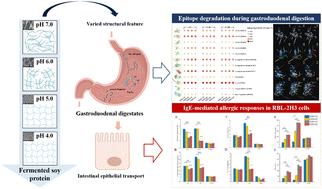
This study delves into the immunoreactivity of lactic acid bacterium (LAB)-fermented soy protein isolates (FSPIs), with various structural features, during gastrointestinal digestion and absorption. Additionally, the structural breakdown and epitope degradation of major allergens were investigated for their gastrointestinal behavior. Allergenicity and IgE-binding capacity assays revealed that at the initial and middle stages of digestion, FSPI-5.0/4.0 exhibited greater ability to reduce immunoreactivity than FSPI-7.0/6.0 and reduced immunoreactivity by 1.9%–36.6%. Caco-2 model transport studies further suggested that FSPI-5.0/4.0 T-5 and T-30 samples decreased immunoreactivity by inducing Th1-dominant differentiation. Peptidomics and bioinformatics analyses corroborated these findings, revealing that FSPI-5.0/4.0 promoted the epitope destruction of basic 7S globulin, β-conglycinin, P34, and glycinin and was dominated by secondary structures consisting of α-helices and β-sheets. Therefore, structural control through LAB fermentation represents a promising strategy for regulating the degradation of allergen epitopes.
期刊介绍:
Food & Function provides a unique venue for physicists, chemists, biochemists, nutritionists and other food scientists to publish work at the interface of the chemistry, physics and biology of food. The journal focuses on food and the functions of food in relation to health.



 京公网安备 11010802042870号
京ICP备2023020795号-1
京公网安备 11010802042870号
京ICP备2023020795号-1

 分享
分享
 求助内容:
求助内容: 应助结果提醒方式:
 扫码关注我们
