Se-containing compounds with different Se species alleviate alcoholic liver injury through regulating liver metabolism and modulating gut microbiota composition†
Yiqing Li, Yue Li, Song Zhu, Xin Cong, Dejian Huang, Ruipeng Yu and Shangwei Chen
{"title":"Se-containing compounds with different Se species alleviate alcoholic liver injury through regulating liver metabolism and modulating gut microbiota composition†","authors":"Yiqing Li, Yue Li, Song Zhu, Xin Cong, Dejian Huang, Ruipeng Yu and Shangwei Chen","doi":"10.1039/D5FO00469A","DOIUrl":null,"url":null,"abstract":"<p >Alcoholic liver injury is primarily caused by long-term excessive alcohol consumption and has become a global public health concern. It is well known that selenium (Se) has excellent beneficial effects in regulating oxidative stress and protecting liver function. However, the effects of different species of Se compounds on alcohol-induced liver injury and their underlying mechanisms remain unclear. Hence, this study investigated the intervention of three different species of Se compounds—Se-enriched <em>Cardamine violifolia</em> peptides (CV), Se-enriched soybean peptides (SO), and sodium selenite (SS)—in an alcohol-induced liver injury mice model. The results of serum biochemical indices and hepatic oxidative stress indexes showed that although both Se-enriched peptides and SS exhibited protective effects against alcohol-induced liver injury, Se-enriched peptides exerted a better effect than SS. Liver metabolomics studies revealed that 30, 15, and 30 metabolites with significant differences were identified in the comparisons of CV <em>vs.</em> model group (MC), SO <em>vs.</em> MC, and SS <em>vs.</em> MC groups, respectively. Common differential metabolites in the three comparison groups were dopamine glucuronide, docosahexaenoic acid, glycerophosphocholine, galactinol and sclareol. KEGG analysis indicated that the differential metabolites between the SS <em>vs.</em> MC groups were enriched in the glycerophospholipid metabolism pathway. The significant metabolic pathways enriched in the SO <em>vs.</em> MC groups were α-linolenic acid metabolism, citric acid cycle, and glucagon signaling pathway. In the CV <em>vs.</em> MC groups, metabolic pathways related to insulin secretion, carbohydrate digestion and absorption, inositol phosphate metabolism, and C-type lectin receptor signaling pathway were also identified. In addition, the intervention of Se-enriched peptides regulated alcohol-induced dysbiosis of the gut microbiota and upgraded the levels of short-chain fatty acids. In the CV group, differential taxa included <em>unidentified_Bacteria</em>, <em>unidentified_Bacteria</em> family and <em>unidentified_Bacteria</em> genus. The dominant species in the SO group included the <em>Atopobiaceae</em> and <em>Turicibiacter</em>. In conclusion, these findings revealed the important role of the gut-liver axis in the protective effects of Se-containing compounds against alcoholic liver injury. Se-enriched peptides, particularly those from CV with selenocystine as the main Se specie, hold great promise as a novel functional food ingredient for the prevention of alcoholic liver injury.</p>","PeriodicalId":77,"journal":{"name":"Food & Function","volume":" 9","pages":" 3384-3399"},"PeriodicalIF":5.4000,"publicationDate":"2025-04-03","publicationTypes":"Journal Article","fieldsOfStudy":null,"isOpenAccess":false,"openAccessPdf":"","citationCount":"0","resultStr":null,"platform":"Semanticscholar","paperid":null,"PeriodicalName":"Food & Function","FirstCategoryId":"97","ListUrlMain":"https://pubs.rsc.org/en/content/articlelanding/2025/fo/d5fo00469a","RegionNum":1,"RegionCategory":"农林科学","ArticlePicture":[],"TitleCN":null,"AbstractTextCN":null,"PMCID":null,"EPubDate":"","PubModel":"","JCR":"Q1","JCRName":"BIOCHEMISTRY & MOLECULAR BIOLOGY","Score":null,"Total":0}
引用次数: 0
Abstract
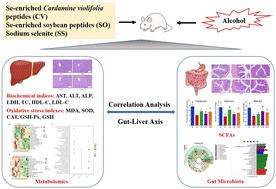
Alcoholic liver injury is primarily caused by long-term excessive alcohol consumption and has become a global public health concern. It is well known that selenium (Se) has excellent beneficial effects in regulating oxidative stress and protecting liver function. However, the effects of different species of Se compounds on alcohol-induced liver injury and their underlying mechanisms remain unclear. Hence, this study investigated the intervention of three different species of Se compounds—Se-enriched Cardamine violifolia peptides (CV), Se-enriched soybean peptides (SO), and sodium selenite (SS)—in an alcohol-induced liver injury mice model. The results of serum biochemical indices and hepatic oxidative stress indexes showed that although both Se-enriched peptides and SS exhibited protective effects against alcohol-induced liver injury, Se-enriched peptides exerted a better effect than SS. Liver metabolomics studies revealed that 30, 15, and 30 metabolites with significant differences were identified in the comparisons of CV vs. model group (MC), SO vs. MC, and SS vs. MC groups, respectively. Common differential metabolites in the three comparison groups were dopamine glucuronide, docosahexaenoic acid, glycerophosphocholine, galactinol and sclareol. KEGG analysis indicated that the differential metabolites between the SS vs. MC groups were enriched in the glycerophospholipid metabolism pathway. The significant metabolic pathways enriched in the SO vs. MC groups were α-linolenic acid metabolism, citric acid cycle, and glucagon signaling pathway. In the CV vs. MC groups, metabolic pathways related to insulin secretion, carbohydrate digestion and absorption, inositol phosphate metabolism, and C-type lectin receptor signaling pathway were also identified. In addition, the intervention of Se-enriched peptides regulated alcohol-induced dysbiosis of the gut microbiota and upgraded the levels of short-chain fatty acids. In the CV group, differential taxa included unidentified_Bacteria, unidentified_Bacteria family and unidentified_Bacteria genus. The dominant species in the SO group included the Atopobiaceae and Turicibiacter. In conclusion, these findings revealed the important role of the gut-liver axis in the protective effects of Se-containing compounds against alcoholic liver injury. Se-enriched peptides, particularly those from CV with selenocystine as the main Se specie, hold great promise as a novel functional food ingredient for the prevention of alcoholic liver injury.
期刊介绍:
Food & Function provides a unique venue for physicists, chemists, biochemists, nutritionists and other food scientists to publish work at the interface of the chemistry, physics and biology of food. The journal focuses on food and the functions of food in relation to health.




 京公网安备 11010802042870号
京ICP备2023020795号-1
京公网安备 11010802042870号
京ICP备2023020795号-1

 分享
分享
 求助内容:
求助内容: 应助结果提醒方式:
 扫码关注我们
