Orindom Shing Pulock, Adnan Mannan, Abul Faisal Md Nuruddin Chowdhury, Golam Tousif, Koushik Majumder, Sabrina Monsur, H M Hamidullah Mehedi, Emrul Kaiser, Afreen Sultana, Md Abdul Hamid Sagar, Silvia Naznin Etu, Nazmul Alam, A H M Tharakul Mazid, M A Sattar
{"title":"Clinical spectrum and risk factors of severe dengue infection: findings from the 2023 dengue outbreak in Bangladesh.","authors":"Orindom Shing Pulock, Adnan Mannan, Abul Faisal Md Nuruddin Chowdhury, Golam Tousif, Koushik Majumder, Sabrina Monsur, H M Hamidullah Mehedi, Emrul Kaiser, Afreen Sultana, Md Abdul Hamid Sagar, Silvia Naznin Etu, Nazmul Alam, A H M Tharakul Mazid, M A Sattar","doi":"10.1186/s12879-025-10792-y","DOIUrl":null,"url":null,"abstract":"<p><strong>Background: </strong>Since the first detection of dengue in 2000, Bangladesh has been facing an increasing number of dengue patients and related deaths every year. This situation warrants the importance of quickly identifying severe dengue patients to expedite necessary medical interventions which could potentially reduce the adverse consequences. The aim of this study was to identify clinical features and laboratory parameters of the severe dengue patients in the 2023 dengue outbreak in Bangladesh.</p><p><strong>Methods: </strong>This hospital based cross-sectional study included the demographic, clinical and laboratory data of 1313 Dengue patients from several secondary and tertiary hospitals across Bangladesh from August 2023 to December 2023. According to the 2009 WHO classification, dengue cases were classified into severe dengue and non-severe dengue (with and without warning signs). Chi-square test, Fischer's exact test and multiple logistic regression analyses were conducted to identify potential risk factors associated with severe dengue cases.</p><p><strong>Results: </strong>Of the 1313 patients included in this study, nearly 20% had severe dengue, 36.71% of them were from the 16-25 year age bracket and nearly two-thirds were male. Fever (99.54%) was the most common clinical symptom followed by anorexia (69.54%) and severe headache (66.03%); whereas most common warning signs were severe lethargy (43.64%), persistent vomiting (27.57%), and severe abdominal pain and tenderness (20.03%) across all patients. Gastrointestinal symptoms such as nausea, vomiting, and diarrhea are significantly more common in severe dengue cases compared to non-severe ones. Among the laboratory parameters, decrease of platelet level and increased ALT level was more prominent in severe patients. Multiple logistic regression analysis found that severe abdominal pain, severe lethargy, respiratory distress, altered mental status, decreased urine output, pleural effusion and ascites were positively associated with the development of severe dengue.</p><p><strong>Conclusion: </strong>This study presents warning signs, clinical symptoms and trends of laboratory parameters associated with severe cases of dengue in Bangladesh that can be used in improving patient management in the future.</p>","PeriodicalId":8981,"journal":{"name":"BMC Infectious Diseases","volume":"25 1","pages":"469"},"PeriodicalIF":3.0000,"publicationDate":"2025-04-07","publicationTypes":"Journal Article","fieldsOfStudy":null,"isOpenAccess":false,"openAccessPdf":"https://www.ncbi.nlm.nih.gov/pmc/articles/PMC11974146/pdf/","citationCount":"0","resultStr":null,"platform":"Semanticscholar","paperid":null,"PeriodicalName":"BMC Infectious Diseases","FirstCategoryId":"3","ListUrlMain":"https://doi.org/10.1186/s12879-025-10792-y","RegionNum":3,"RegionCategory":"医学","ArticlePicture":[],"TitleCN":null,"AbstractTextCN":null,"PMCID":null,"EPubDate":"","PubModel":"","JCR":"Q2","JCRName":"INFECTIOUS DISEASES","Score":null,"Total":0}
引用次数: 0
Abstract
Background: Since the first detection of dengue in 2000, Bangladesh has been facing an increasing number of dengue patients and related deaths every year. This situation warrants the importance of quickly identifying severe dengue patients to expedite necessary medical interventions which could potentially reduce the adverse consequences. The aim of this study was to identify clinical features and laboratory parameters of the severe dengue patients in the 2023 dengue outbreak in Bangladesh.
Methods: This hospital based cross-sectional study included the demographic, clinical and laboratory data of 1313 Dengue patients from several secondary and tertiary hospitals across Bangladesh from August 2023 to December 2023. According to the 2009 WHO classification, dengue cases were classified into severe dengue and non-severe dengue (with and without warning signs). Chi-square test, Fischer's exact test and multiple logistic regression analyses were conducted to identify potential risk factors associated with severe dengue cases.
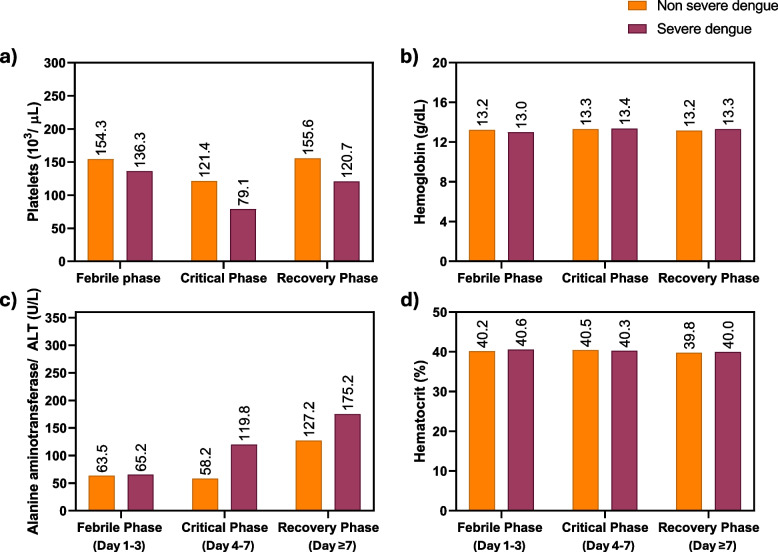
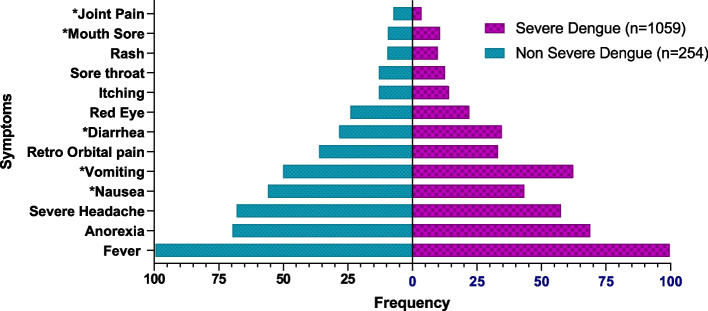
Results: Of the 1313 patients included in this study, nearly 20% had severe dengue, 36.71% of them were from the 16-25 year age bracket and nearly two-thirds were male. Fever (99.54%) was the most common clinical symptom followed by anorexia (69.54%) and severe headache (66.03%); whereas most common warning signs were severe lethargy (43.64%), persistent vomiting (27.57%), and severe abdominal pain and tenderness (20.03%) across all patients. Gastrointestinal symptoms such as nausea, vomiting, and diarrhea are significantly more common in severe dengue cases compared to non-severe ones. Among the laboratory parameters, decrease of platelet level and increased ALT level was more prominent in severe patients. Multiple logistic regression analysis found that severe abdominal pain, severe lethargy, respiratory distress, altered mental status, decreased urine output, pleural effusion and ascites were positively associated with the development of severe dengue.
Conclusion: This study presents warning signs, clinical symptoms and trends of laboratory parameters associated with severe cases of dengue in Bangladesh that can be used in improving patient management in the future.
期刊介绍:
BMC Infectious Diseases is an open access, peer-reviewed journal that considers articles on all aspects of the prevention, diagnosis and management of infectious and sexually transmitted diseases in humans, as well as related molecular genetics, pathophysiology, and epidemiology.




 京公网安备 11010802042870号
京ICP备2023020795号-1
京公网安备 11010802042870号
京ICP备2023020795号-1

 分享
分享
 求助内容:
求助内容: 应助结果提醒方式:
 扫码关注我们
