Ali Rezaie , Bianca W. Chang , Juliana de Freitas Germano , Gabriela Leite , Ruchi Mathur , Krystyna Houser , Ava Hosseini , Daniel Brimberry , Mohamad Rashid , Sepideh Mehravar , Maria Jesus Villanueva-Millan , Maritza Sanchez , Stacy Weitsman , Cristina M. Fajardo , Ignacio G. Rivera , Lijin Joo , Yin Chan , Gillian M. Barlow , Mark Pimentel
{"title":"Effect, Tolerability, and Safety of Exclusive Palatable Elemental Diet in Patients With Intestinal Microbial Overgrowth","authors":"Ali Rezaie , Bianca W. Chang , Juliana de Freitas Germano , Gabriela Leite , Ruchi Mathur , Krystyna Houser , Ava Hosseini , Daniel Brimberry , Mohamad Rashid , Sepideh Mehravar , Maria Jesus Villanueva-Millan , Maritza Sanchez , Stacy Weitsman , Cristina M. Fajardo , Ignacio G. Rivera , Lijin Joo , Yin Chan , Gillian M. Barlow , Mark Pimentel","doi":"10.1016/j.cgh.2025.03.002","DOIUrl":null,"url":null,"abstract":"<div><h3>Background & Aims</h3><div>Elemental diets (EDs) have desirable safety and efficacy profiles in several clinical settings partly because of modulation of gut microbiome. Palatability of EDs remains the main barrier to compliance/adherence, and their effect has not been prospectively explored in microbiome-driven disorders, such as small intestinal bacterial overgrowth (SIBO) and intestinal methanogen overgrowth (IMO). We aimed to assess the effect, tolerance, and safety of a novel palatable ED (PED) in subjects with IMO and/or SIBO.</div></div><div><h3>Methods</h3><div>Adult subjects with positive lactulose breath tests for SIBO and/or IMO completed 1 week of screening, 2 weeks of exclusive oral PED, and 2 weeks of follow-up during reintroduction of regular diet. Primary end point was changes in stool microbiome after PED and reintroduction of regular diet. Secondary end points included tolerability, rate of normalization of lactulose breath tests, change in stool form based on daily diary and artificial intelligence-analyzed images, symptomatic response, and adverse events.</div></div><div><h3>Results</h3><div>All 30 enrolled subjects tolerated the PED and completed the trial. Several taxonomic differences were detected including decreased relative abundance of <em>Prevotella</em>_9 and <em>Fusobacterium</em>. Abundance of <em>Methanobrevibacter smithii</em> decreased at the end of the trial and correlated with average daily methane levels (<em>P</em> = .024; <em>r</em> = 0.489). Maximum methane levels (41 ± 35 to 12 ± 15 ppm; <em>P</em> < .001) and hydrogen rise (43 ± 42 to 12 ± 11 ppm; <em>P</em> < .001) dropped significantly, with 73% normalizing their lactulose breath tests. Adequate global relief of symptoms was reported in 83% of subjects. No serious or severe adverse events were observed.</div></div><div><h3>Conclusions</h3><div>PED significantly impacts the gut microbiome. Tolerance to EDs improves with enhanced palatability. Larger studies with longer follow-up are needed to assess response durability. (<span><span>ClinicalTrials.gov</span><svg><path></path></svg></span> ID: NCT05978973)</div></div>","PeriodicalId":10347,"journal":{"name":"Clinical Gastroenterology and Hepatology","volume":"23 12","pages":"Pages 2306-2317.e7"},"PeriodicalIF":12.0000,"publicationDate":"2025-11-01","publicationTypes":"Journal Article","fieldsOfStudy":null,"isOpenAccess":false,"openAccessPdf":"","citationCount":"0","resultStr":null,"platform":"Semanticscholar","paperid":null,"PeriodicalName":"Clinical Gastroenterology and Hepatology","FirstCategoryId":"3","ListUrlMain":"https://www.sciencedirect.com/science/article/pii/S1542356525002411","RegionNum":1,"RegionCategory":"医学","ArticlePicture":[],"TitleCN":null,"AbstractTextCN":null,"PMCID":null,"EPubDate":"2025/4/4 0:00:00","PubModel":"Epub","JCR":"Q1","JCRName":"GASTROENTEROLOGY & HEPATOLOGY","Score":null,"Total":0}
引用次数: 0
Abstract
Background & Aims
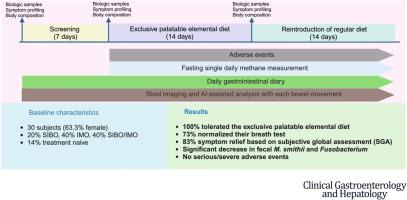
Elemental diets (EDs) have desirable safety and efficacy profiles in several clinical settings partly because of modulation of gut microbiome. Palatability of EDs remains the main barrier to compliance/adherence, and their effect has not been prospectively explored in microbiome-driven disorders, such as small intestinal bacterial overgrowth (SIBO) and intestinal methanogen overgrowth (IMO). We aimed to assess the effect, tolerance, and safety of a novel palatable ED (PED) in subjects with IMO and/or SIBO.
Methods
Adult subjects with positive lactulose breath tests for SIBO and/or IMO completed 1 week of screening, 2 weeks of exclusive oral PED, and 2 weeks of follow-up during reintroduction of regular diet. Primary end point was changes in stool microbiome after PED and reintroduction of regular diet. Secondary end points included tolerability, rate of normalization of lactulose breath tests, change in stool form based on daily diary and artificial intelligence-analyzed images, symptomatic response, and adverse events.
Results
All 30 enrolled subjects tolerated the PED and completed the trial. Several taxonomic differences were detected including decreased relative abundance of Prevotella_9 and Fusobacterium. Abundance of Methanobrevibacter smithii decreased at the end of the trial and correlated with average daily methane levels (P = .024; r = 0.489). Maximum methane levels (41 ± 35 to 12 ± 15 ppm; P < .001) and hydrogen rise (43 ± 42 to 12 ± 11 ppm; P < .001) dropped significantly, with 73% normalizing their lactulose breath tests. Adequate global relief of symptoms was reported in 83% of subjects. No serious or severe adverse events were observed.
Conclusions
PED significantly impacts the gut microbiome. Tolerance to EDs improves with enhanced palatability. Larger studies with longer follow-up are needed to assess response durability. (ClinicalTrials.gov ID: NCT05978973)
期刊介绍:
Clinical Gastroenterology and Hepatology (CGH) is dedicated to offering readers a comprehensive exploration of themes in clinical gastroenterology and hepatology. Encompassing diagnostic, endoscopic, interventional, and therapeutic advances, the journal covers areas such as cancer, inflammatory diseases, functional gastrointestinal disorders, nutrition, absorption, and secretion.
As a peer-reviewed publication, CGH features original articles and scholarly reviews, ensuring immediate relevance to the practice of gastroenterology and hepatology. Beyond peer-reviewed content, the journal includes invited key reviews and articles on endoscopy/practice-based technology, health-care policy, and practice management. Multimedia elements, including images, video abstracts, and podcasts, enhance the reader's experience. CGH remains actively engaged with its audience through updates and commentary shared via platforms such as Facebook and Twitter.



 京公网安备 11010802042870号
京ICP备2023020795号-1
京公网安备 11010802042870号
京ICP备2023020795号-1

 分享
分享
 求助内容:
求助内容: 应助结果提醒方式:
 扫码关注我们
