Prevalence of co-occurring forms of intimate partner violence against women aged 15-49 and the role of education-related inequalities: analysis of Demographic and Health Surveys across 49 low-income and middle-income countries.
Shuangyu Zhao, Shan Liu, Jiuxuan Gao, Ning Ma, Shaoru Chen, Joht Singh Chandan, Rockli Kim, Peter Karoli, John Lapah Niyi, Jayalakshmi Rajeev, Melkamu Aderajew Zemene, Md Nuruzzaman Khan, Hajirani M Msuya, Chunling Lu, S V Subramanian, Feng Cheng, John S Ji, Kun Tang, Pascal Geldsetzer, Zhihui Li
{"title":"Prevalence of co-occurring forms of intimate partner violence against women aged 15-49 and the role of education-related inequalities: analysis of Demographic and Health Surveys across 49 low-income and middle-income countries.","authors":"Shuangyu Zhao, Shan Liu, Jiuxuan Gao, Ning Ma, Shaoru Chen, Joht Singh Chandan, Rockli Kim, Peter Karoli, John Lapah Niyi, Jayalakshmi Rajeev, Melkamu Aderajew Zemene, Md Nuruzzaman Khan, Hajirani M Msuya, Chunling Lu, S V Subramanian, Feng Cheng, John S Ji, Kun Tang, Pascal Geldsetzer, Zhihui Li","doi":"10.1016/j.eclinm.2025.103150","DOIUrl":null,"url":null,"abstract":"<p><strong>Background: </strong>Women experiencing co-occurring forms of intimate partner violence (IPV; ie, physical, sexual, and/or psychological) often face more severe psychological and health consequences than those experiencing a single form. However, research on IPV co-occurrence in low- and middle-income countries (LMICs) remains limited. This study examines the prevalence of IPV co-occurrence in LMICs and its education-based inequalities.</p><p><strong>Methods: </strong>Data from the most recent Demographic and Health Surveys in 49 LMICs (2011-2023) were used. Our primary outcome was IPV co-occurrence, defined as a woman aged 15-49 ever experiencing any two or three forms of physical, sexual, or psychological IPV from her partner within the past year. We categorised IPV co-occurrence into four subtypes: co-occurrence of (1) physical and sexual IPV, (2) physical and psychological IPV, (3) sexual and psychological IPV, and (4) all three forms of IPV. We analysed the prevalence of IPV co-occurrence and its subtypes by women's education levels, calculating odds ratios to assess inequalities. Nonparametric restricted cubic splines were used to explore nonlinear relationships between education and IPV.</p><p><strong>Findings: </strong>The study included a total of 344,661 women. The weighted prevalence of IPV co-occurrence varied widely across countries-from 2.4% in Armenia to 38.9% in Papua New Guinea. Overall, women with no education were most at risk, experiencing an adjusted prevalence of 14.3% (95% CI: 13.3-15.2), compared to 11.8% (95% CI: 10.8-12.9) among those with primary education, 9.9% (95% CI: 9.3-10.6) for secondary education, and 5.3% (95% CI: 4.5-6.2) for higher education. The prevalence of IPV co-occurrence involving sexual IPV was highest among women with primary education, with 4.1% (95% CI: 3.4-4.8) reporting concurrent physical and sexual violence, compared to 1.5% (95% CI: 1.1-1.9) to 3.7% (95% CI: 3.2-4.1) among other education levels.</p><p><strong>Interpretation: </strong>IPV co-occurrence remains high, particularly among women with little or no education. Education-focused interventions are urgently needed to reduce IPV risk and its severe impact. However, the findings may be influenced by potential reporting biases and cross-country variability in IPV measurement methodologies, which may limit generalizability.</p><p><strong>Funding: </strong>The China National Natural Science Foundation (Grant numbers 72203119) and The Research Fund, Vanke School of Public Health, Tsinghua University.</p>","PeriodicalId":11393,"journal":{"name":"EClinicalMedicine","volume":"82 ","pages":"103150"},"PeriodicalIF":10.0000,"publicationDate":"2025-03-18","publicationTypes":"Journal Article","fieldsOfStudy":null,"isOpenAccess":false,"openAccessPdf":"https://www.ncbi.nlm.nih.gov/pmc/articles/PMC11968286/pdf/","citationCount":"0","resultStr":null,"platform":"Semanticscholar","paperid":null,"PeriodicalName":"EClinicalMedicine","FirstCategoryId":"3","ListUrlMain":"https://doi.org/10.1016/j.eclinm.2025.103150","RegionNum":1,"RegionCategory":"医学","ArticlePicture":[],"TitleCN":null,"AbstractTextCN":null,"PMCID":null,"EPubDate":"2025/4/1 0:00:00","PubModel":"eCollection","JCR":"Q1","JCRName":"MEDICINE, GENERAL & INTERNAL","Score":null,"Total":0}
引用次数: 0
Abstract
Background: Women experiencing co-occurring forms of intimate partner violence (IPV; ie, physical, sexual, and/or psychological) often face more severe psychological and health consequences than those experiencing a single form. However, research on IPV co-occurrence in low- and middle-income countries (LMICs) remains limited. This study examines the prevalence of IPV co-occurrence in LMICs and its education-based inequalities.
Methods: Data from the most recent Demographic and Health Surveys in 49 LMICs (2011-2023) were used. Our primary outcome was IPV co-occurrence, defined as a woman aged 15-49 ever experiencing any two or three forms of physical, sexual, or psychological IPV from her partner within the past year. We categorised IPV co-occurrence into four subtypes: co-occurrence of (1) physical and sexual IPV, (2) physical and psychological IPV, (3) sexual and psychological IPV, and (4) all three forms of IPV. We analysed the prevalence of IPV co-occurrence and its subtypes by women's education levels, calculating odds ratios to assess inequalities. Nonparametric restricted cubic splines were used to explore nonlinear relationships between education and IPV.
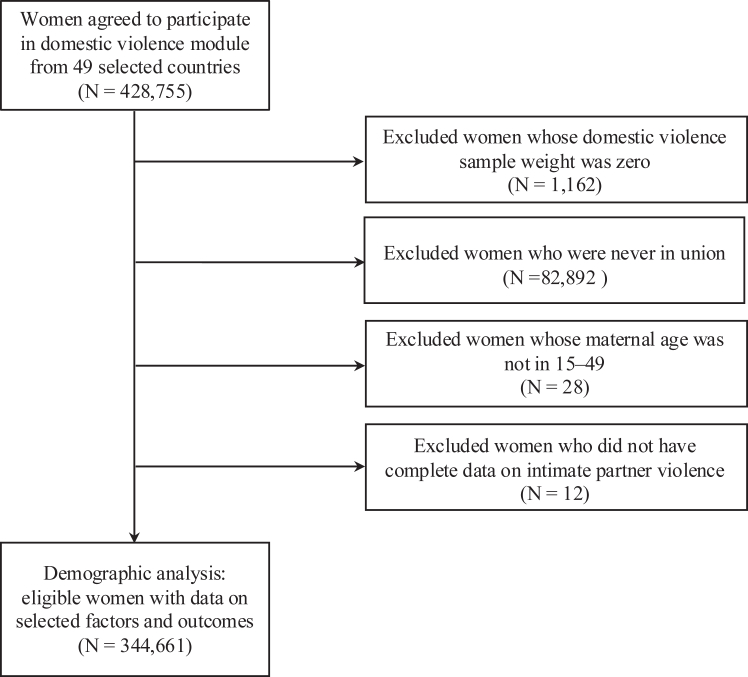
Findings: The study included a total of 344,661 women. The weighted prevalence of IPV co-occurrence varied widely across countries-from 2.4% in Armenia to 38.9% in Papua New Guinea. Overall, women with no education were most at risk, experiencing an adjusted prevalence of 14.3% (95% CI: 13.3-15.2), compared to 11.8% (95% CI: 10.8-12.9) among those with primary education, 9.9% (95% CI: 9.3-10.6) for secondary education, and 5.3% (95% CI: 4.5-6.2) for higher education. The prevalence of IPV co-occurrence involving sexual IPV was highest among women with primary education, with 4.1% (95% CI: 3.4-4.8) reporting concurrent physical and sexual violence, compared to 1.5% (95% CI: 1.1-1.9) to 3.7% (95% CI: 3.2-4.1) among other education levels.
Interpretation: IPV co-occurrence remains high, particularly among women with little or no education. Education-focused interventions are urgently needed to reduce IPV risk and its severe impact. However, the findings may be influenced by potential reporting biases and cross-country variability in IPV measurement methodologies, which may limit generalizability.
Funding: The China National Natural Science Foundation (Grant numbers 72203119) and The Research Fund, Vanke School of Public Health, Tsinghua University.
期刊介绍:
eClinicalMedicine is a gold open-access clinical journal designed to support frontline health professionals in addressing the complex and rapid health transitions affecting societies globally. The journal aims to assist practitioners in overcoming healthcare challenges across diverse communities, spanning diagnosis, treatment, prevention, and health promotion. Integrating disciplines from various specialties and life stages, it seeks to enhance health systems as fundamental institutions within societies. With a forward-thinking approach, eClinicalMedicine aims to redefine the future of healthcare.





 京公网安备 11010802042870号
京ICP备2023020795号-1
京公网安备 11010802042870号
京ICP备2023020795号-1

 分享
分享
 求助内容:
求助内容: 应助结果提醒方式:
 扫码关注我们
