Hong Xu, Pengxin Xie, Hui Liu, Zhenyu Tian, Ruitao Zhang, Ming Cui
{"title":"The relationship between dietary inflammatory index in adults and coronary heart disease: from NHANES 1999-2018.","authors":"Hong Xu, Pengxin Xie, Hui Liu, Zhenyu Tian, Ruitao Zhang, Ming Cui","doi":"10.3389/fnut.2025.1564580","DOIUrl":null,"url":null,"abstract":"<p><strong>Background: </strong>Previous studies have shown that pro-inflammatory diets increase the risk of coronary heart disease (CHD) and all-cause mortality. The dietary inflammatory index (DII) is a quantitative measure of dietary inflammation, and its accuracy has been validated by several studies.</p><p><strong>Methods: </strong>This study included 43,842 participants aged ≥18 years from the National Health and Nutrition Examination Survey (NHANES) 1999-2018. The data of CHD was obtained through a questionnaire survey, and the DII was calculated using 24-h dietary recall data. Generalized linear models and logistic regression were used to determine the mediation factors, and subgroup analyses were conducted to evaluate the interaction between DII and CHD. Mean decrease in Gini (MDG) was used to determine the importance of individual dietary components.</p><p><strong>Results: </strong>The age of the participants was 49.81 ± 18.10 years, with 20,793 (47.4%) being male. A total of 1,892 (4.3%) participants were diagnosed with CHD, and the median DII score was 1.33 (0.11, 2.40). After adjusting for potential confounders, logistic regression analysis revealed that DII independently associated with CHD [OR: 1.049 (1.012-1.087), <i>p</i> = 0.008]. Triglyceride-glucose index, visceral adiposity index, body mass index, waist-to-height ratio, high-density lipoprotein, and glomerular filtration rate (all <i>p</i> < 0.05) may mediate the relationship between DII and CHD. Subgroup analyses showed that DII was more sensitive in participants aged <75 years (<i>p</i> < 0.001), females (<i>p</i> = 0.028), those with low cholesterol levels (<i>p</i> = 0.004), and individuals with low Framingham risk scores (<i>p</i> = 0.005). MDG analysis indicated that carbohydrate, vitamin C and iron intake have the greatest impact on CHD.</p><p><strong>Conclusion: </strong>This study suggests that various metabolic and lipid indicators play a mediating role in the relationship between DII and CHD. DII may have a greater adverse impact on traditional low-risk CHD populations.</p>","PeriodicalId":12473,"journal":{"name":"Frontiers in Nutrition","volume":"12 ","pages":"1564580"},"PeriodicalIF":4.0000,"publicationDate":"2025-03-21","publicationTypes":"Journal Article","fieldsOfStudy":null,"isOpenAccess":false,"openAccessPdf":"https://www.ncbi.nlm.nih.gov/pmc/articles/PMC11970130/pdf/","citationCount":"0","resultStr":null,"platform":"Semanticscholar","paperid":null,"PeriodicalName":"Frontiers in Nutrition","FirstCategoryId":"97","ListUrlMain":"https://doi.org/10.3389/fnut.2025.1564580","RegionNum":2,"RegionCategory":"农林科学","ArticlePicture":[],"TitleCN":null,"AbstractTextCN":null,"PMCID":null,"EPubDate":"2025/1/1 0:00:00","PubModel":"eCollection","JCR":"Q2","JCRName":"NUTRITION & DIETETICS","Score":null,"Total":0}
引用次数: 0
Abstract
Background: Previous studies have shown that pro-inflammatory diets increase the risk of coronary heart disease (CHD) and all-cause mortality. The dietary inflammatory index (DII) is a quantitative measure of dietary inflammation, and its accuracy has been validated by several studies.
Methods: This study included 43,842 participants aged ≥18 years from the National Health and Nutrition Examination Survey (NHANES) 1999-2018. The data of CHD was obtained through a questionnaire survey, and the DII was calculated using 24-h dietary recall data. Generalized linear models and logistic regression were used to determine the mediation factors, and subgroup analyses were conducted to evaluate the interaction between DII and CHD. Mean decrease in Gini (MDG) was used to determine the importance of individual dietary components.
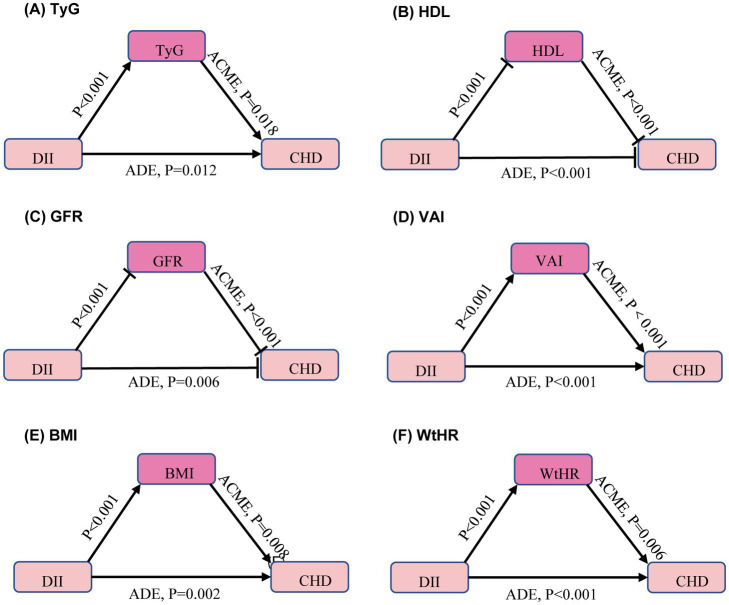
Results: The age of the participants was 49.81 ± 18.10 years, with 20,793 (47.4%) being male. A total of 1,892 (4.3%) participants were diagnosed with CHD, and the median DII score was 1.33 (0.11, 2.40). After adjusting for potential confounders, logistic regression analysis revealed that DII independently associated with CHD [OR: 1.049 (1.012-1.087), p = 0.008]. Triglyceride-glucose index, visceral adiposity index, body mass index, waist-to-height ratio, high-density lipoprotein, and glomerular filtration rate (all p < 0.05) may mediate the relationship between DII and CHD. Subgroup analyses showed that DII was more sensitive in participants aged <75 years (p < 0.001), females (p = 0.028), those with low cholesterol levels (p = 0.004), and individuals with low Framingham risk scores (p = 0.005). MDG analysis indicated that carbohydrate, vitamin C and iron intake have the greatest impact on CHD.
Conclusion: This study suggests that various metabolic and lipid indicators play a mediating role in the relationship between DII and CHD. DII may have a greater adverse impact on traditional low-risk CHD populations.
期刊介绍:
No subject pertains more to human life than nutrition. The aim of Frontiers in Nutrition is to integrate major scientific disciplines in this vast field in order to address the most relevant and pertinent questions and developments. Our ambition is to create an integrated podium based on original research, clinical trials, and contemporary reviews to build a reputable knowledge forum in the domains of human health, dietary behaviors, agronomy & 21st century food science. Through the recognized open-access Frontiers platform we welcome manuscripts to our dedicated sections relating to different areas in the field of nutrition with a focus on human health.
Specialty sections in Frontiers in Nutrition include, for example, Clinical Nutrition, Nutrition & Sustainable Diets, Nutrition and Food Science Technology, Nutrition Methodology, Sport & Exercise Nutrition, Food Chemistry, and Nutritional Immunology. Based on the publication of rigorous scientific research, we thrive to achieve a visible impact on the global nutrition agenda addressing the grand challenges of our time, including obesity, malnutrition, hunger, food waste, sustainability and consumer health.





 京公网安备 11010802042870号
京ICP备2023020795号-1
京公网安备 11010802042870号
京ICP备2023020795号-1

 分享
分享
 求助内容:
求助内容: 应助结果提醒方式:
 扫码关注我们
