Alyce M Whipp, Gabin Drouard, Richard J Rose, Lea Pulkkinen, Jaakko Kaprio
{"title":"Protein associations and protein-metabolite interactions with depressive symptoms and the p-factor.","authors":"Alyce M Whipp, Gabin Drouard, Richard J Rose, Lea Pulkkinen, Jaakko Kaprio","doi":"10.1038/s41398-025-03362-y","DOIUrl":null,"url":null,"abstract":"<p><p>Despite increasing mental health problems among young people, few studies have examined associations between plasma proteins and mental health. Interactions between proteins and metabolites in association with mental health problems remain underexplored. In 730 twins, we quantified associations between plasma proteins measured at age 22 with 21 indicators of either depressive symptoms or the p-factor and tested for interactions with metabolites. Symptoms were collected from questionnaires and interviews completed by different raters (e.g., self-report, teachers) through adolescence to young adulthood (12 to 22 years). We found 47 proteins associated with depressive symptoms or the p-factor (FDR < 0.2), 9 being associated with both. Two proteins, contactin-1 and mast/stem cell growth factor receptor kit, positively interacted with valine levels in explaining p-factor variability. Our study demonstrates strong associations between plasma proteins and mental health and provides evidence for proteome-metabolome interactions in explaining higher levels of mental health problems.</p>","PeriodicalId":23278,"journal":{"name":"Translational Psychiatry","volume":"15 1","pages":"128"},"PeriodicalIF":6.2000,"publicationDate":"2025-04-06","publicationTypes":"Journal Article","fieldsOfStudy":null,"isOpenAccess":false,"openAccessPdf":"https://www.ncbi.nlm.nih.gov/pmc/articles/PMC11973182/pdf/","citationCount":"0","resultStr":null,"platform":"Semanticscholar","paperid":null,"PeriodicalName":"Translational Psychiatry","FirstCategoryId":"3","ListUrlMain":"https://doi.org/10.1038/s41398-025-03362-y","RegionNum":1,"RegionCategory":"医学","ArticlePicture":[],"TitleCN":null,"AbstractTextCN":null,"PMCID":null,"EPubDate":"","PubModel":"","JCR":"Q1","JCRName":"PSYCHIATRY","Score":null,"Total":0}
引用次数: 0
Abstract
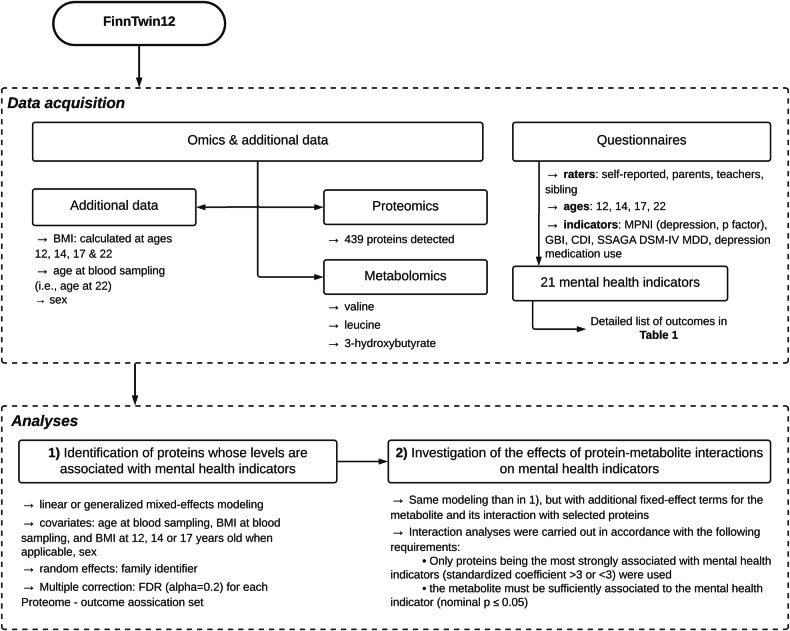
Despite increasing mental health problems among young people, few studies have examined associations between plasma proteins and mental health. Interactions between proteins and metabolites in association with mental health problems remain underexplored. In 730 twins, we quantified associations between plasma proteins measured at age 22 with 21 indicators of either depressive symptoms or the p-factor and tested for interactions with metabolites. Symptoms were collected from questionnaires and interviews completed by different raters (e.g., self-report, teachers) through adolescence to young adulthood (12 to 22 years). We found 47 proteins associated with depressive symptoms or the p-factor (FDR < 0.2), 9 being associated with both. Two proteins, contactin-1 and mast/stem cell growth factor receptor kit, positively interacted with valine levels in explaining p-factor variability. Our study demonstrates strong associations between plasma proteins and mental health and provides evidence for proteome-metabolome interactions in explaining higher levels of mental health problems.
期刊介绍:
Psychiatry has suffered tremendously by the limited translational pipeline. Nobel laureate Julius Axelrod''s discovery in 1961 of monoamine reuptake by pre-synaptic neurons still forms the basis of contemporary antidepressant treatment. There is a grievous gap between the explosion of knowledge in neuroscience and conceptually novel treatments for our patients. Translational Psychiatry bridges this gap by fostering and highlighting the pathway from discovery to clinical applications, healthcare and global health. We view translation broadly as the full spectrum of work that marks the pathway from discovery to global health, inclusive. The steps of translation that are within the scope of Translational Psychiatry include (i) fundamental discovery, (ii) bench to bedside, (iii) bedside to clinical applications (clinical trials), (iv) translation to policy and health care guidelines, (v) assessment of health policy and usage, and (vi) global health. All areas of medical research, including — but not restricted to — molecular biology, genetics, pharmacology, imaging and epidemiology are welcome as they contribute to enhance the field of translational psychiatry.




 京公网安备 11010802042870号
京ICP备2023020795号-1
京公网安备 11010802042870号
京ICP备2023020795号-1

 分享
分享
 求助内容:
求助内容: 应助结果提醒方式:
 扫码关注我们
