Mini Sharma, Neeraj Kumar, Subhas Saha, Vanita Suri, G R Prasad, Radhika Srinivasan, Arnab Pal
{"title":"Role of HE4 in evaluation of adnexal masses and its comparison with CA125, ROMA and RMI in premenopausal women.","authors":"Mini Sharma, Neeraj Kumar, Subhas Saha, Vanita Suri, G R Prasad, Radhika Srinivasan, Arnab Pal","doi":"10.4314/ahs.v24i4.16","DOIUrl":null,"url":null,"abstract":"<p><strong>Background: </strong>Ovarian cancer is the seventh most common cancer in women and is ranked third among gynaecological malignancies after cervical and uterine cancers. Prospective studies have failed to establish a definite screening programme based on tumour markers or ultrasonography.</p><p><strong>Objective: </strong>To evaluate potential role of Human Epididymis protein 4 (HE4) as a biomarker for diagnosis of various ovarian malignancies in premenopausal age group, either alone or as a part of diagnostic algorithm like Risk of Malignancy Algorithm (ROMA) and to analyse if it has any advantage over Cancer Antigen 125 (CA125) or Risk of Malignancy Index (RMI).</p><p><strong>Methods: </strong>It was an observational cross-sectional study which included 100 premenopausal women having ovarian mass and underwent surgery. The diagnostic performances of CA125, HE4, ROMA score and RMI for ovarian cancer were evaluated.</p><p><strong>Results: </strong>Postoperative histopathology confirmed 30% (n=30) women to have malignant ovarian tumors. According to receiver operating characteristic (ROC) analysis; area under curve (AUC) was maximum for ROMA (0.791) followed by HE4 (0.784), RMI (0.750) and CA125 (0.715).</p><p><strong>Conclusion: </strong>HE4 is not superior to CA125 but, it can be used in series or as part of diagnostic algorithm (ROMA) along with CA125 to get higher diagnostic accuracy for premenopausal women.</p>","PeriodicalId":94295,"journal":{"name":"African health sciences","volume":"24 4","pages":"120-128"},"PeriodicalIF":0.9000,"publicationDate":"2024-12-01","publicationTypes":"Journal Article","fieldsOfStudy":null,"isOpenAccess":false,"openAccessPdf":"https://www.ncbi.nlm.nih.gov/pmc/articles/PMC11970180/pdf/","citationCount":"0","resultStr":null,"platform":"Semanticscholar","paperid":null,"PeriodicalName":"African health sciences","FirstCategoryId":"1085","ListUrlMain":"https://doi.org/10.4314/ahs.v24i4.16","RegionNum":0,"RegionCategory":null,"ArticlePicture":[],"TitleCN":null,"AbstractTextCN":null,"PMCID":null,"EPubDate":"","PubModel":"","JCR":"","JCRName":"","Score":null,"Total":0}
引用次数: 0
Abstract
Background: Ovarian cancer is the seventh most common cancer in women and is ranked third among gynaecological malignancies after cervical and uterine cancers. Prospective studies have failed to establish a definite screening programme based on tumour markers or ultrasonography.
Objective: To evaluate potential role of Human Epididymis protein 4 (HE4) as a biomarker for diagnosis of various ovarian malignancies in premenopausal age group, either alone or as a part of diagnostic algorithm like Risk of Malignancy Algorithm (ROMA) and to analyse if it has any advantage over Cancer Antigen 125 (CA125) or Risk of Malignancy Index (RMI).
Methods: It was an observational cross-sectional study which included 100 premenopausal women having ovarian mass and underwent surgery. The diagnostic performances of CA125, HE4, ROMA score and RMI for ovarian cancer were evaluated.
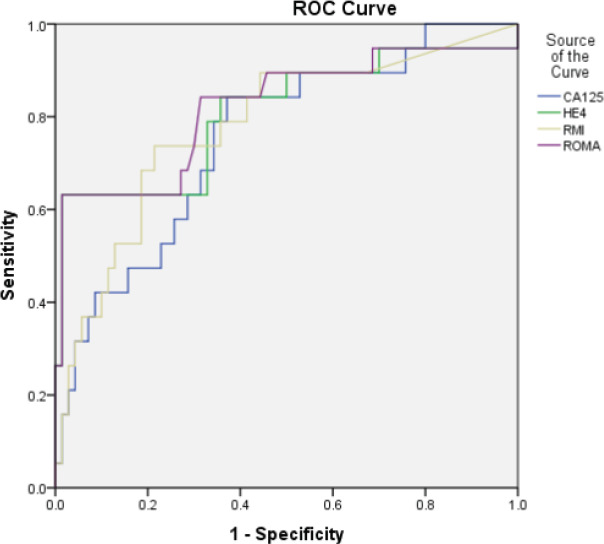
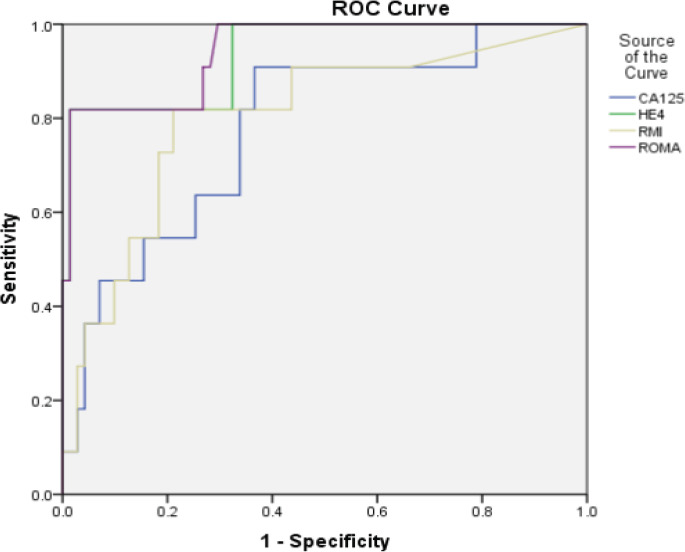
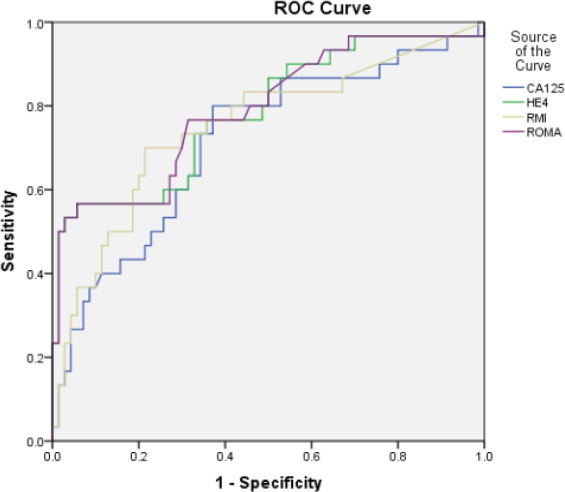
Results: Postoperative histopathology confirmed 30% (n=30) women to have malignant ovarian tumors. According to receiver operating characteristic (ROC) analysis; area under curve (AUC) was maximum for ROMA (0.791) followed by HE4 (0.784), RMI (0.750) and CA125 (0.715).
Conclusion: HE4 is not superior to CA125 but, it can be used in series or as part of diagnostic algorithm (ROMA) along with CA125 to get higher diagnostic accuracy for premenopausal women.



 京公网安备 11010802042870号
京ICP备2023020795号-1
京公网安备 11010802042870号
京ICP备2023020795号-1

 分享
分享

 求助内容:
求助内容: 应助结果提醒方式:
 扫码关注我们
