{"title":"Mechanistic analysis on electrochemo-mechanics behaviors of lithium iron phosphate cathodes","authors":"Huacui Wang , Binghe Liu , Dongjiang Li , Jun Xu","doi":"10.1016/j.actamat.2025.121024","DOIUrl":null,"url":null,"abstract":"<div><div>The cathode in lithium-ion batteries (LIBs) is invariably subjected to mechanical stress due to external packaging constraints, and internal ionic diffusion and particle phase change. The (de)lithiation in lithium iron phosphate (LiFePO<sub>4</sub>) occurs through the growth of a two-phase front with a fixed activity, thereby producing a relatively flat (dis)charge curve, posing a grand challenge for the battery status estimation. This knowledge gap not only hinders our understanding of the relationship between mechanics and electrochemical behavior but also limits the potential for leveraging mechanical regulation in the development of high-performance electrode materials and cells. To address this issue, we quantitatively investigate the stress effects on the LiFePO<sub>4</sub> cathode by employing constant current charge/discharge processes to capture the electrochemical performance of LIBs. To further understand the underlying mechanism and establish a new electrochemo-mechanics coupling model, comprehensive electrochemical characterizations upon various external stress statuses are conducted. Our findings reveal that within the 0–0.9 MPa range of external compressive stress, LiFePO<sub>4</sub> cathodes exhibit enhanced ionic diffusion coefficients, improved nucleation kinetics and reversibility, although accompanied by a small reduction in the cathode's equilibrium potential. <em>In-situ</em> X-ray diffraction experiments under diverse stress conditions corroborate the beneficial effects of mechanical stress on electrode reactions. These insights offer critical knowledge and pave the way for improved performance, reliability, and durability.</div></div>","PeriodicalId":238,"journal":{"name":"Acta Materialia","volume":"292 ","pages":"Article 121024"},"PeriodicalIF":9.3000,"publicationDate":"2025-04-08","publicationTypes":"Journal Article","fieldsOfStudy":null,"isOpenAccess":false,"openAccessPdf":"","citationCount":"0","resultStr":null,"platform":"Semanticscholar","paperid":null,"PeriodicalName":"Acta Materialia","FirstCategoryId":"88","ListUrlMain":"https://www.sciencedirect.com/science/article/pii/S1359645425003143","RegionNum":1,"RegionCategory":"材料科学","ArticlePicture":[],"TitleCN":null,"AbstractTextCN":null,"PMCID":null,"EPubDate":"","PubModel":"","JCR":"Q1","JCRName":"MATERIALS SCIENCE, MULTIDISCIPLINARY","Score":null,"Total":0}
引用次数: 0
Abstract
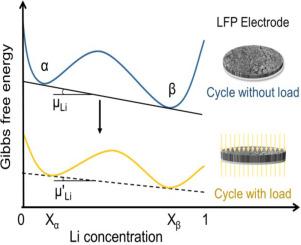
The cathode in lithium-ion batteries (LIBs) is invariably subjected to mechanical stress due to external packaging constraints, and internal ionic diffusion and particle phase change. The (de)lithiation in lithium iron phosphate (LiFePO4) occurs through the growth of a two-phase front with a fixed activity, thereby producing a relatively flat (dis)charge curve, posing a grand challenge for the battery status estimation. This knowledge gap not only hinders our understanding of the relationship between mechanics and electrochemical behavior but also limits the potential for leveraging mechanical regulation in the development of high-performance electrode materials and cells. To address this issue, we quantitatively investigate the stress effects on the LiFePO4 cathode by employing constant current charge/discharge processes to capture the electrochemical performance of LIBs. To further understand the underlying mechanism and establish a new electrochemo-mechanics coupling model, comprehensive electrochemical characterizations upon various external stress statuses are conducted. Our findings reveal that within the 0–0.9 MPa range of external compressive stress, LiFePO4 cathodes exhibit enhanced ionic diffusion coefficients, improved nucleation kinetics and reversibility, although accompanied by a small reduction in the cathode's equilibrium potential. In-situ X-ray diffraction experiments under diverse stress conditions corroborate the beneficial effects of mechanical stress on electrode reactions. These insights offer critical knowledge and pave the way for improved performance, reliability, and durability.
期刊介绍:
Acta Materialia serves as a platform for publishing full-length, original papers and commissioned overviews that contribute to a profound understanding of the correlation between the processing, structure, and properties of inorganic materials. The journal seeks papers with high impact potential or those that significantly propel the field forward. The scope includes the atomic and molecular arrangements, chemical and electronic structures, and microstructure of materials, focusing on their mechanical or functional behavior across all length scales, including nanostructures.




 京公网安备 11010802042870号
京ICP备2023020795号-1
京公网安备 11010802042870号
京ICP备2023020795号-1

 分享
分享
 求助内容:
求助内容: 应助结果提醒方式:
 扫码关注我们
