Fabrication of rice straw nano-biochar by ball milling for efficient adsorption of ammonium nitrogen and reduction of ammonia volatilization: effects and mechanisms
Yidi Sun, Tao Zong, Qi Wu, Xuetao Wang, Huijing Hou, Xiaoping Xin, Jigan Xie, Yuhao Zhou and Jianchang Yang
{"title":"Fabrication of rice straw nano-biochar by ball milling for efficient adsorption of ammonium nitrogen and reduction of ammonia volatilization: effects and mechanisms","authors":"Yidi Sun, Tao Zong, Qi Wu, Xuetao Wang, Huijing Hou, Xiaoping Xin, Jigan Xie, Yuhao Zhou and Jianchang Yang","doi":"10.1039/D5EN00103J","DOIUrl":null,"url":null,"abstract":"<p >The use of nitrogen fertilizers leads to substantial nitrogen losses and subsequent environmental pollution. Biochar (BC) demonstrates considerable potential for enhancing N fixation and reducing emissions, but it frequently induces a liming effect that increases ammonia (NH<small><sub>3</sub></small>) volatilization. Nano-biochar (NBC) is attracting considerable attention due to its higher surface energy. However, little information is available whether it could enhance nitrogen adsorption and reduce NH<small><sub>3</sub></small> volatilization. Therefore, this study utilized a one-step ball milling method to produce NBC, characterized its physicochemical properties, and investigated its effects and mechanisms on NH<small><sub>4</sub></small><small><sup>+</sup></small>–N adsorption and NH<small><sub>3</sub></small> volatilization. Our results showed that the specific surface area, pore volume and acidic functional groups (carboxyl, lactone group and phenolic hydroxyl groups) of NBC were higher than those of bulk BC, while the pore diameter, zeta potential and pH were the opposite, which was more conducive to promoting adsorption. The maximum adsorption amount of NBC for NH<small><sub>4</sub></small><small><sup>+</sup></small>–N was 6.880 mg g<small><sup>−1</sup></small>, approximately 1.9 times that of bulk BC. The adsorption process conformed to the Langmuir adsorption isotherm model and the pseudo-second-order kinetic equation, indicating that the adsorption was monolayer and chemical. The primary adsorption mechanisms included physical adsorption, ion exchange, electrostatic and π–π interactions. The addition of 0.30–30% of bulk BC and NBC reduced NH<small><sub>3</sub></small> volatilization by 6.40–31.50% and 5.00–42.20%, relative to no BC addition, respectively. The main reason for lower NH<small><sub>3</sub></small> volatilization observed with NBC was its ability to improve soil mineral nitrogen content, mineralization and nitrification rates, and decrease urease activity and pH. Therefore, NBC is a green and efficient adsorbent for reducing nitrogen emissions.</p>","PeriodicalId":73,"journal":{"name":"Environmental Science: Nano","volume":" 6","pages":" 3122-3138"},"PeriodicalIF":5.1000,"publicationDate":"2025-04-08","publicationTypes":"Journal Article","fieldsOfStudy":null,"isOpenAccess":false,"openAccessPdf":"","citationCount":"0","resultStr":null,"platform":"Semanticscholar","paperid":null,"PeriodicalName":"Environmental Science: Nano","FirstCategoryId":"6","ListUrlMain":"https://pubs.rsc.org/en/content/articlelanding/2025/en/d5en00103j","RegionNum":2,"RegionCategory":"环境科学与生态学","ArticlePicture":[],"TitleCN":null,"AbstractTextCN":null,"PMCID":null,"EPubDate":"","PubModel":"","JCR":"Q1","JCRName":"CHEMISTRY, MULTIDISCIPLINARY","Score":null,"Total":0}
引用次数: 0
Abstract
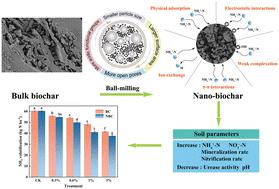
The use of nitrogen fertilizers leads to substantial nitrogen losses and subsequent environmental pollution. Biochar (BC) demonstrates considerable potential for enhancing N fixation and reducing emissions, but it frequently induces a liming effect that increases ammonia (NH3) volatilization. Nano-biochar (NBC) is attracting considerable attention due to its higher surface energy. However, little information is available whether it could enhance nitrogen adsorption and reduce NH3 volatilization. Therefore, this study utilized a one-step ball milling method to produce NBC, characterized its physicochemical properties, and investigated its effects and mechanisms on NH4+–N adsorption and NH3 volatilization. Our results showed that the specific surface area, pore volume and acidic functional groups (carboxyl, lactone group and phenolic hydroxyl groups) of NBC were higher than those of bulk BC, while the pore diameter, zeta potential and pH were the opposite, which was more conducive to promoting adsorption. The maximum adsorption amount of NBC for NH4+–N was 6.880 mg g−1, approximately 1.9 times that of bulk BC. The adsorption process conformed to the Langmuir adsorption isotherm model and the pseudo-second-order kinetic equation, indicating that the adsorption was monolayer and chemical. The primary adsorption mechanisms included physical adsorption, ion exchange, electrostatic and π–π interactions. The addition of 0.30–30% of bulk BC and NBC reduced NH3 volatilization by 6.40–31.50% and 5.00–42.20%, relative to no BC addition, respectively. The main reason for lower NH3 volatilization observed with NBC was its ability to improve soil mineral nitrogen content, mineralization and nitrification rates, and decrease urease activity and pH. Therefore, NBC is a green and efficient adsorbent for reducing nitrogen emissions.
期刊介绍:
Environmental Science: Nano serves as a comprehensive and high-impact peer-reviewed source of information on the design and demonstration of engineered nanomaterials for environment-based applications. It also covers the interactions between engineered, natural, and incidental nanomaterials with biological and environmental systems. This scope includes, but is not limited to, the following topic areas:
Novel nanomaterial-based applications for water, air, soil, food, and energy sustainability
Nanomaterial interactions with biological systems and nanotoxicology
Environmental fate, reactivity, and transformations of nanoscale materials
Nanoscale processes in the environment
Sustainable nanotechnology including rational nanomaterial design, life cycle assessment, risk/benefit analysis



 京公网安备 11010802042870号
京ICP备2023020795号-1
京公网安备 11010802042870号
京ICP备2023020795号-1

 分享
分享
 求助内容:
求助内容: 应助结果提醒方式:
 扫码关注我们
