Kai Shang, Jiacai Li, Yifan Wu, Shihang Wang, Yang Feng, Shengtao Li
{"title":"Diffusion-limited free radical mechanisms in peroxide-initiated crosslinking of low-density polyethylene","authors":"Kai Shang, Jiacai Li, Yifan Wu, Shihang Wang, Yang Feng, Shengtao Li","doi":"10.1016/j.polymer.2025.128376","DOIUrl":null,"url":null,"abstract":"<div><div>There have been many attempts to describe the kinetics of the peroxide-initiated crosslinking of low-density polyethylene (LDPE). However, these kinetic models have not comprehensively captured the free radical behavior during LDPE crosslinking. In this study, the evolution of the reduced reaction rate (<em>R</em><sub>r</sub>), derived from the mechanistic kinetic model, is employed to gain detailed insight into free radical behaviors in LDPE during crosslinking. The curve of <em>R</em><sub>r</sub> over time, which follows a bell shape, demonstrates that the complexity of the crosslinking chemistry incorporates diffusional limitation, leading to ineffective free radical terminations. When combined with structural characterization of functional <em>trans</em>-vinylene groups and hydroxyl groups of antioxidants, our analysis highlights a diffusion-limited mechanism associated with a continuous decrease in the effective consumption of peroxide and a sequential increase in radical scavenging. These observations are a result of the intramolecular disproportionation induced by the cage effect in peroxides and the unimolecular termination of LDPE radicals by antioxidants during network formation, respectively. Consequently, a refined kinetic model is proposed, which accounts for the effect of diffusional limitation on free radical terminations, thereby providing an accurate description of the LDPE crosslinking process. This comprehensive understanding of free radical crosslinking mechanisms in LDPE will facilitate the precise control and optimization of the properties of this reaction.</div></div>","PeriodicalId":405,"journal":{"name":"Polymer","volume":"327 ","pages":"Article 128376"},"PeriodicalIF":4.5000,"publicationDate":"2025-05-16","publicationTypes":"Journal Article","fieldsOfStudy":null,"isOpenAccess":false,"openAccessPdf":"","citationCount":"0","resultStr":null,"platform":"Semanticscholar","paperid":null,"PeriodicalName":"Polymer","FirstCategoryId":"92","ListUrlMain":"https://www.sciencedirect.com/science/article/pii/S0032386125003623","RegionNum":2,"RegionCategory":"化学","ArticlePicture":[],"TitleCN":null,"AbstractTextCN":null,"PMCID":null,"EPubDate":"2025/4/8 0:00:00","PubModel":"Epub","JCR":"Q2","JCRName":"POLYMER SCIENCE","Score":null,"Total":0}
引用次数: 0
Abstract
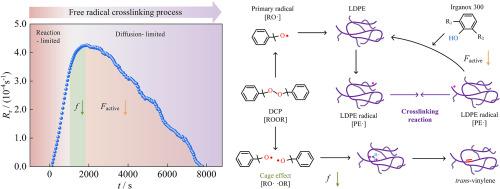
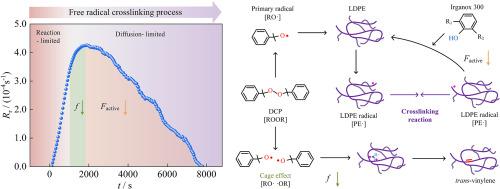
There have been many attempts to describe the kinetics of the peroxide-initiated crosslinking of low-density polyethylene (LDPE). However, these kinetic models have not comprehensively captured the free radical behavior during LDPE crosslinking. In this study, the evolution of the reduced reaction rate (Rr), derived from the mechanistic kinetic model, is employed to gain detailed insight into free radical behaviors in LDPE during crosslinking. The curve of Rr over time, which follows a bell shape, demonstrates that the complexity of the crosslinking chemistry incorporates diffusional limitation, leading to ineffective free radical terminations. When combined with structural characterization of functional trans-vinylene groups and hydroxyl groups of antioxidants, our analysis highlights a diffusion-limited mechanism associated with a continuous decrease in the effective consumption of peroxide and a sequential increase in radical scavenging. These observations are a result of the intramolecular disproportionation induced by the cage effect in peroxides and the unimolecular termination of LDPE radicals by antioxidants during network formation, respectively. Consequently, a refined kinetic model is proposed, which accounts for the effect of diffusional limitation on free radical terminations, thereby providing an accurate description of the LDPE crosslinking process. This comprehensive understanding of free radical crosslinking mechanisms in LDPE will facilitate the precise control and optimization of the properties of this reaction.
期刊介绍:
Polymer is an interdisciplinary journal dedicated to publishing innovative and significant advances in Polymer Physics, Chemistry and Technology. We welcome submissions on polymer hybrids, nanocomposites, characterisation and self-assembly. Polymer also publishes work on the technological application of polymers in energy and optoelectronics.
The main scope is covered but not limited to the following core areas:
Polymer Materials
Nanocomposites and hybrid nanomaterials
Polymer blends, films, fibres, networks and porous materials
Physical Characterization
Characterisation, modelling and simulation* of molecular and materials properties in bulk, solution, and thin films
Polymer Engineering
Advanced multiscale processing methods
Polymer Synthesis, Modification and Self-assembly
Including designer polymer architectures, mechanisms and kinetics, and supramolecular polymerization
Technological Applications
Polymers for energy generation and storage
Polymer membranes for separation technology
Polymers for opto- and microelectronics.



 京公网安备 11010802042870号
京ICP备2023020795号-1
京公网安备 11010802042870号
京ICP备2023020795号-1

 分享
分享
 求助内容:
求助内容: 应助结果提醒方式:
 扫码关注我们
