{"title":"CO2-triggered break-in and formation of accessible high surface area nanoporous Cu cathode for CO2RR from CuO-MgO nanocomposites","authors":"Ding-Huei Tsai, Wei-Ting Tu, Lu-Yu Chueh, Chun-I Chou, Cheng-Yang Chang, Yung-Tin (Frank) Pan","doi":"10.1016/j.electacta.2025.146207","DOIUrl":null,"url":null,"abstract":"<div><div>Accessible high surface area copper nanoporous electrode is created in a zero-gap CO<sub>2</sub> reduction reaction (CO<sub>2</sub>RR) electrolyzer <em>in-situ</em> from a nanocomposite of copper oxide and magnesium oxide (CuO-MgO). Upon the removal of MgO, a nanoporous CuO exhibiting a very compelling surface area of 201 m<sup>2</sup>/g with regular 30 nm pores is obtained. After electrochemical reduction, it transformed into a Cu electrode with an unprecedented high roughness factor of 36 cm<sup>2</sup><sub>Cu</sub>/cm<sup>2</sup><sub>geo</sub> based on the monolayer surface oxidation charge measured under aqueous half-cell conditions. Under MEA testing conditions, the on-site dissolution of MgO under the presence of water and CO<sub>2</sub> leads to formation of nanoporous copper that exposes large amounts of triple-phase boundaries accessible for mass and charge carriers. The uniformity of the obtained Cu electrode, spanning from macro to nanoscale, is a key essence towards good CO<sub>2</sub>RR performance and the suppression of hydrogen evolution reaction. The nanoporous high surface area Cu delivers a maximum CO<sub>2</sub>RR current density (<em>j</em><sub>CO2RR</sub>) of 150.8 ± 4.8 mA/cm<sup>2</sup> at a cell voltage of 3.4 V. At 3.2 V, it delivered a maximum C<sub>2</sub> Faradaic efficiency of 49.6 ± 6.7 % at 103.4 ± 9.9 mA/cm<sup>2</sup> that was dominated by ethylene production, exhibiting a Faradaic efficiency of 31.0 ± 0.5 %.</div></div>","PeriodicalId":305,"journal":{"name":"Electrochimica Acta","volume":"526 ","pages":"Article 146207"},"PeriodicalIF":5.6000,"publicationDate":"2025-06-20","publicationTypes":"Journal Article","fieldsOfStudy":null,"isOpenAccess":false,"openAccessPdf":"","citationCount":"0","resultStr":null,"platform":"Semanticscholar","paperid":null,"PeriodicalName":"Electrochimica Acta","FirstCategoryId":"88","ListUrlMain":"https://www.sciencedirect.com/science/article/pii/S0013468625005687","RegionNum":3,"RegionCategory":"材料科学","ArticlePicture":[],"TitleCN":null,"AbstractTextCN":null,"PMCID":null,"EPubDate":"2025/4/8 0:00:00","PubModel":"Epub","JCR":"Q1","JCRName":"ELECTROCHEMISTRY","Score":null,"Total":0}
引用次数: 0
Abstract
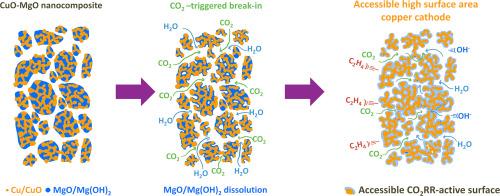
Accessible high surface area copper nanoporous electrode is created in a zero-gap CO2 reduction reaction (CO2RR) electrolyzer in-situ from a nanocomposite of copper oxide and magnesium oxide (CuO-MgO). Upon the removal of MgO, a nanoporous CuO exhibiting a very compelling surface area of 201 m2/g with regular 30 nm pores is obtained. After electrochemical reduction, it transformed into a Cu electrode with an unprecedented high roughness factor of 36 cm2Cu/cm2geo based on the monolayer surface oxidation charge measured under aqueous half-cell conditions. Under MEA testing conditions, the on-site dissolution of MgO under the presence of water and CO2 leads to formation of nanoporous copper that exposes large amounts of triple-phase boundaries accessible for mass and charge carriers. The uniformity of the obtained Cu electrode, spanning from macro to nanoscale, is a key essence towards good CO2RR performance and the suppression of hydrogen evolution reaction. The nanoporous high surface area Cu delivers a maximum CO2RR current density (jCO2RR) of 150.8 ± 4.8 mA/cm2 at a cell voltage of 3.4 V. At 3.2 V, it delivered a maximum C2 Faradaic efficiency of 49.6 ± 6.7 % at 103.4 ± 9.9 mA/cm2 that was dominated by ethylene production, exhibiting a Faradaic efficiency of 31.0 ± 0.5 %.
期刊介绍:
Electrochimica Acta is an international journal. It is intended for the publication of both original work and reviews in the field of electrochemistry. Electrochemistry should be interpreted to mean any of the research fields covered by the Divisions of the International Society of Electrochemistry listed below, as well as emerging scientific domains covered by ISE New Topics Committee.




 京公网安备 11010802042870号
京ICP备2023020795号-1
京公网安备 11010802042870号
京ICP备2023020795号-1

 分享
分享
 求助内容:
求助内容: 应助结果提醒方式:
 扫码关注我们
