Zhimin Wang , Zijun Lu , Yufen Xia , Yuanfeng Wei , Huiling Liu , Haifang Tang , Xiangxiong Liu , Jinfang Shi , Junfeng Zhang , Chengbin Liu
{"title":"L-cysteine-grafted polyacrylonitrile sheets with amphoteric adsorption sites enabling efficient removal of Hg(II) from acidic wastewater","authors":"Zhimin Wang , Zijun Lu , Yufen Xia , Yuanfeng Wei , Huiling Liu , Haifang Tang , Xiangxiong Liu , Jinfang Shi , Junfeng Zhang , Chengbin Liu","doi":"10.1016/j.watres.2025.123624","DOIUrl":null,"url":null,"abstract":"<div><div>Conventional adsorbents for Hg(II) are not suitable for acidic environments because they degrade and lose activity. In this study, high-density sulfur and nitrogen-containing porous polyacrylonitrile sheet (HSN-PANS) was developed by grafting l-cysteine. The amphoteric HSN-PANS adsorbent can effectively remove Hg(II) from acidic wastewater, reducing its concentration from 11 mg/L to below the drinking water standard of 1 μg/L at pH 2. It shows high adsorption capacity (764 mg/g), strong anti-interference properties, and excellent selectivity. The adsorption mechanism involves coordination and electrostatic interactions. Thanks to its stable structure and efficient desorption, HSN-PANS demonstrates excellent acid resistance and reusability, retaining 99.9 % adsorption efficiency after 43 cycles. Furthermore, it performs reliably in industrial wastewater treatment. Notably, an HSN-PANS-packed column can treat about 5845 bed volumes (69 L) of Hg(II)-spiked acidic wastewater until reaching a breakthrough point of 1 μg/L, concentrating the adsorbed Hg(II) into 1.8 L of desorbent. This study demonstrates the potential of HSN-PANS as an effective adsorbent for directly and efficiently removing Hg(II) from acidic wastewater, providing a promising solution to reduce Hg(II) emissions in industrial processes.</div></div>","PeriodicalId":443,"journal":{"name":"Water Research","volume":"282 ","pages":"Article 123624"},"PeriodicalIF":12.4000,"publicationDate":"2025-08-15","publicationTypes":"Journal Article","fieldsOfStudy":null,"isOpenAccess":false,"openAccessPdf":"","citationCount":"0","resultStr":null,"platform":"Semanticscholar","paperid":null,"PeriodicalName":"Water Research","FirstCategoryId":"93","ListUrlMain":"https://www.sciencedirect.com/science/article/pii/S0043135425005342","RegionNum":1,"RegionCategory":"环境科学与生态学","ArticlePicture":[],"TitleCN":null,"AbstractTextCN":null,"PMCID":null,"EPubDate":"2025/4/8 0:00:00","PubModel":"Epub","JCR":"Q1","JCRName":"ENGINEERING, ENVIRONMENTAL","Score":null,"Total":0}
引用次数: 0
Abstract
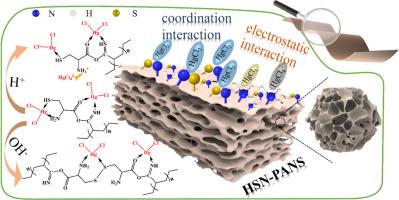
Conventional adsorbents for Hg(II) are not suitable for acidic environments because they degrade and lose activity. In this study, high-density sulfur and nitrogen-containing porous polyacrylonitrile sheet (HSN-PANS) was developed by grafting l-cysteine. The amphoteric HSN-PANS adsorbent can effectively remove Hg(II) from acidic wastewater, reducing its concentration from 11 mg/L to below the drinking water standard of 1 μg/L at pH 2. It shows high adsorption capacity (764 mg/g), strong anti-interference properties, and excellent selectivity. The adsorption mechanism involves coordination and electrostatic interactions. Thanks to its stable structure and efficient desorption, HSN-PANS demonstrates excellent acid resistance and reusability, retaining 99.9 % adsorption efficiency after 43 cycles. Furthermore, it performs reliably in industrial wastewater treatment. Notably, an HSN-PANS-packed column can treat about 5845 bed volumes (69 L) of Hg(II)-spiked acidic wastewater until reaching a breakthrough point of 1 μg/L, concentrating the adsorbed Hg(II) into 1.8 L of desorbent. This study demonstrates the potential of HSN-PANS as an effective adsorbent for directly and efficiently removing Hg(II) from acidic wastewater, providing a promising solution to reduce Hg(II) emissions in industrial processes.
期刊介绍:
Water Research, along with its open access companion journal Water Research X, serves as a platform for publishing original research papers covering various aspects of the science and technology related to the anthropogenic water cycle, water quality, and its management worldwide. The audience targeted by the journal comprises biologists, chemical engineers, chemists, civil engineers, environmental engineers, limnologists, and microbiologists. The scope of the journal include:
•Treatment processes for water and wastewaters (municipal, agricultural, industrial, and on-site treatment), including resource recovery and residuals management;
•Urban hydrology including sewer systems, stormwater management, and green infrastructure;
•Drinking water treatment and distribution;
•Potable and non-potable water reuse;
•Sanitation, public health, and risk assessment;
•Anaerobic digestion, solid and hazardous waste management, including source characterization and the effects and control of leachates and gaseous emissions;
•Contaminants (chemical, microbial, anthropogenic particles such as nanoparticles or microplastics) and related water quality sensing, monitoring, fate, and assessment;
•Anthropogenic impacts on inland, tidal, coastal and urban waters, focusing on surface and ground waters, and point and non-point sources of pollution;
•Environmental restoration, linked to surface water, groundwater and groundwater remediation;
•Analysis of the interfaces between sediments and water, and between water and atmosphere, focusing specifically on anthropogenic impacts;
•Mathematical modelling, systems analysis, machine learning, and beneficial use of big data related to the anthropogenic water cycle;
•Socio-economic, policy, and regulations studies.




 京公网安备 11010802042870号
京ICP备2023020795号-1
京公网安备 11010802042870号
京ICP备2023020795号-1

 分享
分享
 求助内容:
求助内容: 应助结果提醒方式:
 扫码关注我们
