Lixin Sun , Dong Tian , Kaiming Zhang , Yahui Wu , Yanan Sun , Yujie Jiang , Chuanhui Gao , Lei Liu , Yuetao Liu
{"title":"Antimicrobial anticorrosive silicone resin coating with high adhesion and excellent mechanical properties","authors":"Lixin Sun , Dong Tian , Kaiming Zhang , Yahui Wu , Yanan Sun , Yujie Jiang , Chuanhui Gao , Lei Liu , Yuetao Liu","doi":"10.1016/j.polymer.2025.128366","DOIUrl":null,"url":null,"abstract":"<div><div>Silicone resin is increasingly recognized for its applications in anti-fouling and anti-corrosion coatings. However, its inherent limitations such as low strength, poor mechanical properties, and weak substrate adhesion, hinder its widespread application. This study introduces a novel antibacterial and anticorrosive silicone resin coating characterized by excellent mechanical properties, and strong adhesion. By modifying natural rosin with KH 560, we successfully synthesized a novel rosin modifier DAS and introduced it into methylphenylsilicone (MPSR) matrix through a hydrolysis-condensation method, producing antibacterial coatings with different DAS content (MPSR-x% DAS, x= 0, 3, 5, 7, 10). Especially the MPSR-7% DAS coating reached 98.9% against <em>Staphylococcus aureus (S. aureus)</em> and 94.5% against <em>Escherichia coli (E. coli)</em>. In addition, in order to enhance the hardness and adhesion of the coating, a multifunctional siloxane crosslinker (MF-S) was introduced to form an MPSR-7% DAS-<em>y</em> coating. The MPSR-7%DAS-<em>y</em> (<em>y</em>= 2- 5) coating all achieved grade 1 adhesion, and the hardness of the MPSR-7%DAS-4 coating exceeded 6H. The higher crosslinking density of MF-S contributes to a denser coating and improves the long-term corrosion resistance of the coating. This study provides potential progress for the development of coatings with enhanced antifouling and anti-corrosion properties.</div></div>","PeriodicalId":405,"journal":{"name":"Polymer","volume":"326 ","pages":"Article 128366"},"PeriodicalIF":4.5000,"publicationDate":"2025-04-07","publicationTypes":"Journal Article","fieldsOfStudy":null,"isOpenAccess":false,"openAccessPdf":"","citationCount":"0","resultStr":null,"platform":"Semanticscholar","paperid":null,"PeriodicalName":"Polymer","FirstCategoryId":"92","ListUrlMain":"https://www.sciencedirect.com/science/article/pii/S0032386125003520","RegionNum":2,"RegionCategory":"化学","ArticlePicture":[],"TitleCN":null,"AbstractTextCN":null,"PMCID":null,"EPubDate":"","PubModel":"","JCR":"Q2","JCRName":"POLYMER SCIENCE","Score":null,"Total":0}
引用次数: 0
Abstract
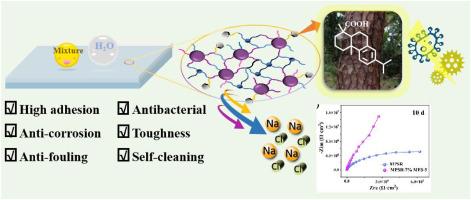
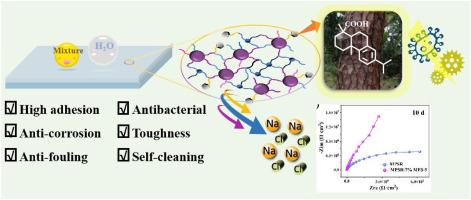
Silicone resin is increasingly recognized for its applications in anti-fouling and anti-corrosion coatings. However, its inherent limitations such as low strength, poor mechanical properties, and weak substrate adhesion, hinder its widespread application. This study introduces a novel antibacterial and anticorrosive silicone resin coating characterized by excellent mechanical properties, and strong adhesion. By modifying natural rosin with KH 560, we successfully synthesized a novel rosin modifier DAS and introduced it into methylphenylsilicone (MPSR) matrix through a hydrolysis-condensation method, producing antibacterial coatings with different DAS content (MPSR-x% DAS, x= 0, 3, 5, 7, 10). Especially the MPSR-7% DAS coating reached 98.9% against Staphylococcus aureus (S. aureus) and 94.5% against Escherichia coli (E. coli). In addition, in order to enhance the hardness and adhesion of the coating, a multifunctional siloxane crosslinker (MF-S) was introduced to form an MPSR-7% DAS-y coating. The MPSR-7%DAS-y (y= 2- 5) coating all achieved grade 1 adhesion, and the hardness of the MPSR-7%DAS-4 coating exceeded 6H. The higher crosslinking density of MF-S contributes to a denser coating and improves the long-term corrosion resistance of the coating. This study provides potential progress for the development of coatings with enhanced antifouling and anti-corrosion properties.
期刊介绍:
Polymer is an interdisciplinary journal dedicated to publishing innovative and significant advances in Polymer Physics, Chemistry and Technology. We welcome submissions on polymer hybrids, nanocomposites, characterisation and self-assembly. Polymer also publishes work on the technological application of polymers in energy and optoelectronics.
The main scope is covered but not limited to the following core areas:
Polymer Materials
Nanocomposites and hybrid nanomaterials
Polymer blends, films, fibres, networks and porous materials
Physical Characterization
Characterisation, modelling and simulation* of molecular and materials properties in bulk, solution, and thin films
Polymer Engineering
Advanced multiscale processing methods
Polymer Synthesis, Modification and Self-assembly
Including designer polymer architectures, mechanisms and kinetics, and supramolecular polymerization
Technological Applications
Polymers for energy generation and storage
Polymer membranes for separation technology
Polymers for opto- and microelectronics.



 京公网安备 11010802042870号
京ICP备2023020795号-1
京公网安备 11010802042870号
京ICP备2023020795号-1

 分享
分享
 求助内容:
求助内容: 应助结果提醒方式:
 扫码关注我们
