Guofang Xu, Haozheng He, Daoyu Tang, Qihong Lu, Bixian Mai, Zhili He, Lorenz Adrian, Jianzhong He, Jan Dolfing, Shanquan Wang
{"title":"High-Throughput Screening of Microbial Reductive Dechlorination of Polychlorinated Biphenyls: Patterns in Reactivity and Pathways","authors":"Guofang Xu, Haozheng He, Daoyu Tang, Qihong Lu, Bixian Mai, Zhili He, Lorenz Adrian, Jianzhong He, Jan Dolfing, Shanquan Wang","doi":"10.1021/acs.est.4c13917","DOIUrl":null,"url":null,"abstract":"Polychlorinated biphenyls (PCBs) are pervasive pollutants that pose risks to ecosystems and human health. Microbial reductive dehalogenation plays crucial roles in attenuating PCBs, but comprehensive insights into PCB dechlorination pathways, reactivity, and governing factors are limited by the vast number of congeners and costly experimental approaches. We address this challenge by establishing a high-throughput <i>in vitro</i> assay approach of reductive dehalogenation (HINVARD), which increases dechlorination test throughput by 30-fold and enhances reagents and cell utilization efficiency by over 10-fold compared to conventional assay methods. Using HINVARD, we screened 61 PCB congeners across 9 enrichment cultures and 3 <i>Dehalococcoides</i> isolates, identifying active dechlorination of 31–44 congeners. Results showed that PCB congener properties (chlorine substitution patterns, steric hindrance, and solubility) primarily determine the dechlorination potential, leading to consistent reactivity trends across cultures. In contrast, different organohalide-respiring bacteria catalyzed distinct dechlorination pathways, preferentially removing <i>para</i>- or <i>meta</i>-chlorines. Structural modeling of reductive dehalogenases revealed unique binding orientations governing substrate specificity, offering molecular insights into these pathways. This study provides a high-efficiency strategy for investigating microbial reductive dehalogenation, yielding the first comprehensive understanding of PCB dechlorination patterns and mechanisms. These findings guide the design of tailored microbial consortia for effective PCB bioremediation.","PeriodicalId":36,"journal":{"name":"环境科学与技术","volume":"66 1","pages":""},"PeriodicalIF":11.3000,"publicationDate":"2025-04-07","publicationTypes":"Journal Article","fieldsOfStudy":null,"isOpenAccess":false,"openAccessPdf":"","citationCount":"0","resultStr":null,"platform":"Semanticscholar","paperid":null,"PeriodicalName":"环境科学与技术","FirstCategoryId":"1","ListUrlMain":"https://doi.org/10.1021/acs.est.4c13917","RegionNum":1,"RegionCategory":"环境科学与生态学","ArticlePicture":[],"TitleCN":null,"AbstractTextCN":null,"PMCID":null,"EPubDate":"","PubModel":"","JCR":"Q1","JCRName":"ENGINEERING, ENVIRONMENTAL","Score":null,"Total":0}
引用次数: 0
Abstract
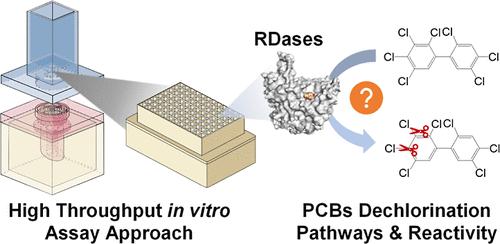
Polychlorinated biphenyls (PCBs) are pervasive pollutants that pose risks to ecosystems and human health. Microbial reductive dehalogenation plays crucial roles in attenuating PCBs, but comprehensive insights into PCB dechlorination pathways, reactivity, and governing factors are limited by the vast number of congeners and costly experimental approaches. We address this challenge by establishing a high-throughput in vitro assay approach of reductive dehalogenation (HINVARD), which increases dechlorination test throughput by 30-fold and enhances reagents and cell utilization efficiency by over 10-fold compared to conventional assay methods. Using HINVARD, we screened 61 PCB congeners across 9 enrichment cultures and 3 Dehalococcoides isolates, identifying active dechlorination of 31–44 congeners. Results showed that PCB congener properties (chlorine substitution patterns, steric hindrance, and solubility) primarily determine the dechlorination potential, leading to consistent reactivity trends across cultures. In contrast, different organohalide-respiring bacteria catalyzed distinct dechlorination pathways, preferentially removing para- or meta-chlorines. Structural modeling of reductive dehalogenases revealed unique binding orientations governing substrate specificity, offering molecular insights into these pathways. This study provides a high-efficiency strategy for investigating microbial reductive dehalogenation, yielding the first comprehensive understanding of PCB dechlorination patterns and mechanisms. These findings guide the design of tailored microbial consortia for effective PCB bioremediation.
期刊介绍:
Environmental Science & Technology (ES&T) is a co-sponsored academic and technical magazine by the Hubei Provincial Environmental Protection Bureau and the Hubei Provincial Academy of Environmental Sciences.
Environmental Science & Technology (ES&T) holds the status of Chinese core journals, scientific papers source journals of China, Chinese Science Citation Database source journals, and Chinese Academic Journal Comprehensive Evaluation Database source journals. This publication focuses on the academic field of environmental protection, featuring articles related to environmental protection and technical advancements.




 京公网安备 11010802042870号
京ICP备2023020795号-1
京公网安备 11010802042870号
京ICP备2023020795号-1

 分享
分享
 求助内容:
求助内容: 应助结果提醒方式:
 扫码关注我们
