Zhiyuan Chen, Yifan Zhao, Ping Cui, Jiayan Zhu, Xuan Gao, Guanjie He, Xiaosu Yi
{"title":"Unidirectional Ion Sieve Enabling High-Flux and Reversible Zinc Anodes","authors":"Zhiyuan Chen, Yifan Zhao, Ping Cui, Jiayan Zhu, Xuan Gao, Guanjie He, Xiaosu Yi","doi":"10.1021/acsnano.5c01103","DOIUrl":null,"url":null,"abstract":"The longevity of aqueous batteries after scaling up is largely restricted by metal anodes (Zn, Al, and Mg). Parasitic reactions and uncontrolled dendrites dominate failure modes, especially at high current densities. To fully improve its reversibility, tailored surface chemistry and well-designed ion transport channels are simultaneously demanded. Here, inspired by the reticulated structure of the sea urchin shell, an aligned porous coating assembled from graphene oxide and sodium alginate is anchored on zinc anodes, termed a unidirectional ion sieve. As revealed by multiscale modeling and tests, this biomimetic layer produces a high surface area, creating low-tortuosity channels that greatly enhance transport kinetics and uniform distribution of ions. The introduction of an ion-conductive natural polymer enables a well-tuned hydration structure and ion selectivity, greatly alleviating aqueous side reactions. With the structural-functional integrity design, the decorated symmetrical cell presents reversible cycling for 1600 h, with a greatly reduced nucleation potential of 21 mV and high Coulombic efficiency. Aided by the Distribution of Relaxation Time tool, different electrochemical processes are deconvoluted to understand respective mechanisms, thereby providing a referable strategy for product scaling. In the end, a 7Ah Zn||VO<sub>2</sub> pouch cell demonstrates stable cycling for over 500 cycles at 1 A·g<sup>–1</sup>, with the capacity retention over 90%.","PeriodicalId":21,"journal":{"name":"ACS Nano","volume":"29 1","pages":""},"PeriodicalIF":16.0000,"publicationDate":"2025-04-08","publicationTypes":"Journal Article","fieldsOfStudy":null,"isOpenAccess":false,"openAccessPdf":"","citationCount":"0","resultStr":null,"platform":"Semanticscholar","paperid":null,"PeriodicalName":"ACS Nano","FirstCategoryId":"88","ListUrlMain":"https://doi.org/10.1021/acsnano.5c01103","RegionNum":1,"RegionCategory":"材料科学","ArticlePicture":[],"TitleCN":null,"AbstractTextCN":null,"PMCID":null,"EPubDate":"","PubModel":"","JCR":"Q1","JCRName":"CHEMISTRY, MULTIDISCIPLINARY","Score":null,"Total":0}
引用次数: 0
Abstract
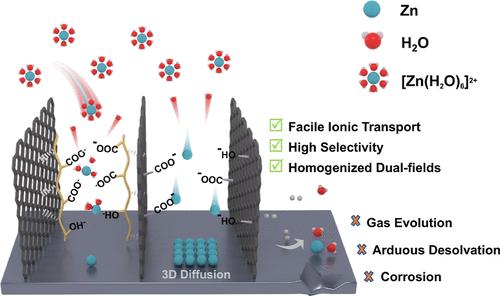
The longevity of aqueous batteries after scaling up is largely restricted by metal anodes (Zn, Al, and Mg). Parasitic reactions and uncontrolled dendrites dominate failure modes, especially at high current densities. To fully improve its reversibility, tailored surface chemistry and well-designed ion transport channels are simultaneously demanded. Here, inspired by the reticulated structure of the sea urchin shell, an aligned porous coating assembled from graphene oxide and sodium alginate is anchored on zinc anodes, termed a unidirectional ion sieve. As revealed by multiscale modeling and tests, this biomimetic layer produces a high surface area, creating low-tortuosity channels that greatly enhance transport kinetics and uniform distribution of ions. The introduction of an ion-conductive natural polymer enables a well-tuned hydration structure and ion selectivity, greatly alleviating aqueous side reactions. With the structural-functional integrity design, the decorated symmetrical cell presents reversible cycling for 1600 h, with a greatly reduced nucleation potential of 21 mV and high Coulombic efficiency. Aided by the Distribution of Relaxation Time tool, different electrochemical processes are deconvoluted to understand respective mechanisms, thereby providing a referable strategy for product scaling. In the end, a 7Ah Zn||VO2 pouch cell demonstrates stable cycling for over 500 cycles at 1 A·g–1, with the capacity retention over 90%.
期刊介绍:
ACS Nano, published monthly, serves as an international forum for comprehensive articles on nanoscience and nanotechnology research at the intersections of chemistry, biology, materials science, physics, and engineering. The journal fosters communication among scientists in these communities, facilitating collaboration, new research opportunities, and advancements through discoveries. ACS Nano covers synthesis, assembly, characterization, theory, and simulation of nanostructures, nanobiotechnology, nanofabrication, methods and tools for nanoscience and nanotechnology, and self- and directed-assembly. Alongside original research articles, it offers thorough reviews, perspectives on cutting-edge research, and discussions envisioning the future of nanoscience and nanotechnology.




 京公网安备 11010802042870号
京ICP备2023020795号-1
京公网安备 11010802042870号
京ICP备2023020795号-1

 分享
分享
 求助内容:
求助内容: 应助结果提醒方式:
 扫码关注我们
