Li Zhou, Rui Ou, Pu Zhang, Lin Shen, Kai Xu, Weijie Wang, Sanjida Afrin, Yange Luan, Jiaru Zhang, Guanghui Ren, Yinfen Cheng, Zhong Li, Guanyu Chen, Bao Yue Zhang, Jian Zhen Ou
{"title":"Tailorable Ultrathin Copper Oxysulfide for Room-Temperature, Reversible, and Selective Hydrogen Sulfide Sensing","authors":"Li Zhou, Rui Ou, Pu Zhang, Lin Shen, Kai Xu, Weijie Wang, Sanjida Afrin, Yange Luan, Jiaru Zhang, Guanghui Ren, Yinfen Cheng, Zhong Li, Guanyu Chen, Bao Yue Zhang, Jian Zhen Ou","doi":"10.1021/acssensors.4c03349","DOIUrl":null,"url":null,"abstract":"Accurate, low-cost, and energy-efficient detection of hydrogen sulfide (H<sub>2</sub>S) is vital for industries such as petroleum, natural gas, and wastewater treatment. While chemiresistive sensors are well suited for this purpose, traditional metal oxides typically require high operating temperatures (>100 °C) or external stimuli (e.g., UV light) for activation. In this work, we introduce two-dimensional (2D) copper oxysulfide nanoflakes (∼10 nm thick) as a novel material for room-temperature, reversible, and selective H<sub>2</sub>S sensing. These 2D copper oxysulfides, synthesized via the calcination of copper sulfide under both oxygen-deficient and oxygen-rich conditions, show significant changes in crystal structure and electronic band properties compared to copper sulfide while retaining p-type semiconducting behavior. This alteration enables efficient interfacial charge transfer with adsorbed H<sub>2</sub>S molecules. The oxygen-rich copper oxysulfide exhibits a response magnitude of 143% for 2 ppm of H<sub>2</sub>S in air at room temperature, with a linear response across concentrations ranging from 0.25 to 2 ppm. Furthermore, the sensor demonstrates complete reversibility, excellent selectivity, and high stability. This work presents a promising strategy for high-performance room-temperature H<sub>2</sub>S sensing utilizing metal oxysulfides as an emerging class of materials derived from metal oxides and sulfides.","PeriodicalId":24,"journal":{"name":"ACS Sensors","volume":"75 1","pages":""},"PeriodicalIF":9.1000,"publicationDate":"2025-04-08","publicationTypes":"Journal Article","fieldsOfStudy":null,"isOpenAccess":false,"openAccessPdf":"","citationCount":"0","resultStr":null,"platform":"Semanticscholar","paperid":null,"PeriodicalName":"ACS Sensors","FirstCategoryId":"92","ListUrlMain":"https://doi.org/10.1021/acssensors.4c03349","RegionNum":1,"RegionCategory":"化学","ArticlePicture":[],"TitleCN":null,"AbstractTextCN":null,"PMCID":null,"EPubDate":"","PubModel":"","JCR":"Q1","JCRName":"CHEMISTRY, ANALYTICAL","Score":null,"Total":0}
引用次数: 0
Abstract
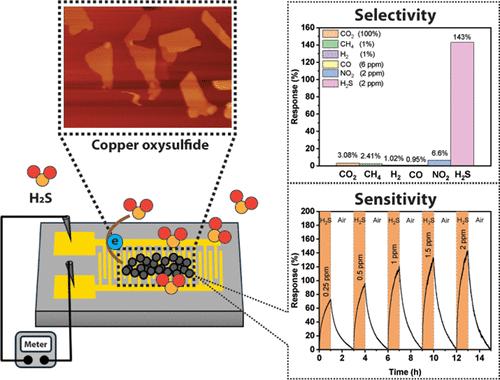
Accurate, low-cost, and energy-efficient detection of hydrogen sulfide (H2S) is vital for industries such as petroleum, natural gas, and wastewater treatment. While chemiresistive sensors are well suited for this purpose, traditional metal oxides typically require high operating temperatures (>100 °C) or external stimuli (e.g., UV light) for activation. In this work, we introduce two-dimensional (2D) copper oxysulfide nanoflakes (∼10 nm thick) as a novel material for room-temperature, reversible, and selective H2S sensing. These 2D copper oxysulfides, synthesized via the calcination of copper sulfide under both oxygen-deficient and oxygen-rich conditions, show significant changes in crystal structure and electronic band properties compared to copper sulfide while retaining p-type semiconducting behavior. This alteration enables efficient interfacial charge transfer with adsorbed H2S molecules. The oxygen-rich copper oxysulfide exhibits a response magnitude of 143% for 2 ppm of H2S in air at room temperature, with a linear response across concentrations ranging from 0.25 to 2 ppm. Furthermore, the sensor demonstrates complete reversibility, excellent selectivity, and high stability. This work presents a promising strategy for high-performance room-temperature H2S sensing utilizing metal oxysulfides as an emerging class of materials derived from metal oxides and sulfides.
期刊介绍:
ACS Sensors is a peer-reviewed research journal that focuses on the dissemination of new and original knowledge in the field of sensor science, particularly those that selectively sense chemical or biological species or processes. The journal covers a broad range of topics, including but not limited to biosensors, chemical sensors, gas sensors, intracellular sensors, single molecule sensors, cell chips, and microfluidic devices. It aims to publish articles that address conceptual advances in sensing technology applicable to various types of analytes or application papers that report on the use of existing sensing concepts in new ways or for new analytes.




 京公网安备 11010802042870号
京ICP备2023020795号-1
京公网安备 11010802042870号
京ICP备2023020795号-1

 分享
分享
 求助内容:
求助内容: 应助结果提醒方式:
 扫码关注我们
