Hyeran Cho, Geonhee Lee, Doyoon Kim, DongHyeon Kim, BeomJun Kim, YunJae Choi, Jeong-O. Lee, Gyu-Tae Kim
{"title":"New Dynamic Fingerprint in Derivative-Based Phase Space: Rapid Gas Sensing in Seconds","authors":"Hyeran Cho, Geonhee Lee, Doyoon Kim, DongHyeon Kim, BeomJun Kim, YunJae Choi, Jeong-O. Lee, Gyu-Tae Kim","doi":"10.1021/acssensors.4c03594","DOIUrl":null,"url":null,"abstract":"Many studies have focused on smart electronic noses combining machine learning and gas sensor arrays, but feature extraction for training has generally relied on dimensionality reduction techniques based on raw time-series data. These methods do not reflect the principles of sensor responses, limiting their applicability in diverse gas environments. In this study, we propose a new phase space, expressed through the first and second derivatives of dynamic response signals, to effectively characterize the nonlinear responses between gas sensors and gases. Sensing data transformed into a phase space showed unique patterns depending on the type and concentration of gases, and these were investigated for alkanes with various chain lengths (CH<sub>4</sub>, C<sub>3</sub>H<sub>8</sub>, C<sub>4</sub>H<sub>10</sub>). By applying these patterns as a preprocessing method, CNN-based gas identification machine learning achieved a high classification accuracy of 99.1% and a low concentration prediction error of 2.23 ppm using only a single sensor. Additionally, the algorithm was trained and validated across various regions of the phase space, identifying the minimum time and region required for simultaneous gas classification and concentration prediction. This study presents a novel strategy for the fast and accurate identification of gases within seconds and is expected to have significant scalability in diverse gas environments.","PeriodicalId":24,"journal":{"name":"ACS Sensors","volume":"60 1","pages":""},"PeriodicalIF":9.1000,"publicationDate":"2025-04-08","publicationTypes":"Journal Article","fieldsOfStudy":null,"isOpenAccess":false,"openAccessPdf":"","citationCount":"0","resultStr":null,"platform":"Semanticscholar","paperid":null,"PeriodicalName":"ACS Sensors","FirstCategoryId":"92","ListUrlMain":"https://doi.org/10.1021/acssensors.4c03594","RegionNum":1,"RegionCategory":"化学","ArticlePicture":[],"TitleCN":null,"AbstractTextCN":null,"PMCID":null,"EPubDate":"","PubModel":"","JCR":"Q1","JCRName":"CHEMISTRY, ANALYTICAL","Score":null,"Total":0}
引用次数: 0
Abstract
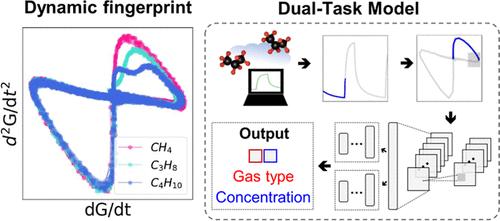
Many studies have focused on smart electronic noses combining machine learning and gas sensor arrays, but feature extraction for training has generally relied on dimensionality reduction techniques based on raw time-series data. These methods do not reflect the principles of sensor responses, limiting their applicability in diverse gas environments. In this study, we propose a new phase space, expressed through the first and second derivatives of dynamic response signals, to effectively characterize the nonlinear responses between gas sensors and gases. Sensing data transformed into a phase space showed unique patterns depending on the type and concentration of gases, and these were investigated for alkanes with various chain lengths (CH4, C3H8, C4H10). By applying these patterns as a preprocessing method, CNN-based gas identification machine learning achieved a high classification accuracy of 99.1% and a low concentration prediction error of 2.23 ppm using only a single sensor. Additionally, the algorithm was trained and validated across various regions of the phase space, identifying the minimum time and region required for simultaneous gas classification and concentration prediction. This study presents a novel strategy for the fast and accurate identification of gases within seconds and is expected to have significant scalability in diverse gas environments.
期刊介绍:
ACS Sensors is a peer-reviewed research journal that focuses on the dissemination of new and original knowledge in the field of sensor science, particularly those that selectively sense chemical or biological species or processes. The journal covers a broad range of topics, including but not limited to biosensors, chemical sensors, gas sensors, intracellular sensors, single molecule sensors, cell chips, and microfluidic devices. It aims to publish articles that address conceptual advances in sensing technology applicable to various types of analytes or application papers that report on the use of existing sensing concepts in new ways or for new analytes.



 京公网安备 11010802042870号
京ICP备2023020795号-1
京公网安备 11010802042870号
京ICP备2023020795号-1

 分享
分享
 求助内容:
求助内容: 应助结果提醒方式:
 扫码关注我们
