{"title":"Early Screening and Subtype Identification of High-Risk Lung Nodules via Breathprint by Graphene eNose Platform: A Large Cohort Study","authors":"Xingyu Zhu, Qiaofen Chen, Jiajing Sun, Lichen Zhang, Zhengwei Huang, Jingwei Xu, Haichuan Hu, Yuqi He, Zhao Chen, Xiaogang Ye, Xueyin Chen, Aotian Guo, Sheng Lu, Tao Shen, Jianmin Wu, Zhengfu He","doi":"10.1021/acssensors.5c00314","DOIUrl":null,"url":null,"abstract":"Early screening of individuals with high-risk lung nodules can significantly improve the prognosis of lung cancer patients, and accurate identification of lung nodule subtypes can provide guidance for medical treatment. Exhaled breath (EB) analysis via eNoses offers a quick and noninvasive approach, but current eNose technology lacks quality control and solid validation in large population studies. Herein, an eNose platform integrated with a metal ion-decorated graphene sensor array and a breath sampling accessory was established. EB samples from 427 healthy subjects and 2586 subjects with lung nodules, including various benign and malignant subtypes, were collected through the breath sampling accessory for quality control. The large-cohort clinical EB samples were analyzed by the eNose platform to acquire the cross-reactive resistance response. Breathprint analysis for high-risk lung nodules using SVM and age-matched training sets yielded strong and robust performance. Combined with baseline data, the model achieved an AUC of 0.93 (95% CI, 0.89–0.96) on the external test set, with 97% sensitivity and 73% specificity. Moreover, dimensionality reduction analysis of breathprints demonstrated separability across different lung nodule subtypes. This study demonstrates the reliability of the graphene eNose platform to identify high-risk lung nodules and classify lung nodule subtypes in a noninvasive and rapid method.","PeriodicalId":24,"journal":{"name":"ACS Sensors","volume":"60 1","pages":""},"PeriodicalIF":9.1000,"publicationDate":"2025-04-07","publicationTypes":"Journal Article","fieldsOfStudy":null,"isOpenAccess":false,"openAccessPdf":"","citationCount":"0","resultStr":null,"platform":"Semanticscholar","paperid":null,"PeriodicalName":"ACS Sensors","FirstCategoryId":"92","ListUrlMain":"https://doi.org/10.1021/acssensors.5c00314","RegionNum":1,"RegionCategory":"化学","ArticlePicture":[],"TitleCN":null,"AbstractTextCN":null,"PMCID":null,"EPubDate":"","PubModel":"","JCR":"Q1","JCRName":"CHEMISTRY, ANALYTICAL","Score":null,"Total":0}
引用次数: 0
Abstract
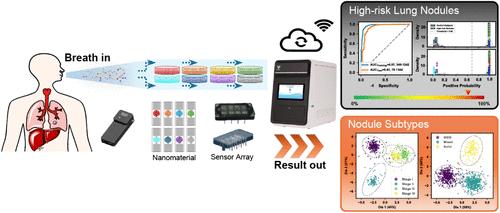
Early screening of individuals with high-risk lung nodules can significantly improve the prognosis of lung cancer patients, and accurate identification of lung nodule subtypes can provide guidance for medical treatment. Exhaled breath (EB) analysis via eNoses offers a quick and noninvasive approach, but current eNose technology lacks quality control and solid validation in large population studies. Herein, an eNose platform integrated with a metal ion-decorated graphene sensor array and a breath sampling accessory was established. EB samples from 427 healthy subjects and 2586 subjects with lung nodules, including various benign and malignant subtypes, were collected through the breath sampling accessory for quality control. The large-cohort clinical EB samples were analyzed by the eNose platform to acquire the cross-reactive resistance response. Breathprint analysis for high-risk lung nodules using SVM and age-matched training sets yielded strong and robust performance. Combined with baseline data, the model achieved an AUC of 0.93 (95% CI, 0.89–0.96) on the external test set, with 97% sensitivity and 73% specificity. Moreover, dimensionality reduction analysis of breathprints demonstrated separability across different lung nodule subtypes. This study demonstrates the reliability of the graphene eNose platform to identify high-risk lung nodules and classify lung nodule subtypes in a noninvasive and rapid method.
期刊介绍:
ACS Sensors is a peer-reviewed research journal that focuses on the dissemination of new and original knowledge in the field of sensor science, particularly those that selectively sense chemical or biological species or processes. The journal covers a broad range of topics, including but not limited to biosensors, chemical sensors, gas sensors, intracellular sensors, single molecule sensors, cell chips, and microfluidic devices. It aims to publish articles that address conceptual advances in sensing technology applicable to various types of analytes or application papers that report on the use of existing sensing concepts in new ways or for new analytes.




 京公网安备 11010802042870号
京ICP备2023020795号-1
京公网安备 11010802042870号
京ICP备2023020795号-1

 分享
分享
 求助内容:
求助内容: 应助结果提醒方式:
 扫码关注我们
