Nina Prakash, Paul Gasper, Francois Usseglio-Viretta
{"title":"ExpertSegmentation: Segmentation for microscopy with domain-informed targets via custom loss","authors":"Nina Prakash, Paul Gasper, Francois Usseglio-Viretta","doi":"10.1016/j.actamat.2025.120993","DOIUrl":null,"url":null,"abstract":"<div><div>Semantic segmentation is a critical step in microscopy analysis to enable quantification of sample properties or to run structurally-resolved physics-based simulations. Machine learning has emerged as a viable alternative to traditional segmentation approaches like thresholding or watershed segmentation due to its noise tolerance and ability to perform shape- and texture-based segmentation. However, traditional methods still maintain an advantage by allowing for the explicit incorporation of domain knowledge that may be known a priori or measured ex situ, for example, enforcing that the volume fractions of phases from the segmentation match known values. In comparison, machine learning methods for semantic segmentation in the materials domain, which are limited by sparsely available hand-labels for model training, cannot explicitly incorporate domain knowledge into the classification problem, limiting their trustability and explainability. Here, we develop new regularization loss terms that incorporate domain knowledge into the training of a tree-based machine learning classification model, and demonstrate that the predicted segmentation can be tuned without modifying the training labels. The loss terms presented here enable targeting of specific volume fractions for the predicted phases as well as maximizing or minimizing the connectivity of a target phase. This method provides materials researchers additional knobs to tune the output of a machine learning-based segmentation model, leveraging the capabilities of machine-learned segmentation models while enabling domain knowledge to be explicitly incorporated into the model training process.</div></div>","PeriodicalId":238,"journal":{"name":"Acta Materialia","volume":"291 ","pages":"Article 120993"},"PeriodicalIF":9.3000,"publicationDate":"2025-06-01","publicationTypes":"Journal Article","fieldsOfStudy":null,"isOpenAccess":false,"openAccessPdf":"","citationCount":"0","resultStr":null,"platform":"Semanticscholar","paperid":null,"PeriodicalName":"Acta Materialia","FirstCategoryId":"88","ListUrlMain":"https://www.sciencedirect.com/science/article/pii/S1359645425002848","RegionNum":1,"RegionCategory":"材料科学","ArticlePicture":[],"TitleCN":null,"AbstractTextCN":null,"PMCID":null,"EPubDate":"2025/4/7 0:00:00","PubModel":"Epub","JCR":"Q1","JCRName":"MATERIALS SCIENCE, MULTIDISCIPLINARY","Score":null,"Total":0}
引用次数: 0
Abstract
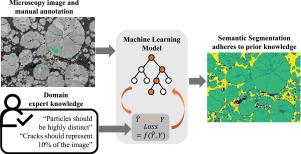
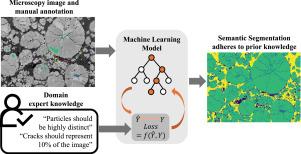
Semantic segmentation is a critical step in microscopy analysis to enable quantification of sample properties or to run structurally-resolved physics-based simulations. Machine learning has emerged as a viable alternative to traditional segmentation approaches like thresholding or watershed segmentation due to its noise tolerance and ability to perform shape- and texture-based segmentation. However, traditional methods still maintain an advantage by allowing for the explicit incorporation of domain knowledge that may be known a priori or measured ex situ, for example, enforcing that the volume fractions of phases from the segmentation match known values. In comparison, machine learning methods for semantic segmentation in the materials domain, which are limited by sparsely available hand-labels for model training, cannot explicitly incorporate domain knowledge into the classification problem, limiting their trustability and explainability. Here, we develop new regularization loss terms that incorporate domain knowledge into the training of a tree-based machine learning classification model, and demonstrate that the predicted segmentation can be tuned without modifying the training labels. The loss terms presented here enable targeting of specific volume fractions for the predicted phases as well as maximizing or minimizing the connectivity of a target phase. This method provides materials researchers additional knobs to tune the output of a machine learning-based segmentation model, leveraging the capabilities of machine-learned segmentation models while enabling domain knowledge to be explicitly incorporated into the model training process.
期刊介绍:
Acta Materialia serves as a platform for publishing full-length, original papers and commissioned overviews that contribute to a profound understanding of the correlation between the processing, structure, and properties of inorganic materials. The journal seeks papers with high impact potential or those that significantly propel the field forward. The scope includes the atomic and molecular arrangements, chemical and electronic structures, and microstructure of materials, focusing on their mechanical or functional behavior across all length scales, including nanostructures.



 京公网安备 11010802042870号
京ICP备2023020795号-1
京公网安备 11010802042870号
京ICP备2023020795号-1

 分享
分享
 求助内容:
求助内容: 应助结果提醒方式:
 扫码关注我们
