Boxin Wei , Mengchao Niu , Zheng Cai , Jin Xu , Cheng Sun , Wei Wang , Zhongji Sun , Tangqing Wu , Upadrasta Ramamurty
{"title":"Cu-rich nano precipitates simultaneously enhance the tensile properties, antibacterial efficacy, and corrosion resistance of ultra-high strength steel","authors":"Boxin Wei , Mengchao Niu , Zheng Cai , Jin Xu , Cheng Sun , Wei Wang , Zhongji Sun , Tangqing Wu , Upadrasta Ramamurty","doi":"10.1016/j.actamat.2025.121026","DOIUrl":null,"url":null,"abstract":"<div><div>Ultra-high strength steels with exceptional mechanical properties and corrosion resistance are increasingly critical in energy, aerospace, and biomedical applications. This study introduces a novel antibacterial Fe‒Ni‒Co‒Cr‒Ti‒Mo ultra-high strength steel, enhanced with Cu alloying, achieving a strength of approximately 1.8 GPa. We conducted a comprehensive investigation into the effects of Cu on tensile properties, antibacterial efficacy, and corrosion resistance at the atomic scale. Our findings reveal that Cu addition promotes the co-precipitation of Cu-rich and Ni<sub>3</sub>Ti nano precipitates, which not only enhances the strength of the steel, but also provides heterogeneous nucleation sites for the reversion of austenite, resulting in improved uniform elongation. Moreover, the high density of Cu-rich precipitates disrupts the passive layer on the steel surface, facilitating the release of Cu²⁺ ions that penetrate and damage bacterial colonies, demonstrating effectiveness in reducing sulfate-reducing bacteria (SRB) related degradation. Additionally, the presence of Cu enhances the corrosion resistance by inhibiting the formation of (Cr,Mo)-enriched clusters, which promotes the development of a more continuous and adherent passive layer to mitigate localized pitting corrosion caused by SRB. These findings highlight the triple roles of Cu-rich nano precipitates in enhancing tensile properties, antibacterial efficacy, and corrosion resistance, presenting a promising strategy for extending the durability of steels in SRB-prone industrial environments.</div></div>","PeriodicalId":238,"journal":{"name":"Acta Materialia","volume":"292 ","pages":"Article 121026"},"PeriodicalIF":9.3000,"publicationDate":"2025-04-08","publicationTypes":"Journal Article","fieldsOfStudy":null,"isOpenAccess":false,"openAccessPdf":"","citationCount":"0","resultStr":null,"platform":"Semanticscholar","paperid":null,"PeriodicalName":"Acta Materialia","FirstCategoryId":"88","ListUrlMain":"https://www.sciencedirect.com/science/article/pii/S1359645425003167","RegionNum":1,"RegionCategory":"材料科学","ArticlePicture":[],"TitleCN":null,"AbstractTextCN":null,"PMCID":null,"EPubDate":"","PubModel":"","JCR":"Q1","JCRName":"MATERIALS SCIENCE, MULTIDISCIPLINARY","Score":null,"Total":0}
引用次数: 0
Abstract
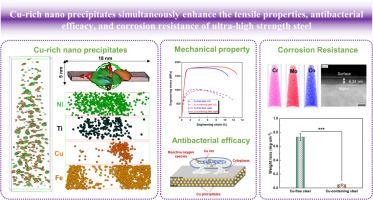
Ultra-high strength steels with exceptional mechanical properties and corrosion resistance are increasingly critical in energy, aerospace, and biomedical applications. This study introduces a novel antibacterial Fe‒Ni‒Co‒Cr‒Ti‒Mo ultra-high strength steel, enhanced with Cu alloying, achieving a strength of approximately 1.8 GPa. We conducted a comprehensive investigation into the effects of Cu on tensile properties, antibacterial efficacy, and corrosion resistance at the atomic scale. Our findings reveal that Cu addition promotes the co-precipitation of Cu-rich and Ni3Ti nano precipitates, which not only enhances the strength of the steel, but also provides heterogeneous nucleation sites for the reversion of austenite, resulting in improved uniform elongation. Moreover, the high density of Cu-rich precipitates disrupts the passive layer on the steel surface, facilitating the release of Cu²⁺ ions that penetrate and damage bacterial colonies, demonstrating effectiveness in reducing sulfate-reducing bacteria (SRB) related degradation. Additionally, the presence of Cu enhances the corrosion resistance by inhibiting the formation of (Cr,Mo)-enriched clusters, which promotes the development of a more continuous and adherent passive layer to mitigate localized pitting corrosion caused by SRB. These findings highlight the triple roles of Cu-rich nano precipitates in enhancing tensile properties, antibacterial efficacy, and corrosion resistance, presenting a promising strategy for extending the durability of steels in SRB-prone industrial environments.
期刊介绍:
Acta Materialia serves as a platform for publishing full-length, original papers and commissioned overviews that contribute to a profound understanding of the correlation between the processing, structure, and properties of inorganic materials. The journal seeks papers with high impact potential or those that significantly propel the field forward. The scope includes the atomic and molecular arrangements, chemical and electronic structures, and microstructure of materials, focusing on their mechanical or functional behavior across all length scales, including nanostructures.



 京公网安备 11010802042870号
京ICP备2023020795号-1
京公网安备 11010802042870号
京ICP备2023020795号-1

 分享
分享
 求助内容:
求助内容: 应助结果提醒方式:
 扫码关注我们
