Yang Liu, Chunling Wang, Pengfei Wei, Chengzhi Yang, Xiaoyu Cheng, Yinlong Zhang, Guangjun Nie
{"title":"Mesoporous Silica Nanotraps for Mitigating Bleeding Risk From ‘Irreversible’ Antiplatelet Drugs","authors":"Yang Liu, Chunling Wang, Pengfei Wei, Chengzhi Yang, Xiaoyu Cheng, Yinlong Zhang, Guangjun Nie","doi":"10.1002/adma.202501576","DOIUrl":null,"url":null,"abstract":"<p>The severe bleeding complications of long-term antiplatelet therapy limit its broader application in the treatment or prevention of thrombosis-associated diseases. This risk is particularly serious when facing emergency surgeries where rapid restoration of normal platelet function is required. Timely reversal of the effects of antiplatelet agents becomes crucial in such scenarios. Despite the widespread use of clopidogrel and prasugrel for their potent antiplatelet activity, the absence of specific and effective reversal agents remains a notable challenge. The pharmacological activity of clopidogrel and prasugrel is mediated by sulfhydryl-containing active metabolites, which form disulfide bonds with P2Y<sub>12</sub> receptors on the surface of platelets to inhibit their aggregation. Taking advantage of this action mechanism of these “irreversible” antiplatelet drugs, click chemistry-functionalized mesoporous silica (SiO<sub>2</sub>-Mal) nanotraps are fabricated to capture the antiplatelet drugs' active metabolites and restore hemostasis. Subsequently, a comprehensive assessment of the effectiveness and safety of the SiO<sub>2</sub>-Mal nanotraps is conducted using mouse, rabbit, and pig animal models, highlighting their potential application as a functional reversal agent for clinically relevant thienopyridine antiplatelet drugs, believed until now to be irreversible in their inhibition of platelet activity.</p>","PeriodicalId":114,"journal":{"name":"Advanced Materials","volume":"37 24","pages":""},"PeriodicalIF":26.8000,"publicationDate":"2025-04-08","publicationTypes":"Journal Article","fieldsOfStudy":null,"isOpenAccess":false,"openAccessPdf":"","citationCount":"0","resultStr":null,"platform":"Semanticscholar","paperid":null,"PeriodicalName":"Advanced Materials","FirstCategoryId":"88","ListUrlMain":"https://advanced.onlinelibrary.wiley.com/doi/10.1002/adma.202501576","RegionNum":1,"RegionCategory":"材料科学","ArticlePicture":[],"TitleCN":null,"AbstractTextCN":null,"PMCID":null,"EPubDate":"","PubModel":"","JCR":"Q1","JCRName":"CHEMISTRY, MULTIDISCIPLINARY","Score":null,"Total":0}
引用次数: 0
Abstract
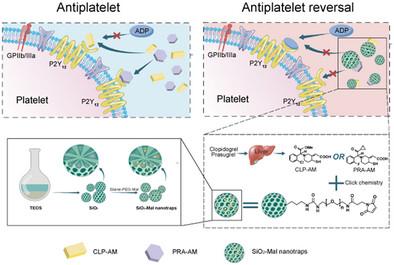
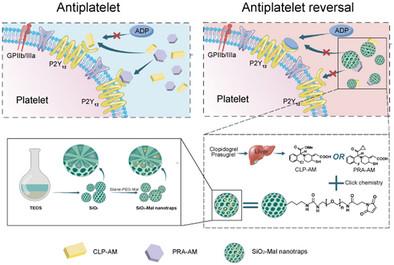
The severe bleeding complications of long-term antiplatelet therapy limit its broader application in the treatment or prevention of thrombosis-associated diseases. This risk is particularly serious when facing emergency surgeries where rapid restoration of normal platelet function is required. Timely reversal of the effects of antiplatelet agents becomes crucial in such scenarios. Despite the widespread use of clopidogrel and prasugrel for their potent antiplatelet activity, the absence of specific and effective reversal agents remains a notable challenge. The pharmacological activity of clopidogrel and prasugrel is mediated by sulfhydryl-containing active metabolites, which form disulfide bonds with P2Y12 receptors on the surface of platelets to inhibit their aggregation. Taking advantage of this action mechanism of these “irreversible” antiplatelet drugs, click chemistry-functionalized mesoporous silica (SiO2-Mal) nanotraps are fabricated to capture the antiplatelet drugs' active metabolites and restore hemostasis. Subsequently, a comprehensive assessment of the effectiveness and safety of the SiO2-Mal nanotraps is conducted using mouse, rabbit, and pig animal models, highlighting their potential application as a functional reversal agent for clinically relevant thienopyridine antiplatelet drugs, believed until now to be irreversible in their inhibition of platelet activity.
期刊介绍:
Advanced Materials, one of the world's most prestigious journals and the foundation of the Advanced portfolio, is the home of choice for best-in-class materials science for more than 30 years. Following this fast-growing and interdisciplinary field, we are considering and publishing the most important discoveries on any and all materials from materials scientists, chemists, physicists, engineers as well as health and life scientists and bringing you the latest results and trends in modern materials-related research every week.






 京公网安备 11010802042870号
京ICP备2023020795号-1
京公网安备 11010802042870号
京ICP备2023020795号-1

 分享
分享
 求助内容:
求助内容: 应助结果提醒方式:
 扫码关注我们
