{"title":"Demulsification performance of oil-in-water emulsions utilizing bidirectional pulse electric field and fiber media","authors":"Xuan Bai , Yuntao Liu , Yong Kang","doi":"10.1016/j.seppur.2025.132923","DOIUrl":null,"url":null,"abstract":"<div><div>The method of utilizing a bidirectional pulsed electric field (BPEF) coupled with fiber aggregation has proven effective for demulsifying oil-in-water (O/W) emulsions. Nevertheless, the interaction between oil droplets and fibers in coupled fields has not been sufficiently investigated. This article innovatively combines BPEF with filament fibers. It employs COMSOL software to numerically simulate the migration, aggregation, and adhesion of emulsified oil droplets influenced by both fluid–structure interaction (FSI) and electric fields. The effectiveness of this combined demulsification method was validated through laboratory experiments. Numerical simulation results indicate that hydrophilic aggregated fibers facilitate oil droplets aggregation, while non-uniform electric fields accelerate the colliding and migration of the oil droplets. Analysis of simulation results revealed the demulsification mechanism, demonstrating that oil droplets migrate and aggregate into larger droplets in the combined operation of electrical forces and FSI fields. Fibers reduce the migration distance of oil droplets, diminishing their hardness at the oil–water contact in the novel integrated electric field. Experimental results show that, under the 0.5 % filling rate of viscose fiber, and electric field of 400 V, 50 Hz and 30 % duty cycle, the oil content can be reduced from 4500 mg/L to 5.3 mg/L, achieving a 3.22 NTU turbidity and a demulsification efficiency of 99.88 %. The theoretical characterization and procedure enhancement of electrochemical demulsification for removing oil would greatly benefit from this work.</div></div>","PeriodicalId":427,"journal":{"name":"Separation and Purification Technology","volume":"367 ","pages":"Article 132923"},"PeriodicalIF":9.0000,"publicationDate":"2025-09-07","publicationTypes":"Journal Article","fieldsOfStudy":null,"isOpenAccess":false,"openAccessPdf":"","citationCount":"0","resultStr":null,"platform":"Semanticscholar","paperid":null,"PeriodicalName":"Separation and Purification Technology","FirstCategoryId":"5","ListUrlMain":"https://www.sciencedirect.com/science/article/pii/S1383586625015205","RegionNum":1,"RegionCategory":"工程技术","ArticlePicture":[],"TitleCN":null,"AbstractTextCN":null,"PMCID":null,"EPubDate":"2025/4/8 0:00:00","PubModel":"Epub","JCR":"Q1","JCRName":"ENGINEERING, CHEMICAL","Score":null,"Total":0}
引用次数: 0
Abstract
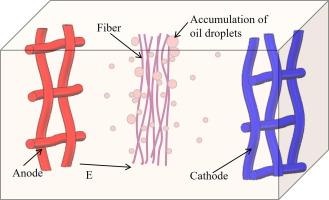
The method of utilizing a bidirectional pulsed electric field (BPEF) coupled with fiber aggregation has proven effective for demulsifying oil-in-water (O/W) emulsions. Nevertheless, the interaction between oil droplets and fibers in coupled fields has not been sufficiently investigated. This article innovatively combines BPEF with filament fibers. It employs COMSOL software to numerically simulate the migration, aggregation, and adhesion of emulsified oil droplets influenced by both fluid–structure interaction (FSI) and electric fields. The effectiveness of this combined demulsification method was validated through laboratory experiments. Numerical simulation results indicate that hydrophilic aggregated fibers facilitate oil droplets aggregation, while non-uniform electric fields accelerate the colliding and migration of the oil droplets. Analysis of simulation results revealed the demulsification mechanism, demonstrating that oil droplets migrate and aggregate into larger droplets in the combined operation of electrical forces and FSI fields. Fibers reduce the migration distance of oil droplets, diminishing their hardness at the oil–water contact in the novel integrated electric field. Experimental results show that, under the 0.5 % filling rate of viscose fiber, and electric field of 400 V, 50 Hz and 30 % duty cycle, the oil content can be reduced from 4500 mg/L to 5.3 mg/L, achieving a 3.22 NTU turbidity and a demulsification efficiency of 99.88 %. The theoretical characterization and procedure enhancement of electrochemical demulsification for removing oil would greatly benefit from this work.
期刊介绍:
Separation and Purification Technology is a premier journal committed to sharing innovative methods for separation and purification in chemical and environmental engineering, encompassing both homogeneous solutions and heterogeneous mixtures. Our scope includes the separation and/or purification of liquids, vapors, and gases, as well as carbon capture and separation techniques. However, it's important to note that methods solely intended for analytical purposes are not within the scope of the journal. Additionally, disciplines such as soil science, polymer science, and metallurgy fall outside the purview of Separation and Purification Technology. Join us in advancing the field of separation and purification methods for sustainable solutions in chemical and environmental engineering.




 京公网安备 11010802042870号
京ICP备2023020795号-1
京公网安备 11010802042870号
京ICP备2023020795号-1

 分享
分享
 求助内容:
求助内容: 应助结果提醒方式:
 扫码关注我们
