Green extraction of pure aluminum from coarse AlSiCu alloys via centrifugal separation under isothermal semi-solid conditions: A novel upcycling strategy
Bolin Sun, Lei Guo, Zhe Wang, Xi Lan, Zhancheng Guo
{"title":"Green extraction of pure aluminum from coarse AlSiCu alloys via centrifugal separation under isothermal semi-solid conditions: A novel upcycling strategy","authors":"Bolin Sun, Lei Guo, Zhe Wang, Xi Lan, Zhancheng Guo","doi":"10.1016/j.seppur.2025.132920","DOIUrl":null,"url":null,"abstract":"<div><div>The aluminum industry is facing a “dead metal” crisis, primarily due to the unsustainable aluminum cycle. With the rapid rise of electric vehicles, the demand for cast aluminum has gradually failed to support the continued accumulation of “down-cycling” of aluminum scraps, at which point the upcycling of low-grade aluminum has become a new challenge to solve the crisis. To this end, this paper introduces a new technique which combines semi-solid isothermal treatment with centrifugal separation to directly extract industrial-grade pure aluminum from coarse AlSiCu alloys. This method is a new upgrading strategy that does not involve secondary pollution. Firstly, excess precipitated impurities were removed from the melt by centrifugal filtration, where the impurity phases accumulated at grain boundaries. Subsequently, under centrifugal force, the removal of dissolved elements was promoted by controlling the liquefaction and separation of intergranular phases during isothermal treatment, and ultimately high-purity aluminum with Al content up to 99.4 wt% was successfully obtained after secondary purification. In addition, more high-value refined silicon was easily extracted from the filtrates. Based on this, an efficient recycling process was designed, achieving an extraction efficiency of over 92% for metallic Al. Given its promising application prospects in recycled aluminum industry, this process is expected to be a more economical and green option for solving “dead metal” crisis in the future.</div></div>","PeriodicalId":427,"journal":{"name":"Separation and Purification Technology","volume":"367 ","pages":"Article 132920"},"PeriodicalIF":9.0000,"publicationDate":"2025-04-08","publicationTypes":"Journal Article","fieldsOfStudy":null,"isOpenAccess":false,"openAccessPdf":"","citationCount":"0","resultStr":null,"platform":"Semanticscholar","paperid":null,"PeriodicalName":"Separation and Purification Technology","FirstCategoryId":"5","ListUrlMain":"https://www.sciencedirect.com/science/article/pii/S1383586625015175","RegionNum":1,"RegionCategory":"工程技术","ArticlePicture":[],"TitleCN":null,"AbstractTextCN":null,"PMCID":null,"EPubDate":"","PubModel":"","JCR":"Q1","JCRName":"ENGINEERING, CHEMICAL","Score":null,"Total":0}
引用次数: 0
Abstract
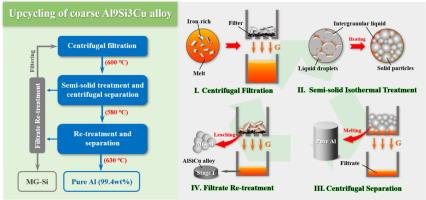
The aluminum industry is facing a “dead metal” crisis, primarily due to the unsustainable aluminum cycle. With the rapid rise of electric vehicles, the demand for cast aluminum has gradually failed to support the continued accumulation of “down-cycling” of aluminum scraps, at which point the upcycling of low-grade aluminum has become a new challenge to solve the crisis. To this end, this paper introduces a new technique which combines semi-solid isothermal treatment with centrifugal separation to directly extract industrial-grade pure aluminum from coarse AlSiCu alloys. This method is a new upgrading strategy that does not involve secondary pollution. Firstly, excess precipitated impurities were removed from the melt by centrifugal filtration, where the impurity phases accumulated at grain boundaries. Subsequently, under centrifugal force, the removal of dissolved elements was promoted by controlling the liquefaction and separation of intergranular phases during isothermal treatment, and ultimately high-purity aluminum with Al content up to 99.4 wt% was successfully obtained after secondary purification. In addition, more high-value refined silicon was easily extracted from the filtrates. Based on this, an efficient recycling process was designed, achieving an extraction efficiency of over 92% for metallic Al. Given its promising application prospects in recycled aluminum industry, this process is expected to be a more economical and green option for solving “dead metal” crisis in the future.
期刊介绍:
Separation and Purification Technology is a premier journal committed to sharing innovative methods for separation and purification in chemical and environmental engineering, encompassing both homogeneous solutions and heterogeneous mixtures. Our scope includes the separation and/or purification of liquids, vapors, and gases, as well as carbon capture and separation techniques. However, it's important to note that methods solely intended for analytical purposes are not within the scope of the journal. Additionally, disciplines such as soil science, polymer science, and metallurgy fall outside the purview of Separation and Purification Technology. Join us in advancing the field of separation and purification methods for sustainable solutions in chemical and environmental engineering.





 京公网安备 11010802042870号
京ICP备2023020795号-1
京公网安备 11010802042870号
京ICP备2023020795号-1

 分享
分享
 求助内容:
求助内容: 应助结果提醒方式:
 扫码关注我们
