Di Zhang, Lizhi Liu, Caixia Li, Yiliang Zhang, Huiyong Wang, Juan Du, Baozhan Zheng, Yong Guo
{"title":"Efficient Photoelectrocatalytic Degradation of Tetracycline on the Ov-TiO2 Anode Coupled with Cathodic Oxygen Reduction to Produce H2O2","authors":"Di Zhang, Lizhi Liu, Caixia Li, Yiliang Zhang, Huiyong Wang, Juan Du, Baozhan Zheng, Yong Guo","doi":"10.1021/acs.iecr.5c00276","DOIUrl":null,"url":null,"abstract":"Electrochemical O<sub>2</sub> reduction through a two-electron process (2e<sup>–</sup> ORR) to produce H<sub>2</sub>O<sub>2</sub> <i>on-site</i> has attracted more attention, but how to make full use of the anodic reaction and investigate its synergistic effect on the 2e<sup>–</sup>ORR remains to be further studied. Herein, a coupled electrochemical system was constructed in an H-type cell using TiO<sub>2</sub> nanotubes with oxygen vacancy (Ov-TiO<sub>2</sub>) and P-doped porous carbon (P-MC) as the anode and cathode, respectively, on which the degradation of tetracycline (TC) and <i>on-site</i> H<sub>2</sub>O<sub>2</sub> production occurred simultaneously. The results show that Ov-TiO<sub>2</sub> exhibits excellent photoelectrocatalytic (PEC) activity for TC degradationin an electrolyte containing chloride ions (Cl<sup>–</sup>), and more than 95% of TC can be efficiently degraded within 8 min. Interestingly, an enhanced 2e<sup>–</sup> ORR performance is achieved on the cathode with a higher H<sub>2</sub>O<sub>2</sub> yield of 5.23 mol h<sup>–1</sup> g<sub>cat</sub><sup>–1</sup> (Faraday efficiency of >90%), which is 5.13 times higher than that using TiO<sub>2</sub> as the anode (1.02 mol h<sup>–1</sup> g<sub>cat</sub><sup>–1</sup>), indicating that Ov and illumination on TiO<sub>2</sub> can not only promote the degradation of TC but also accelerate the 2e<sup>–</sup> ORR on the cathode. The mechanism of this coupled system was also investigated. Based on these findings, the anodic cell has been successfully used for the efficient treatment of other wastes (dye and antibiotics) and as an effective bactericide. In a word, this work opens an avenue to develop highly efficient electrochemical system both for organic pollutant treatment on the anode and <i>on-site</i> H<sub>2</sub>O<sub>2</sub> production on the cathode.","PeriodicalId":39,"journal":{"name":"Industrial & Engineering Chemistry Research","volume":"39 1","pages":""},"PeriodicalIF":3.9000,"publicationDate":"2025-04-08","publicationTypes":"Journal Article","fieldsOfStudy":null,"isOpenAccess":false,"openAccessPdf":"","citationCount":"0","resultStr":null,"platform":"Semanticscholar","paperid":null,"PeriodicalName":"Industrial & Engineering Chemistry Research","FirstCategoryId":"5","ListUrlMain":"https://doi.org/10.1021/acs.iecr.5c00276","RegionNum":3,"RegionCategory":"工程技术","ArticlePicture":[],"TitleCN":null,"AbstractTextCN":null,"PMCID":null,"EPubDate":"","PubModel":"","JCR":"Q2","JCRName":"ENGINEERING, CHEMICAL","Score":null,"Total":0}
引用次数: 0
Abstract
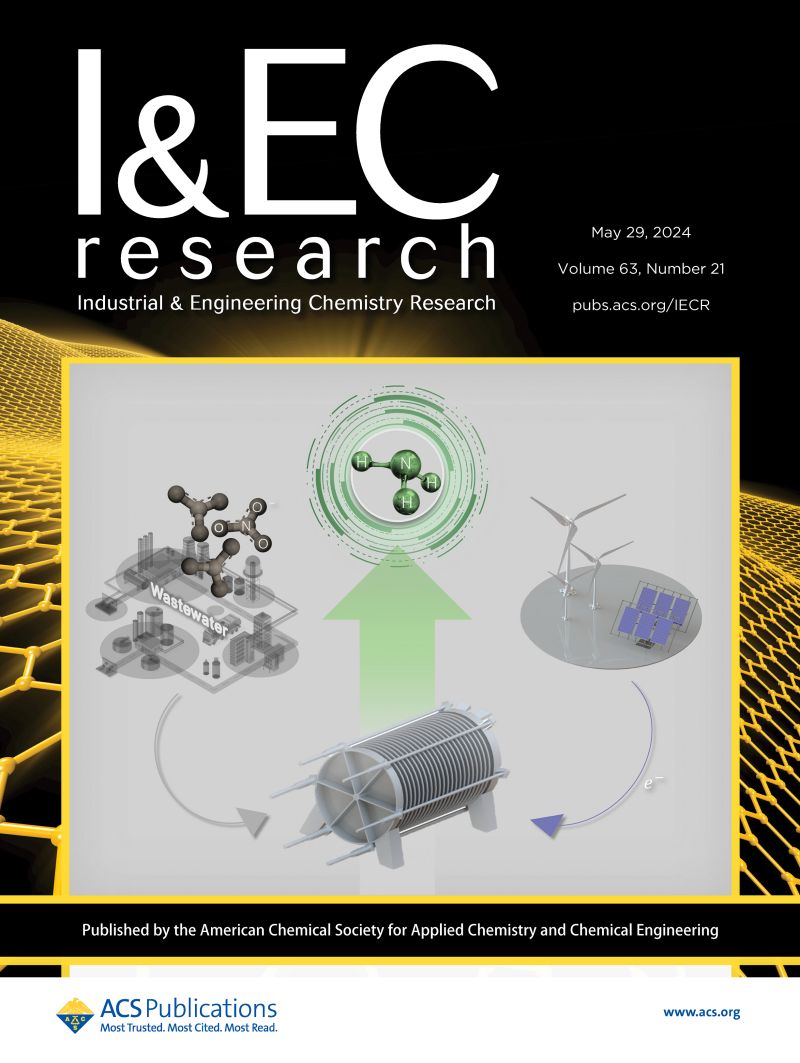
Electrochemical O2 reduction through a two-electron process (2e– ORR) to produce H2O2on-site has attracted more attention, but how to make full use of the anodic reaction and investigate its synergistic effect on the 2e–ORR remains to be further studied. Herein, a coupled electrochemical system was constructed in an H-type cell using TiO2 nanotubes with oxygen vacancy (Ov-TiO2) and P-doped porous carbon (P-MC) as the anode and cathode, respectively, on which the degradation of tetracycline (TC) and on-site H2O2 production occurred simultaneously. The results show that Ov-TiO2 exhibits excellent photoelectrocatalytic (PEC) activity for TC degradationin an electrolyte containing chloride ions (Cl–), and more than 95% of TC can be efficiently degraded within 8 min. Interestingly, an enhanced 2e– ORR performance is achieved on the cathode with a higher H2O2 yield of 5.23 mol h–1 gcat–1 (Faraday efficiency of >90%), which is 5.13 times higher than that using TiO2 as the anode (1.02 mol h–1 gcat–1), indicating that Ov and illumination on TiO2 can not only promote the degradation of TC but also accelerate the 2e– ORR on the cathode. The mechanism of this coupled system was also investigated. Based on these findings, the anodic cell has been successfully used for the efficient treatment of other wastes (dye and antibiotics) and as an effective bactericide. In a word, this work opens an avenue to develop highly efficient electrochemical system both for organic pollutant treatment on the anode and on-site H2O2 production on the cathode.
期刊介绍:
ndustrial & Engineering Chemistry, with variations in title and format, has been published since 1909 by the American Chemical Society. Industrial & Engineering Chemistry Research is a weekly publication that reports industrial and academic research in the broad fields of applied chemistry and chemical engineering with special focus on fundamentals, processes, and products.




 京公网安备 11010802042870号
京ICP备2023020795号-1
京公网安备 11010802042870号
京ICP备2023020795号-1

 分享
分享
 求助内容:
求助内容: 应助结果提醒方式:
 扫码关注我们
