{"title":"Photofragmentation of Ciprofloxacin: An Orchestrated Trident Attack Employing Activated Carbon Nanodot-Decorated Ti-Doped WO3 Nanodices","authors":"Suprakash Rabha, Suvankar Deka, Biswajit Choudhury, Arundhuti Devi","doi":"10.1021/acs.iecr.5c00209","DOIUrl":null,"url":null,"abstract":"Escalating infiltration of pharmaceutical pollutants into aquatic systems, particularly in freshwater and marine environments, has shot an arrow of menace at flora and fauna. In response, our study emphasizes efficient photocatalytic degradation of ciprofloxacin (CIP) using hydrothermally synthesized activated carbon nanodots (ACNDs)-decorated Ti-doped WO<sub>3</sub> nanodices in both freshwater (FW) and simulated seawater (SSW) environments. XRD and Raman confirm the formation of a monoclinic phase, whereas SEM reveals the distinctive nanodice morphology of WO<sub>3</sub>. Under 1 Sun illumination, Ti-WO<sub>3</sub> ACNDs exhibited an exceptional degradation of CIP (93.83%) within 60 min, outperforming Ti-WO<sub>3</sub> and WO<sub>3</sub> samples. Intriguingly, under the SSW environment, Ti-WO<sub>3</sub> ACNDs manifested a degradation percentage of 85.10 and 59.61% at 5 and 10 ppm concentrations of CIP, respectively. Furthermore, the incorporation of ACNDs profoundly augments the donor density up to 27.27 folds in comparison to that of the Ti-doped WO<sub>3</sub>. LC-MS chromatograms convincingly depict the successful defragmentation of CIP, indicating its transformation into less harmful products. Comprehensibly, our work highlights the pivotal role of ACNDs as “electron sinks” and offers mechanistic insights into accelerated CIP degradation in both freshwater and simulated seawater conditions spearheaded through a trident attack mechanism initiated by <sup>•</sup>OH radicals.","PeriodicalId":39,"journal":{"name":"Industrial & Engineering Chemistry Research","volume":"92 1","pages":""},"PeriodicalIF":3.9000,"publicationDate":"2025-04-08","publicationTypes":"Journal Article","fieldsOfStudy":null,"isOpenAccess":false,"openAccessPdf":"","citationCount":"0","resultStr":null,"platform":"Semanticscholar","paperid":null,"PeriodicalName":"Industrial & Engineering Chemistry Research","FirstCategoryId":"5","ListUrlMain":"https://doi.org/10.1021/acs.iecr.5c00209","RegionNum":3,"RegionCategory":"工程技术","ArticlePicture":[],"TitleCN":null,"AbstractTextCN":null,"PMCID":null,"EPubDate":"","PubModel":"","JCR":"Q2","JCRName":"ENGINEERING, CHEMICAL","Score":null,"Total":0}
引用次数: 0
Abstract
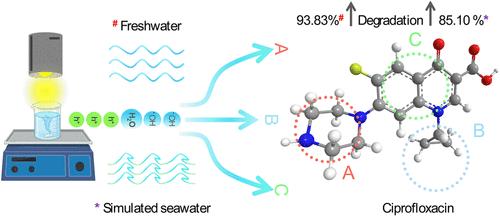
Escalating infiltration of pharmaceutical pollutants into aquatic systems, particularly in freshwater and marine environments, has shot an arrow of menace at flora and fauna. In response, our study emphasizes efficient photocatalytic degradation of ciprofloxacin (CIP) using hydrothermally synthesized activated carbon nanodots (ACNDs)-decorated Ti-doped WO3 nanodices in both freshwater (FW) and simulated seawater (SSW) environments. XRD and Raman confirm the formation of a monoclinic phase, whereas SEM reveals the distinctive nanodice morphology of WO3. Under 1 Sun illumination, Ti-WO3 ACNDs exhibited an exceptional degradation of CIP (93.83%) within 60 min, outperforming Ti-WO3 and WO3 samples. Intriguingly, under the SSW environment, Ti-WO3 ACNDs manifested a degradation percentage of 85.10 and 59.61% at 5 and 10 ppm concentrations of CIP, respectively. Furthermore, the incorporation of ACNDs profoundly augments the donor density up to 27.27 folds in comparison to that of the Ti-doped WO3. LC-MS chromatograms convincingly depict the successful defragmentation of CIP, indicating its transformation into less harmful products. Comprehensibly, our work highlights the pivotal role of ACNDs as “electron sinks” and offers mechanistic insights into accelerated CIP degradation in both freshwater and simulated seawater conditions spearheaded through a trident attack mechanism initiated by •OH radicals.
期刊介绍:
ndustrial & Engineering Chemistry, with variations in title and format, has been published since 1909 by the American Chemical Society. Industrial & Engineering Chemistry Research is a weekly publication that reports industrial and academic research in the broad fields of applied chemistry and chemical engineering with special focus on fundamentals, processes, and products.



 京公网安备 11010802042870号
京ICP备2023020795号-1
京公网安备 11010802042870号
京ICP备2023020795号-1

 分享
分享
 求助内容:
求助内容: 应助结果提醒方式:
 扫码关注我们
