{"title":"Investigation of 1T′ MoxRe(1–x)S2/2H MoS2 Heterojunction Morphology Evolution through Vapor–Liquid–Solid Growth Mechanism by Temperature-Gradient CVD","authors":"Tong Cheng, Qi-Bo Wang, Qin-Qin Xu, Zhen-Hua Han, Jian-Zhong Yin","doi":"10.1021/acs.iecr.5c00302","DOIUrl":null,"url":null,"abstract":"Mo doping optimizes the electronic structure of ReS<sub>2</sub>. Mo<sub><i>x</i></sub>Re<sub>(1–<i>x</i>)</sub>S<sub>2</sub>/MoS<sub>2</sub> alloy heterojunction exhibits more favorable application prospects in photodetection due to its higher electrical conductivity than ReS<sub>2</sub>/MoS<sub>2</sub> heterojunction. However, alloy heterojunctions are difficult to prepare controllably using conventional vapor-phase chemical vapor deposition (CVD), and the heterojunction growth mechanism remains unclear. Here, a vapor–liquid–solid temperature-gradient process is proposed to grow alloy heterojunctions within predeposited molten Mo precursor droplets. The sulfuration reaction between Re diffusing into the droplet and Mo atoms facilitates the formation of alloy structures. The growth temperatures <i>T</i><sub>Re</sub> and <i>T</i><sub>Mo</sub> in the temperature-gradient significantly affect the growth patterns and morphology evolution of the heterojunction. The MoS<sub>2</sub> morphology in vertical alloy heterojunctions becomes triangular as the growth temperature increases. The dimension of the top Mo<sub><i>x</i></sub>Re<sub>(1–<i>x</i>)</sub>S<sub>2</sub> alloy is positively correlated with the Re diffusion concentration. Moreover, lateral alloy heterojunctions and single alloys are formed at lower and higher growth temperature differences between <i>T</i><sub>Re</sub> and <i>T</i><sub>Mo</sub>, respectively. These results provide a controllable strategy for the synthesis of isotropic/anisotropic van der Waals TMDC heterojunctions.","PeriodicalId":39,"journal":{"name":"Industrial & Engineering Chemistry Research","volume":"64 1","pages":""},"PeriodicalIF":3.9000,"publicationDate":"2025-04-08","publicationTypes":"Journal Article","fieldsOfStudy":null,"isOpenAccess":false,"openAccessPdf":"","citationCount":"0","resultStr":null,"platform":"Semanticscholar","paperid":null,"PeriodicalName":"Industrial & Engineering Chemistry Research","FirstCategoryId":"5","ListUrlMain":"https://doi.org/10.1021/acs.iecr.5c00302","RegionNum":3,"RegionCategory":"工程技术","ArticlePicture":[],"TitleCN":null,"AbstractTextCN":null,"PMCID":null,"EPubDate":"","PubModel":"","JCR":"Q2","JCRName":"ENGINEERING, CHEMICAL","Score":null,"Total":0}
引用次数: 0
Abstract
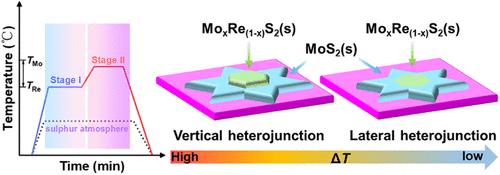
Mo doping optimizes the electronic structure of ReS2. MoxRe(1–x)S2/MoS2 alloy heterojunction exhibits more favorable application prospects in photodetection due to its higher electrical conductivity than ReS2/MoS2 heterojunction. However, alloy heterojunctions are difficult to prepare controllably using conventional vapor-phase chemical vapor deposition (CVD), and the heterojunction growth mechanism remains unclear. Here, a vapor–liquid–solid temperature-gradient process is proposed to grow alloy heterojunctions within predeposited molten Mo precursor droplets. The sulfuration reaction between Re diffusing into the droplet and Mo atoms facilitates the formation of alloy structures. The growth temperatures TRe and TMo in the temperature-gradient significantly affect the growth patterns and morphology evolution of the heterojunction. The MoS2 morphology in vertical alloy heterojunctions becomes triangular as the growth temperature increases. The dimension of the top MoxRe(1–x)S2 alloy is positively correlated with the Re diffusion concentration. Moreover, lateral alloy heterojunctions and single alloys are formed at lower and higher growth temperature differences between TRe and TMo, respectively. These results provide a controllable strategy for the synthesis of isotropic/anisotropic van der Waals TMDC heterojunctions.
期刊介绍:
ndustrial & Engineering Chemistry, with variations in title and format, has been published since 1909 by the American Chemical Society. Industrial & Engineering Chemistry Research is a weekly publication that reports industrial and academic research in the broad fields of applied chemistry and chemical engineering with special focus on fundamentals, processes, and products.



 京公网安备 11010802042870号
京ICP备2023020795号-1
京公网安备 11010802042870号
京ICP备2023020795号-1

 分享
分享
 求助内容:
求助内容: 应助结果提醒方式:
 扫码关注我们
