Xinyi Liu, Zhaoyuan He, Ziyi Huang, Chunrong Tian, Xiaowen Zhao, Lin Ye
{"title":"Construction of Thermoplastic Polyurethane-Based Unidirectional Thermal Conductive Foam with a Gradient Structure","authors":"Xinyi Liu, Zhaoyuan He, Ziyi Huang, Chunrong Tian, Xiaowen Zhao, Lin Ye","doi":"10.1021/acs.iecr.5c00489","DOIUrl":null,"url":null,"abstract":"In order to protect electronic components from high-temperature impact and also dissipate accumulated heat during use, thermoplastic polyurethane (TPU)-based unidirectional thermal conductive foam with a gradient structure was assembled layer by layer and subsequent scCO<sub>2</sub> foaming. Polydopamine (PDA) coating layer was first introduced to the surfaces of boron nitride (BN) with carbon nanotubes (CNTs) as bridging (PBC) through π–π stacking and hydrogen bonding interaction, leading to a high intercalation ratio of TPU molecules between BN layers. The in-plane thermal conductivity (TC) of TPU/60wt%PBC sample reached as high as 4.68 W·m<sup>–1</sup>·K<sup>–1</sup> due to horizontal alignment of uniformly dispersed BN sheets, and excellent flexibility and foldability were also exhibited. Besides, PBC particles were selectively distributed in hard domain (HD), while with increasing TPU hardness and HD region ratio, the effective concentration of PBC in HD decreased, resulting in a drop of TC. Moreover, with increasing PBC content in each layer of TPU/PBC assembled foam, due to decreasing cell size, increasing apparent density, and formation of interconnected 3D thermal conductive network, the in-plane TC of each layer increased gradually and even reached 2.39 W·m<sup>–1</sup>·K<sup>–1</sup> for TPU/40wt%PBC foam layer, resulting in a gradient distribution of cell structure and thermal conductivity. The assembled foam exhibited a tightly integrated structure with blurred interfaces between each layer, and unidirectional thermal conductivity was confirmed by infrared thermography.","PeriodicalId":39,"journal":{"name":"Industrial & Engineering Chemistry Research","volume":"31 1","pages":""},"PeriodicalIF":3.9000,"publicationDate":"2025-04-08","publicationTypes":"Journal Article","fieldsOfStudy":null,"isOpenAccess":false,"openAccessPdf":"","citationCount":"0","resultStr":null,"platform":"Semanticscholar","paperid":null,"PeriodicalName":"Industrial & Engineering Chemistry Research","FirstCategoryId":"5","ListUrlMain":"https://doi.org/10.1021/acs.iecr.5c00489","RegionNum":3,"RegionCategory":"工程技术","ArticlePicture":[],"TitleCN":null,"AbstractTextCN":null,"PMCID":null,"EPubDate":"","PubModel":"","JCR":"Q2","JCRName":"ENGINEERING, CHEMICAL","Score":null,"Total":0}
引用次数: 0
Abstract
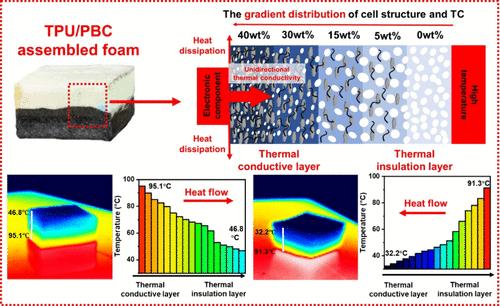
In order to protect electronic components from high-temperature impact and also dissipate accumulated heat during use, thermoplastic polyurethane (TPU)-based unidirectional thermal conductive foam with a gradient structure was assembled layer by layer and subsequent scCO2 foaming. Polydopamine (PDA) coating layer was first introduced to the surfaces of boron nitride (BN) with carbon nanotubes (CNTs) as bridging (PBC) through π–π stacking and hydrogen bonding interaction, leading to a high intercalation ratio of TPU molecules between BN layers. The in-plane thermal conductivity (TC) of TPU/60wt%PBC sample reached as high as 4.68 W·m–1·K–1 due to horizontal alignment of uniformly dispersed BN sheets, and excellent flexibility and foldability were also exhibited. Besides, PBC particles were selectively distributed in hard domain (HD), while with increasing TPU hardness and HD region ratio, the effective concentration of PBC in HD decreased, resulting in a drop of TC. Moreover, with increasing PBC content in each layer of TPU/PBC assembled foam, due to decreasing cell size, increasing apparent density, and formation of interconnected 3D thermal conductive network, the in-plane TC of each layer increased gradually and even reached 2.39 W·m–1·K–1 for TPU/40wt%PBC foam layer, resulting in a gradient distribution of cell structure and thermal conductivity. The assembled foam exhibited a tightly integrated structure with blurred interfaces between each layer, and unidirectional thermal conductivity was confirmed by infrared thermography.
期刊介绍:
ndustrial & Engineering Chemistry, with variations in title and format, has been published since 1909 by the American Chemical Society. Industrial & Engineering Chemistry Research is a weekly publication that reports industrial and academic research in the broad fields of applied chemistry and chemical engineering with special focus on fundamentals, processes, and products.



 京公网安备 11010802042870号
京ICP备2023020795号-1
京公网安备 11010802042870号
京ICP备2023020795号-1

 分享
分享
 求助内容:
求助内容: 应助结果提醒方式:
 扫码关注我们
