{"title":"Construction of Macropores in a Hollow Fiber Carbon Membrane Enables Efficient CO2 Removal from Natural Gas","authors":"Zhi Li, Xingyu Chen, Guanran Zhao, Yaohao Guo, Wei Zhao, Linfeng Lei, Zhi Xu","doi":"10.1021/acs.iecr.5c00493","DOIUrl":null,"url":null,"abstract":"Membrane-based CO<sub>2</sub> separation technology is highly desired for natural gas sweetening, and the development of advanced membrane materials with low cost and high CO<sub>2</sub>/CH<sub>4</sub> separation factors under high pressures is the key to the membrane market. Herein, cellulose-derived carbon molecular sieve (CMS) hollow fiber membranes within macropores were constructed by incorporating a thermal labile polymer of poly(vinyl butyral) (PVB). During a controlled carbonization protocol, the spun cellulose membranes formed the CMS membrane matrix, while the PVB formed homogenized macropores. As a result, the generated macropores in the CMS hollow fiber membranes (CHFMs) effectively reduced the gas transport resistance, confirmed by an increased CO<sub>2</sub> permeance by ∼2.9-fold from 8.48 to 24.72 GPU (CHFM-1) compared to CHFM-0. Moreover, the membranes were evaluated using a simulated high-pressure natural gas stream (3.44 mol % CO<sub>2</sub>–87.0 mol % CH<sub>4</sub>–9.56 mol % N<sub>2</sub>) and showed good separation performance with a CO<sub>2</sub> permeance of 11.66 GPU and a CO<sub>2</sub>/CH<sub>4</sub> separation factor of 38.3 at 30 bar feeding. A long-term durability test over 100 h at 20 bar with a slight decrease in permeance further verified its potential for CO<sub>2</sub> removal from high-pressure natural gas.","PeriodicalId":39,"journal":{"name":"Industrial & Engineering Chemistry Research","volume":"24 1","pages":""},"PeriodicalIF":3.9000,"publicationDate":"2025-04-08","publicationTypes":"Journal Article","fieldsOfStudy":null,"isOpenAccess":false,"openAccessPdf":"","citationCount":"0","resultStr":null,"platform":"Semanticscholar","paperid":null,"PeriodicalName":"Industrial & Engineering Chemistry Research","FirstCategoryId":"5","ListUrlMain":"https://doi.org/10.1021/acs.iecr.5c00493","RegionNum":3,"RegionCategory":"工程技术","ArticlePicture":[],"TitleCN":null,"AbstractTextCN":null,"PMCID":null,"EPubDate":"","PubModel":"","JCR":"Q2","JCRName":"ENGINEERING, CHEMICAL","Score":null,"Total":0}
引用次数: 0
Abstract
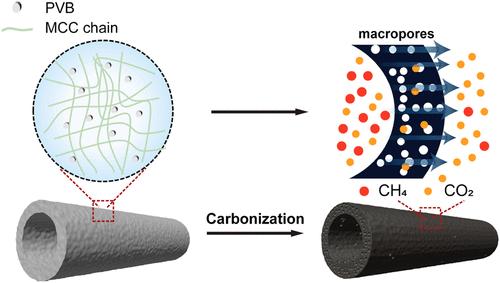
Membrane-based CO2 separation technology is highly desired for natural gas sweetening, and the development of advanced membrane materials with low cost and high CO2/CH4 separation factors under high pressures is the key to the membrane market. Herein, cellulose-derived carbon molecular sieve (CMS) hollow fiber membranes within macropores were constructed by incorporating a thermal labile polymer of poly(vinyl butyral) (PVB). During a controlled carbonization protocol, the spun cellulose membranes formed the CMS membrane matrix, while the PVB formed homogenized macropores. As a result, the generated macropores in the CMS hollow fiber membranes (CHFMs) effectively reduced the gas transport resistance, confirmed by an increased CO2 permeance by ∼2.9-fold from 8.48 to 24.72 GPU (CHFM-1) compared to CHFM-0. Moreover, the membranes were evaluated using a simulated high-pressure natural gas stream (3.44 mol % CO2–87.0 mol % CH4–9.56 mol % N2) and showed good separation performance with a CO2 permeance of 11.66 GPU and a CO2/CH4 separation factor of 38.3 at 30 bar feeding. A long-term durability test over 100 h at 20 bar with a slight decrease in permeance further verified its potential for CO2 removal from high-pressure natural gas.
期刊介绍:
ndustrial & Engineering Chemistry, with variations in title and format, has been published since 1909 by the American Chemical Society. Industrial & Engineering Chemistry Research is a weekly publication that reports industrial and academic research in the broad fields of applied chemistry and chemical engineering with special focus on fundamentals, processes, and products.



 京公网安备 11010802042870号
京ICP备2023020795号-1
京公网安备 11010802042870号
京ICP备2023020795号-1

 分享
分享
 求助内容:
求助内容: 应助结果提醒方式:
 扫码关注我们
