{"title":"Surrogate-Assisted Optimization of Highly Constrained Oil Recovery Processes Using Classification-Based Constraint Modeling","authors":"Zahir Aghayev, Dimitrios Voulanas, Eduardo Gildin, Burcu Beykal","doi":"10.1021/acs.iecr.4c03294","DOIUrl":null,"url":null,"abstract":"Real-world problems often involve constraints that must be carefully managed for feasible and efficient operations. In optimization, this becomes especially challenging with complex, high-dimensional problems that are computationally expensive and subject to hundreds or even thousands of constraints. We address these challenges by optimizing the highly constrained waterflooding process using a surrogate model of the reservoir and a classification-based constraint handling technique. Our study uses benchmark reservoir simulations, beginning with the low-dimensional Egg model and extending to the high-dimensional UNISIM model. We employ a Feedforward Neural Network (FFNN) surrogate for objective quantification and use classification-based modeling to transform the numerous constraints into a binary problem, distinguishing between feasible and infeasible reservoir settings. Our methodology involves an offline phase to develop and train models using reservoir simulation data, achieving high predictive accuracy (<i>R</i><sup>2</sup> > 0.98) with 20,000 bottom-hole pressure (BHP) settings and net present value (NPV) outputs. The classifier algorithms are then trained to model the constraints, ensuring that the solutions identified during optimization are feasible. In the online phase, we employ different model-based and search-based optimizers to find the optimal BHP settings that maximize the NPV throughout the production horizon. By integrating a highly accurate surrogate model and classification-based constraint handling, our approach significantly reduces the computational burden while ensuring that the solutions remain feasible, optimized for maximum economic gain, and yield better results compared to the deterministic approach.","PeriodicalId":39,"journal":{"name":"Industrial & Engineering Chemistry Research","volume":"38 1","pages":""},"PeriodicalIF":3.9000,"publicationDate":"2025-04-07","publicationTypes":"Journal Article","fieldsOfStudy":null,"isOpenAccess":false,"openAccessPdf":"","citationCount":"0","resultStr":null,"platform":"Semanticscholar","paperid":null,"PeriodicalName":"Industrial & Engineering Chemistry Research","FirstCategoryId":"5","ListUrlMain":"https://doi.org/10.1021/acs.iecr.4c03294","RegionNum":3,"RegionCategory":"工程技术","ArticlePicture":[],"TitleCN":null,"AbstractTextCN":null,"PMCID":null,"EPubDate":"","PubModel":"","JCR":"Q2","JCRName":"ENGINEERING, CHEMICAL","Score":null,"Total":0}
引用次数: 0
Abstract
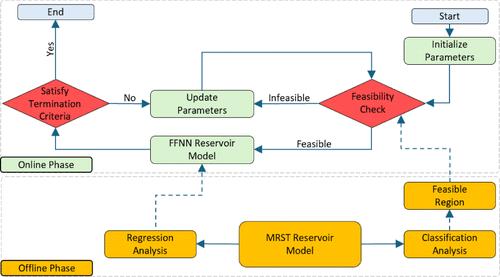
Real-world problems often involve constraints that must be carefully managed for feasible and efficient operations. In optimization, this becomes especially challenging with complex, high-dimensional problems that are computationally expensive and subject to hundreds or even thousands of constraints. We address these challenges by optimizing the highly constrained waterflooding process using a surrogate model of the reservoir and a classification-based constraint handling technique. Our study uses benchmark reservoir simulations, beginning with the low-dimensional Egg model and extending to the high-dimensional UNISIM model. We employ a Feedforward Neural Network (FFNN) surrogate for objective quantification and use classification-based modeling to transform the numerous constraints into a binary problem, distinguishing between feasible and infeasible reservoir settings. Our methodology involves an offline phase to develop and train models using reservoir simulation data, achieving high predictive accuracy (R2 > 0.98) with 20,000 bottom-hole pressure (BHP) settings and net present value (NPV) outputs. The classifier algorithms are then trained to model the constraints, ensuring that the solutions identified during optimization are feasible. In the online phase, we employ different model-based and search-based optimizers to find the optimal BHP settings that maximize the NPV throughout the production horizon. By integrating a highly accurate surrogate model and classification-based constraint handling, our approach significantly reduces the computational burden while ensuring that the solutions remain feasible, optimized for maximum economic gain, and yield better results compared to the deterministic approach.
期刊介绍:
ndustrial & Engineering Chemistry, with variations in title and format, has been published since 1909 by the American Chemical Society. Industrial & Engineering Chemistry Research is a weekly publication that reports industrial and academic research in the broad fields of applied chemistry and chemical engineering with special focus on fundamentals, processes, and products.



 京公网安备 11010802042870号
京ICP备2023020795号-1
京公网安备 11010802042870号
京ICP备2023020795号-1

 分享
分享
 求助内容:
求助内容: 应助结果提醒方式:
 扫码关注我们
