Synergistic Anchoring of Iron Phthalocyanine over Mo2TiC2/BiPO4 Heterostructures for Enhanced Photodegradation of Nerve Agent Simulant and Toxic Dye with DFT-Guided Mechanistic Insights
Idrees Khan, Hong Zheng, Muhammad Rizwan Tariq, Yihao Fan, Mudasir Ahmad, Baoliang Zhang
{"title":"Synergistic Anchoring of Iron Phthalocyanine over Mo2TiC2/BiPO4 Heterostructures for Enhanced Photodegradation of Nerve Agent Simulant and Toxic Dye with DFT-Guided Mechanistic Insights","authors":"Idrees Khan, Hong Zheng, Muhammad Rizwan Tariq, Yihao Fan, Mudasir Ahmad, Baoliang Zhang","doi":"10.1021/acs.iecr.4c04978","DOIUrl":null,"url":null,"abstract":"The enhancement of photocatalytic efficiency of photocatalysts for effectively decontaminating hazardous organic pollutants is a hot research area. Here, BiPO<sub>4</sub> nanoparticles were coupled with Mo<sub>2</sub>TiC<sub>2</sub> at various ratios to synthesize the Mo<sub>2</sub>TiC<sub>2</sub>/BiPO<sub>4</sub> heterojunction, and their light absorbance and reduction of charge recombination were further enhanced by anchoring iron phthalocyanine (FePc) onto their surface. The Mo<sub>2</sub>TiC<sub>2</sub>/BiPO<sub>4</sub>(1:10)FePc nanocomposite outperformed due to the facile fabrication of the heterojunction at the interface and the uniform distribution and intercalation of BiPO<sub>4</sub> over and between the Mo<sub>2</sub>TiC<sub>2</sub> sheets. The Mo<sub>2</sub>TiC<sub>2</sub>/BiPO<sub>4</sub>(1:10)FePc nanocomposite degraded 94.71% of DMMP and 99.68% of MB dye within 2 h, with excellent recyclability and photostability. The density functional theory simulations evince that the Mo<sub>2</sub>TiC<sub>2</sub>/BiPO<sub>4</sub>/FePc composite chemisorbed the DMMP and MB which give roots for the efficient degradation of these pollutants over the composite materials. This work reveals the promising potential of the Mo<sub>2</sub>TiC<sub>2</sub>/BiPO<sub>4</sub>/FePc nanocomposite for environmental pollutant remediation.","PeriodicalId":39,"journal":{"name":"Industrial & Engineering Chemistry Research","volume":"16 1","pages":""},"PeriodicalIF":3.9000,"publicationDate":"2025-04-07","publicationTypes":"Journal Article","fieldsOfStudy":null,"isOpenAccess":false,"openAccessPdf":"","citationCount":"0","resultStr":null,"platform":"Semanticscholar","paperid":null,"PeriodicalName":"Industrial & Engineering Chemistry Research","FirstCategoryId":"5","ListUrlMain":"https://doi.org/10.1021/acs.iecr.4c04978","RegionNum":3,"RegionCategory":"工程技术","ArticlePicture":[],"TitleCN":null,"AbstractTextCN":null,"PMCID":null,"EPubDate":"","PubModel":"","JCR":"Q2","JCRName":"ENGINEERING, CHEMICAL","Score":null,"Total":0}
引用次数: 0
Abstract
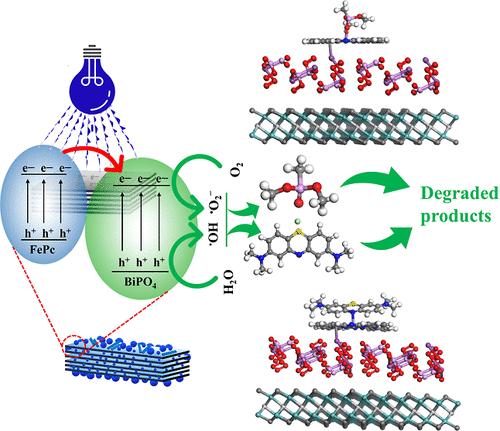
The enhancement of photocatalytic efficiency of photocatalysts for effectively decontaminating hazardous organic pollutants is a hot research area. Here, BiPO4 nanoparticles were coupled with Mo2TiC2 at various ratios to synthesize the Mo2TiC2/BiPO4 heterojunction, and their light absorbance and reduction of charge recombination were further enhanced by anchoring iron phthalocyanine (FePc) onto their surface. The Mo2TiC2/BiPO4(1:10)FePc nanocomposite outperformed due to the facile fabrication of the heterojunction at the interface and the uniform distribution and intercalation of BiPO4 over and between the Mo2TiC2 sheets. The Mo2TiC2/BiPO4(1:10)FePc nanocomposite degraded 94.71% of DMMP and 99.68% of MB dye within 2 h, with excellent recyclability and photostability. The density functional theory simulations evince that the Mo2TiC2/BiPO4/FePc composite chemisorbed the DMMP and MB which give roots for the efficient degradation of these pollutants over the composite materials. This work reveals the promising potential of the Mo2TiC2/BiPO4/FePc nanocomposite for environmental pollutant remediation.
期刊介绍:
ndustrial & Engineering Chemistry, with variations in title and format, has been published since 1909 by the American Chemical Society. Industrial & Engineering Chemistry Research is a weekly publication that reports industrial and academic research in the broad fields of applied chemistry and chemical engineering with special focus on fundamentals, processes, and products.



 京公网安备 11010802042870号
京ICP备2023020795号-1
京公网安备 11010802042870号
京ICP备2023020795号-1

 分享
分享
 求助内容:
求助内容: 应助结果提醒方式:
 扫码关注我们
