Wenjie Guo , Li Li , Junjie Yang , Konghao Yu , Xuecheng Sun , Zhirong Wang , Junling Wang , Jiabao Zhang
{"title":"Mechanism Investigation and Safety Evaluation towards Flame-retardant Structural Thermoplastic Polyurethane Composites Inspired via Interfacial Synergy Strategy","authors":"Wenjie Guo , Li Li , Junjie Yang , Konghao Yu , Xuecheng Sun , Zhirong Wang , Junling Wang , Jiabao Zhang","doi":"10.1016/j.polymdegradstab.2025.111355","DOIUrl":null,"url":null,"abstract":"<div><div>Thermoplastic polyurethane (TPU) is widely applied in many fields including construction, cables, automobiles, and aerospace. However, TPU is extremely flammable, endangering people's lives and property. Boron nitride (BN) nanosheets are highly thermally stable, and nano-metal oxides (CoMoO<sub>4</sub>) are great for catalytic carbonization. Therefore, in this work, CoMoO<sub>4</sub> is facilely assembled on the surface of BN, to design three types of BN-CoMo fillers (namely, BN-CoMo-1, BN-CoMo-2, BN-CoMo-3). These fillers are further utilized as flame retardants for TPU, with composites containing 6.0 wt% BN-CoMo-1 being the most effective. Compared with pure TPU, the peak heat release rate (PHRR) is decreased by 51.6%. Meanwhile, BN-CoMo-1 shows substantial benefits in suppressing smoke and CO production. In specific, the peak smoke production rate (PSPR) and peak CO production rate (PCOP) of TPU/6.0 BN-CoMo-1 are decreased by 64.8% and 62.2%. Through a comprehensive assessment, it is further verified that BN-CoMo-1 has outstanding advantages in enhancing the flame retardancy of TPU. Due to the excellent flame retardant and thermal insulation properties of TPU/6.0 BN-CoMo-1, it can be used as the barrier material to inhibit the thermal runaway propagation of batteries.</div></div>","PeriodicalId":406,"journal":{"name":"Polymer Degradation and Stability","volume":"238 ","pages":"Article 111355"},"PeriodicalIF":7.4000,"publicationDate":"2025-08-01","publicationTypes":"Journal Article","fieldsOfStudy":null,"isOpenAccess":false,"openAccessPdf":"","citationCount":"0","resultStr":null,"platform":"Semanticscholar","paperid":null,"PeriodicalName":"Polymer Degradation and Stability","FirstCategoryId":"92","ListUrlMain":"https://www.sciencedirect.com/science/article/pii/S0141391025001855","RegionNum":2,"RegionCategory":"化学","ArticlePicture":[],"TitleCN":null,"AbstractTextCN":null,"PMCID":null,"EPubDate":"2025/4/1 0:00:00","PubModel":"Epub","JCR":"Q1","JCRName":"POLYMER SCIENCE","Score":null,"Total":0}
引用次数: 0
Abstract
Thermoplastic polyurethane (TPU) is widely applied in many fields including construction, cables, automobiles, and aerospace. However, TPU is extremely flammable, endangering people's lives and property. Boron nitride (BN) nanosheets are highly thermally stable, and nano-metal oxides (CoMoO4) are great for catalytic carbonization. Therefore, in this work, CoMoO4 is facilely assembled on the surface of BN, to design three types of BN-CoMo fillers (namely, BN-CoMo-1, BN-CoMo-2, BN-CoMo-3). These fillers are further utilized as flame retardants for TPU, with composites containing 6.0 wt% BN-CoMo-1 being the most effective. Compared with pure TPU, the peak heat release rate (PHRR) is decreased by 51.6%. Meanwhile, BN-CoMo-1 shows substantial benefits in suppressing smoke and CO production. In specific, the peak smoke production rate (PSPR) and peak CO production rate (PCOP) of TPU/6.0 BN-CoMo-1 are decreased by 64.8% and 62.2%. Through a comprehensive assessment, it is further verified that BN-CoMo-1 has outstanding advantages in enhancing the flame retardancy of TPU. Due to the excellent flame retardant and thermal insulation properties of TPU/6.0 BN-CoMo-1, it can be used as the barrier material to inhibit the thermal runaway propagation of batteries.
热塑性聚氨酯(TPU)广泛应用于建筑、电缆、汽车、航空航天等领域。然而,TPU极易燃,危及人们的生命和财产。氮化硼(BN)纳米片具有很高的热稳定性,纳米金属氧化物(CoMoO4)是催化碳化的好材料。因此,本工作将CoMoO4方便地组装在BN表面,设计了三种BN- como填料(BN- como -1、BN- como -2、BN- como -3)。这些填料进一步用作TPU的阻燃剂,其中含有6.0 wt% BN-CoMo-1的复合材料最有效。与纯TPU相比,峰值放热率(PHRR)降低了51.6%。同时,BN-CoMo-1在抑制烟雾和CO产生方面具有显著的效果。其中TPU/6.0 BN-CoMo-1的峰值产烟率(PSPR)和峰值CO产率(PCOP)分别降低了64.8%和62.2%。通过综合评价,进一步验证了BN-CoMo-1在增强TPU阻燃性方面具有突出的优势。由于TPU/6.0 BN-CoMo-1具有优异的阻燃和隔热性能,可作为抑制电池热失控传播的阻隔材料。
期刊介绍:
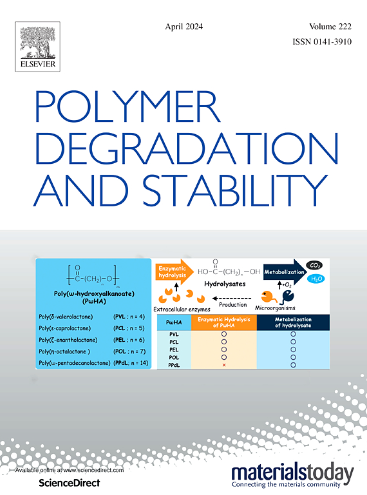
Polymer Degradation and Stability deals with the degradation reactions and their control which are a major preoccupation of practitioners of the many and diverse aspects of modern polymer technology.
Deteriorative reactions occur during processing, when polymers are subjected to heat, oxygen and mechanical stress, and during the useful life of the materials when oxygen and sunlight are the most important degradative agencies. In more specialised applications, degradation may be induced by high energy radiation, ozone, atmospheric pollutants, mechanical stress, biological action, hydrolysis and many other influences. The mechanisms of these reactions and stabilisation processes must be understood if the technology and application of polymers are to continue to advance. The reporting of investigations of this kind is therefore a major function of this journal.
However there are also new developments in polymer technology in which degradation processes find positive applications. For example, photodegradable plastics are now available, the recycling of polymeric products will become increasingly important, degradation and combustion studies are involved in the definition of the fire hazards which are associated with polymeric materials and the microelectronics industry is vitally dependent upon polymer degradation in the manufacture of its circuitry. Polymer properties may also be improved by processes like curing and grafting, the chemistry of which can be closely related to that which causes physical deterioration in other circumstances.



 京公网安备 11010802042870号
京ICP备2023020795号-1
京公网安备 11010802042870号
京ICP备2023020795号-1

 分享
分享
 求助内容:
求助内容: 应助结果提醒方式:
 扫码关注我们
