{"title":"Spatio-temporal analysis of countries' vulnerability to extreme heat, using the hybrid F’ANP model","authors":"Mahdi Suleimany, Tandis Sulaimani","doi":"10.1016/j.ijdrr.2025.105448","DOIUrl":null,"url":null,"abstract":"<div><div>This study aims to investigate the spatio-temporal patterns of countries' vulnerability to extreme heat, a critical consequence of climate change that threatens communities' environmental, infrastructural, economic, and social systems. Recognizing a significant theoretical gap regarding comprehensive country-scale assessments, this research develops a Composite Vulnerability Index (CVI) by employing the hybrid F’ANP model to integrate ten indicators, considering heat exposure, sensitivity, and adaptive capacity. Analyzing data from 156 countries within seven regions over the 2001 to 2020 period, the study reveals notable regional disparities in heat vulnerability levels and fluctuation. Key findings indicate that while East Asia & Pacific and Latin America & the Caribbean regions underwent non-stationary CVI trends, Sub-Saharan Africa is the most vulnerable region due to inadequate infrastructure and economic challenges. Europe & Central Asia, the Middle East & North Africa, and also North American countries exhibit increasing vulnerability, attributed to rising land surface temperatures and the frequency of extreme heat events. Conversely, the South Asia region demonstrates a marked decline in CVI, reflecting improvements in adaptive capacity. This research underscores the need for targeted policy interventions and international collaboration to alleviate countries' heat vulnerability, emphasizing continuous monitoring and informed risk management for mitigating climate change impacts.</div></div>","PeriodicalId":13915,"journal":{"name":"International journal of disaster risk reduction","volume":"122 ","pages":"Article 105448"},"PeriodicalIF":4.5000,"publicationDate":"2025-04-04","publicationTypes":"Journal Article","fieldsOfStudy":null,"isOpenAccess":false,"openAccessPdf":"","citationCount":"0","resultStr":null,"platform":"Semanticscholar","paperid":null,"PeriodicalName":"International journal of disaster risk reduction","FirstCategoryId":"89","ListUrlMain":"https://www.sciencedirect.com/science/article/pii/S2212420925002729","RegionNum":1,"RegionCategory":"地球科学","ArticlePicture":[],"TitleCN":null,"AbstractTextCN":null,"PMCID":null,"EPubDate":"","PubModel":"","JCR":"Q1","JCRName":"GEOSCIENCES, MULTIDISCIPLINARY","Score":null,"Total":0}
引用次数: 0
Abstract
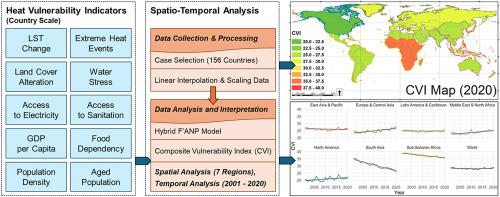
This study aims to investigate the spatio-temporal patterns of countries' vulnerability to extreme heat, a critical consequence of climate change that threatens communities' environmental, infrastructural, economic, and social systems. Recognizing a significant theoretical gap regarding comprehensive country-scale assessments, this research develops a Composite Vulnerability Index (CVI) by employing the hybrid F’ANP model to integrate ten indicators, considering heat exposure, sensitivity, and adaptive capacity. Analyzing data from 156 countries within seven regions over the 2001 to 2020 period, the study reveals notable regional disparities in heat vulnerability levels and fluctuation. Key findings indicate that while East Asia & Pacific and Latin America & the Caribbean regions underwent non-stationary CVI trends, Sub-Saharan Africa is the most vulnerable region due to inadequate infrastructure and economic challenges. Europe & Central Asia, the Middle East & North Africa, and also North American countries exhibit increasing vulnerability, attributed to rising land surface temperatures and the frequency of extreme heat events. Conversely, the South Asia region demonstrates a marked decline in CVI, reflecting improvements in adaptive capacity. This research underscores the need for targeted policy interventions and international collaboration to alleviate countries' heat vulnerability, emphasizing continuous monitoring and informed risk management for mitigating climate change impacts.
期刊介绍:
The International Journal of Disaster Risk Reduction (IJDRR) is the journal for researchers, policymakers and practitioners across diverse disciplines: earth sciences and their implications; environmental sciences; engineering; urban studies; geography; and the social sciences. IJDRR publishes fundamental and applied research, critical reviews, policy papers and case studies with a particular focus on multi-disciplinary research that aims to reduce the impact of natural, technological, social and intentional disasters. IJDRR stimulates exchange of ideas and knowledge transfer on disaster research, mitigation, adaptation, prevention and risk reduction at all geographical scales: local, national and international.
Key topics:-
-multifaceted disaster and cascading disasters
-the development of disaster risk reduction strategies and techniques
-discussion and development of effective warning and educational systems for risk management at all levels
-disasters associated with climate change
-vulnerability analysis and vulnerability trends
-emerging risks
-resilience against disasters.
The journal particularly encourages papers that approach risk from a multi-disciplinary perspective.



 京公网安备 11010802042870号
京ICP备2023020795号-1
京公网安备 11010802042870号
京ICP备2023020795号-1

 分享
分享
 求助内容:
求助内容: 应助结果提醒方式:
 扫码关注我们
