Yongming Lu , Wensheng Xie , Jingliang Dong , Jian Wang , Quan Shu , Jin Zhang , Shaolin Ge , Shun Zhou , Xiaofeng Wang , Mingxi Chen , Guozhao Ji
{"title":"A comprehensive study on the thermal reaction mechanism, products and kinetic characteristics of cut tobacco","authors":"Yongming Lu , Wensheng Xie , Jingliang Dong , Jian Wang , Quan Shu , Jin Zhang , Shaolin Ge , Shun Zhou , Xiaofeng Wang , Mingxi Chen , Guozhao Ji","doi":"10.1016/j.biombioe.2025.107858","DOIUrl":null,"url":null,"abstract":"<div><div>During smoking, the cut tobacco undergoes a series of thermal decomposition and secondary reactions when heated, resulting in the production of harmful substances such as nicotine, CO and furfural, which caused various diseases. Therefore, to elucidate the decomposition and transformation pathways of cut tobacco components and investigate the formation of harmful substances, it is necessary to conduct in-depth research on the thermal reaction mechanism of cut tobacco. To this end, this study employed TG-FTIR to analyze the thermal reaction process and product distribution with different oxygen concentrations. Additionally, the overall pyrolysis reaction of cut tobacco was divided into five independent parallel pyrolysis reactions according to the DTG pattern. The kinetic analysis of these five reactions was carried out using the iso-conversional method. The compensation effect was applied to achieve the separation of the pre-exponential factor <em>A</em>(<em>α</em>) and the reaction mechanism function <em>f</em>(<em>α</em>). The results indicated that the cut tobacco pyrolysis could be segmented into five stages. The major weight loss occurred in the second, third and fourth stages (approximately 222–600 °C), where most of the pyrolysis products were generated, including small molecular gases (such as H<sub>2</sub>O, CO, CO<sub>2</sub> and alkanes) and organic components (including alcohols, phenols, aromatic compounds, as well as carbonyl groups like aldehydes, ketones and acids). The involvement of oxygen became effective in the fourth stage (around 355–600 °C) of cut tobacco pyrolysis, where the combustion of char took place, producing a large amount of CO<sub>2</sub>. The yields of carbonyl compounds, alcohols and phenols decreased in this stage. The kinetic investigation found that the activation energies of lignin pyrolysis showed the most significant changes in activation energy. This study elucidated the mechanisms of cut tobacco pyrolysis and the releasing of the products, providing theoretical references for a deeper understanding of the thermal reaction characteristics and data support for the thermal reaction equation of a comprehensive cigarette numerical simulation.</div></div>","PeriodicalId":253,"journal":{"name":"Biomass & Bioenergy","volume":"198 ","pages":"Article 107858"},"PeriodicalIF":5.8000,"publicationDate":"2025-07-01","publicationTypes":"Journal Article","fieldsOfStudy":null,"isOpenAccess":false,"openAccessPdf":"","citationCount":"0","resultStr":null,"platform":"Semanticscholar","paperid":null,"PeriodicalName":"Biomass & Bioenergy","FirstCategoryId":"5","ListUrlMain":"https://www.sciencedirect.com/science/article/pii/S0961953425002697","RegionNum":2,"RegionCategory":"生物学","ArticlePicture":[],"TitleCN":null,"AbstractTextCN":null,"PMCID":null,"EPubDate":"2025/4/9 0:00:00","PubModel":"Epub","JCR":"Q1","JCRName":"AGRICULTURAL ENGINEERING","Score":null,"Total":0}
引用次数: 0
Abstract
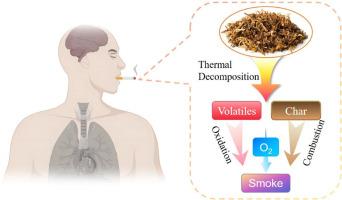
During smoking, the cut tobacco undergoes a series of thermal decomposition and secondary reactions when heated, resulting in the production of harmful substances such as nicotine, CO and furfural, which caused various diseases. Therefore, to elucidate the decomposition and transformation pathways of cut tobacco components and investigate the formation of harmful substances, it is necessary to conduct in-depth research on the thermal reaction mechanism of cut tobacco. To this end, this study employed TG-FTIR to analyze the thermal reaction process and product distribution with different oxygen concentrations. Additionally, the overall pyrolysis reaction of cut tobacco was divided into five independent parallel pyrolysis reactions according to the DTG pattern. The kinetic analysis of these five reactions was carried out using the iso-conversional method. The compensation effect was applied to achieve the separation of the pre-exponential factor A(α) and the reaction mechanism function f(α). The results indicated that the cut tobacco pyrolysis could be segmented into five stages. The major weight loss occurred in the second, third and fourth stages (approximately 222–600 °C), where most of the pyrolysis products were generated, including small molecular gases (such as H2O, CO, CO2 and alkanes) and organic components (including alcohols, phenols, aromatic compounds, as well as carbonyl groups like aldehydes, ketones and acids). The involvement of oxygen became effective in the fourth stage (around 355–600 °C) of cut tobacco pyrolysis, where the combustion of char took place, producing a large amount of CO2. The yields of carbonyl compounds, alcohols and phenols decreased in this stage. The kinetic investigation found that the activation energies of lignin pyrolysis showed the most significant changes in activation energy. This study elucidated the mechanisms of cut tobacco pyrolysis and the releasing of the products, providing theoretical references for a deeper understanding of the thermal reaction characteristics and data support for the thermal reaction equation of a comprehensive cigarette numerical simulation.
期刊介绍:
Biomass & Bioenergy is an international journal publishing original research papers and short communications, review articles and case studies on biological resources, chemical and biological processes, and biomass products for new renewable sources of energy and materials.
The scope of the journal extends to the environmental, management and economic aspects of biomass and bioenergy.
Key areas covered by the journal:
• Biomass: sources, energy crop production processes, genetic improvements, composition. Please note that research on these biomass subjects must be linked directly to bioenergy generation.
• Biological Residues: residues/rests from agricultural production, forestry and plantations (palm, sugar etc), processing industries, and municipal sources (MSW). Papers on the use of biomass residues through innovative processes/technological novelty and/or consideration of feedstock/system sustainability (or unsustainability) are welcomed. However waste treatment processes and pollution control or mitigation which are only tangentially related to bioenergy are not in the scope of the journal, as they are more suited to publications in the environmental arena. Papers that describe conventional waste streams (ie well described in existing literature) that do not empirically address ''new'' added value from the process are not suitable for submission to the journal.
• Bioenergy Processes: fermentations, thermochemical conversions, liquid and gaseous fuels, and petrochemical substitutes
• Bioenergy Utilization: direct combustion, gasification, electricity production, chemical processes, and by-product remediation
• Biomass and the Environment: carbon cycle, the net energy efficiency of bioenergy systems, assessment of sustainability, and biodiversity issues.



 京公网安备 11010802042870号
京ICP备2023020795号-1
京公网安备 11010802042870号
京ICP备2023020795号-1

 分享
分享
 求助内容:
求助内容: 应助结果提醒方式:
 扫码关注我们
