Asif Khan , Daniyar Balapanov , Andrey Glushchuk , Mehdi Feizpour , Carlo S. Iorio
{"title":"Influence of graphene coating structure on the hydrodynamic properties of porous media","authors":"Asif Khan , Daniyar Balapanov , Andrey Glushchuk , Mehdi Feizpour , Carlo S. Iorio","doi":"10.1016/j.powtec.2025.121016","DOIUrl":null,"url":null,"abstract":"<div><div>In light of the growing interest in carbon-based coatings, this paper investigates the influence of graphene coatings on the main hydrodynamic characteristics of sintered porous media. We developed a consistent methodology for coated porous medium characterization, which involves measurement techniques for the three most important parameters: porosity, capillary pressure, and permeability. The latter required special attention because of the coating fragility, which prevented the application of the conventional forced flow method. Thus, a mass rate-of-rise principle has been used, where the absorbed liquid mass is monitored in time and then fitted to the Lucas-Washburn model. The model's validity is strictly proven for the particular experimental conditions and the samples, as well as the rigorous theory for uncertainty estimation in the case of the least squares method. Using a pressing technique, the authors created porous samples of stainless-steel 316 L polydisperse and nickel spherical particles. The graphene coating is applied by the chemical vapour deposition technique. We found that the coating reduces the porosity and permeability of the nickel samples and increases their capillary pressure, with this influence proportional to the synthesis time. Conversely, the stainless-steel 316 L samples evidenced unintuitive results with 3D disordered carbon addition. The variation in porosity and permeability is within the measurement uncertainty, and capillary pressure exhibits an inverse dependence on the deposition process time. The measurement results are correlated with the analysis of the porous space structure and the coating structure obtained by SEM imaging and Raman spectroscopy.</div></div>","PeriodicalId":407,"journal":{"name":"Powder Technology","volume":"458 ","pages":"Article 121016"},"PeriodicalIF":4.6000,"publicationDate":"2025-04-07","publicationTypes":"Journal Article","fieldsOfStudy":null,"isOpenAccess":false,"openAccessPdf":"","citationCount":"0","resultStr":null,"platform":"Semanticscholar","paperid":null,"PeriodicalName":"Powder Technology","FirstCategoryId":"5","ListUrlMain":"https://www.sciencedirect.com/science/article/pii/S0032591025004115","RegionNum":2,"RegionCategory":"工程技术","ArticlePicture":[],"TitleCN":null,"AbstractTextCN":null,"PMCID":null,"EPubDate":"","PubModel":"","JCR":"Q2","JCRName":"ENGINEERING, CHEMICAL","Score":null,"Total":0}
引用次数: 0
Abstract
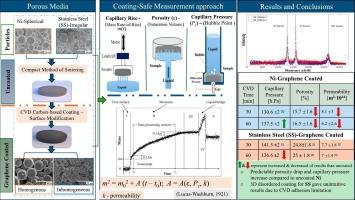
In light of the growing interest in carbon-based coatings, this paper investigates the influence of graphene coatings on the main hydrodynamic characteristics of sintered porous media. We developed a consistent methodology for coated porous medium characterization, which involves measurement techniques for the three most important parameters: porosity, capillary pressure, and permeability. The latter required special attention because of the coating fragility, which prevented the application of the conventional forced flow method. Thus, a mass rate-of-rise principle has been used, where the absorbed liquid mass is monitored in time and then fitted to the Lucas-Washburn model. The model's validity is strictly proven for the particular experimental conditions and the samples, as well as the rigorous theory for uncertainty estimation in the case of the least squares method. Using a pressing technique, the authors created porous samples of stainless-steel 316 L polydisperse and nickel spherical particles. The graphene coating is applied by the chemical vapour deposition technique. We found that the coating reduces the porosity and permeability of the nickel samples and increases their capillary pressure, with this influence proportional to the synthesis time. Conversely, the stainless-steel 316 L samples evidenced unintuitive results with 3D disordered carbon addition. The variation in porosity and permeability is within the measurement uncertainty, and capillary pressure exhibits an inverse dependence on the deposition process time. The measurement results are correlated with the analysis of the porous space structure and the coating structure obtained by SEM imaging and Raman spectroscopy.
期刊介绍:
Powder Technology is an International Journal on the Science and Technology of Wet and Dry Particulate Systems. Powder Technology publishes papers on all aspects of the formation of particles and their characterisation and on the study of systems containing particulate solids. No limitation is imposed on the size of the particles, which may range from nanometre scale, as in pigments or aerosols, to that of mined or quarried materials. The following list of topics is not intended to be comprehensive, but rather to indicate typical subjects which fall within the scope of the journal's interests:
Formation and synthesis of particles by precipitation and other methods.
Modification of particles by agglomeration, coating, comminution and attrition.
Characterisation of the size, shape, surface area, pore structure and strength of particles and agglomerates (including the origins and effects of inter particle forces).
Packing, failure, flow and permeability of assemblies of particles.
Particle-particle interactions and suspension rheology.
Handling and processing operations such as slurry flow, fluidization, pneumatic conveying.
Interactions between particles and their environment, including delivery of particulate products to the body.
Applications of particle technology in production of pharmaceuticals, chemicals, foods, pigments, structural, and functional materials and in environmental and energy related matters.
For materials-oriented contributions we are looking for articles revealing the effect of particle/powder characteristics (size, morphology and composition, in that order) on material performance or functionality and, ideally, comparison to any industrial standard.



 京公网安备 11010802042870号
京ICP备2023020795号-1
京公网安备 11010802042870号
京ICP备2023020795号-1

 分享
分享
 求助内容:
求助内容: 应助结果提醒方式:
 扫码关注我们
