{"title":"Flashback in diluted hydrogen flames","authors":"Seunghyun Jo","doi":"10.1016/j.ijhydene.2025.04.029","DOIUrl":null,"url":null,"abstract":"<div><div>Flashback has been studied experimentally in premixed hydrogen/air with a dilution gas. The experiments, finding a critical velocity that occurs boundary laser flashback, were conducted in a quartz glass tube with an inner diameter of 3, 4, 5, and 6 mm at the equivalence ratio between 0.6 and 3.1. N<sub>2</sub>, Ar, He, and CO<sub>2</sub> were used as a dilution gas. The concentration of the dilution gas in the fuel mixture was 15 and 30 %. An infrared camera monitored flame development in the tube. The critical velocity gradient at the boundary of the gas stream, where the flashback is observed, has been systematically investigated and determined through experimental methods for each specific set of experimental conditions. The critical velocity gradient is independent of the tube diameter and dependent on the equivalence ratio, the dilution fraction, and the dilution gas. Generally, the magnitude of the flashback velocity gradient follows an order: undiluted hydrogen, Ar dilution, He dilution, N<sub>2</sub> dilution, and CO<sub>2</sub> dilution flames. The flashback velocity gradient reduces with increasing the dilution gas concentration. An experimental equation for the flashback velocity gradient indicates that the flashback at the boundary in the hydrogen flames is influenced by both the laminar flame speed and the Lewis number.</div></div>","PeriodicalId":337,"journal":{"name":"International Journal of Hydrogen Energy","volume":"126 ","pages":"Pages 159-169"},"PeriodicalIF":8.3000,"publicationDate":"2025-05-09","publicationTypes":"Journal Article","fieldsOfStudy":null,"isOpenAccess":false,"openAccessPdf":"","citationCount":"0","resultStr":null,"platform":"Semanticscholar","paperid":null,"PeriodicalName":"International Journal of Hydrogen Energy","FirstCategoryId":"5","ListUrlMain":"https://www.sciencedirect.com/science/article/pii/S0360319925016398","RegionNum":2,"RegionCategory":"工程技术","ArticlePicture":[],"TitleCN":null,"AbstractTextCN":null,"PMCID":null,"EPubDate":"2025/4/9 0:00:00","PubModel":"Epub","JCR":"Q1","JCRName":"CHEMISTRY, PHYSICAL","Score":null,"Total":0}
引用次数: 0
Abstract
Flashback has been studied experimentally in premixed hydrogen/air with a dilution gas. The experiments, finding a critical velocity that occurs boundary laser flashback, were conducted in a quartz glass tube with an inner diameter of 3, 4, 5, and 6 mm at the equivalence ratio between 0.6 and 3.1. N2, Ar, He, and CO2 were used as a dilution gas. The concentration of the dilution gas in the fuel mixture was 15 and 30 %. An infrared camera monitored flame development in the tube. The critical velocity gradient at the boundary of the gas stream, where the flashback is observed, has been systematically investigated and determined through experimental methods for each specific set of experimental conditions. The critical velocity gradient is independent of the tube diameter and dependent on the equivalence ratio, the dilution fraction, and the dilution gas. Generally, the magnitude of the flashback velocity gradient follows an order: undiluted hydrogen, Ar dilution, He dilution, N2 dilution, and CO2 dilution flames. The flashback velocity gradient reduces with increasing the dilution gas concentration. An experimental equation for the flashback velocity gradient indicates that the flashback at the boundary in the hydrogen flames is influenced by both the laminar flame speed and the Lewis number.
期刊介绍:
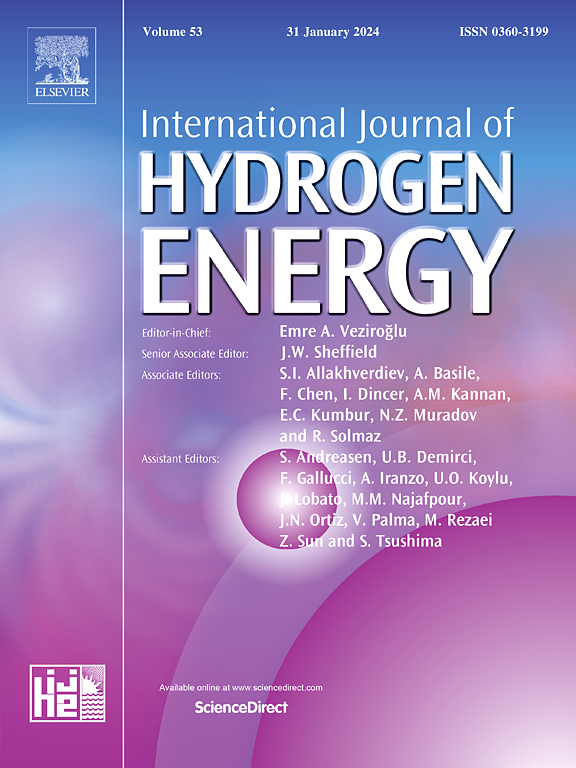
The objective of the International Journal of Hydrogen Energy is to facilitate the exchange of new ideas, technological advancements, and research findings in the field of Hydrogen Energy among scientists and engineers worldwide. This journal showcases original research, both analytical and experimental, covering various aspects of Hydrogen Energy. These include production, storage, transmission, utilization, enabling technologies, environmental impact, economic considerations, and global perspectives on hydrogen and its carriers such as NH3, CH4, alcohols, etc.
The utilization aspect encompasses various methods such as thermochemical (combustion), photochemical, electrochemical (fuel cells), and nuclear conversion of hydrogen, hydrogen isotopes, and hydrogen carriers into thermal, mechanical, and electrical energies. The applications of these energies can be found in transportation (including aerospace), industrial, commercial, and residential sectors.




 京公网安备 11010802042870号
京ICP备2023020795号-1
京公网安备 11010802042870号
京ICP备2023020795号-1

 分享
分享
 求助内容:
求助内容: 应助结果提醒方式:
 扫码关注我们
