Tao Yang , Dongdong Zhang , Hongxue Zhao , Wankai Li, Menghao Wei, Pan Ma, Lanhai He, Dajun Ding
{"title":"Electron thermalization in ammonia clusters induced by femtosecond laser fields","authors":"Tao Yang , Dongdong Zhang , Hongxue Zhao , Wankai Li, Menghao Wei, Pan Ma, Lanhai He, Dajun Ding","doi":"10.1016/j.cplett.2025.142074","DOIUrl":null,"url":null,"abstract":"<div><div>The ionization of large-sized ammonia clusters in 800 nm femtosecond laser fields is investigated by using the velocity map imaging method. The photoelectron spectra obtained at laser intensities of <span><math><mo>∼</mo></math></span>10<sup>13</sup> W/cm<sup>2</sup> exhibit two distinct regions with structureless, exponentially decaying distributions. By utilizing electron temperature, these distributions are characterized and the different mechanisms are revealed. In the low-energy region (<span><math><mi>ϵ</mi></math></span> <span><math><mo>≤</mo></math></span> 0.4 eV), the electron temperature increases with rising laser intensity, primarily due to the enhanced probability of frustrated recombination, where quasi-free electrons are temporarily trapped before eventual ionization. In contrast, in the high-energy region (0.4 eV <span><math><mo>≤</mo></math></span> <span><math><mi>ϵ</mi></math></span> <span><math><mo>≤</mo></math></span> 20 eV) the electron temperature decreases with increasing laser intensity, highlighting the crucial role of cluster expansion during electron thermalization. The photoelectron angular distributions reveal the isotropic nature of thermalized electrons, while field-induced electron scattering significantly influences even high-energy electrons (<span><math><mi>ϵ</mi></math></span> <span><math><mo>≥</mo></math></span> 2U<span><math><msub><mrow></mrow><mrow><mi>p</mi></mrow></msub></math></span>) beyond thermalization. Our results provide new insights into the underlying mechanisms governing electron thermalization in ammonia clusters under intense laser fields.</div></div>","PeriodicalId":273,"journal":{"name":"Chemical Physics Letters","volume":"870 ","pages":"Article 142074"},"PeriodicalIF":3.1000,"publicationDate":"2025-07-01","publicationTypes":"Journal Article","fieldsOfStudy":null,"isOpenAccess":false,"openAccessPdf":"","citationCount":"0","resultStr":null,"platform":"Semanticscholar","paperid":null,"PeriodicalName":"Chemical Physics Letters","FirstCategoryId":"92","ListUrlMain":"https://www.sciencedirect.com/science/article/pii/S0009261425002143","RegionNum":3,"RegionCategory":"化学","ArticlePicture":[],"TitleCN":null,"AbstractTextCN":null,"PMCID":null,"EPubDate":"2025/4/5 0:00:00","PubModel":"Epub","JCR":"Q3","JCRName":"CHEMISTRY, PHYSICAL","Score":null,"Total":0}
引用次数: 0
Abstract
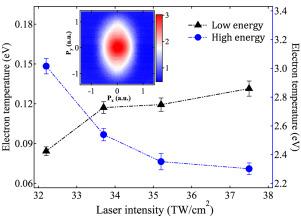
The ionization of large-sized ammonia clusters in 800 nm femtosecond laser fields is investigated by using the velocity map imaging method. The photoelectron spectra obtained at laser intensities of 1013 W/cm2 exhibit two distinct regions with structureless, exponentially decaying distributions. By utilizing electron temperature, these distributions are characterized and the different mechanisms are revealed. In the low-energy region ( 0.4 eV), the electron temperature increases with rising laser intensity, primarily due to the enhanced probability of frustrated recombination, where quasi-free electrons are temporarily trapped before eventual ionization. In contrast, in the high-energy region (0.4 eV 20 eV) the electron temperature decreases with increasing laser intensity, highlighting the crucial role of cluster expansion during electron thermalization. The photoelectron angular distributions reveal the isotropic nature of thermalized electrons, while field-induced electron scattering significantly influences even high-energy electrons ( 2U) beyond thermalization. Our results provide new insights into the underlying mechanisms governing electron thermalization in ammonia clusters under intense laser fields.
期刊介绍:
Chemical Physics Letters has an open access mirror journal, Chemical Physics Letters: X, sharing the same aims and scope, editorial team, submission system and rigorous peer review.
Chemical Physics Letters publishes brief reports on molecules, interfaces, condensed phases, nanomaterials and nanostructures, polymers, biomolecular systems, and energy conversion and storage.
Criteria for publication are quality, urgency and impact. Further, experimental results reported in the journal have direct relevance for theory, and theoretical developments or non-routine computations relate directly to experiment. Manuscripts must satisfy these criteria and should not be minor extensions of previous work.



 京公网安备 11010802042870号
京ICP备2023020795号-1
京公网安备 11010802042870号
京ICP备2023020795号-1

 分享
分享
 求助内容:
求助内容: 应助结果提醒方式:
 扫码关注我们
