{"title":"Amphiphilic self-assembled dye-sensitized graphene quantum dots for efficient hydrogen evolution in seawater†","authors":"Hyunho Park and Soo Young Park","doi":"10.1039/D5SE00148J","DOIUrl":null,"url":null,"abstract":"<p >Developing efficient and stable metal-free photocatalysts for hydrogen evolution reaction (HER) in seawater is crucial for advancing sustainable hydrogen production. While the potential of graphene quantum dots (GQDs) as HER photocatalysts has been established, they face limitations such as inadequate spectral absorption in the visible light spectrum and the presence of electron trap sites. This study introduces a metal-free photocatalyst composed of hexylamine-functionalized graphene quantum dots (GQD-HA) in combination with the ionic organic dye TPATCS, specifically engineered to tackle the challenges associated with HER in seawater. The introduction of amphiphilic assembly between GQD-HA and TPATCS results in strong intermolecular interactions, forming a robust and stable nanostructure. This structure not only demonstrates superior hydrogen evolution rates in simulated seawater compared to standalone TPATCS but also maintains a stable zeta potential and consistent morphology under irradiation, highlighting its significant photostability. The amphiphilic assembly enhances the photocatalyst's performance by effectively passivating electron trapping sites through the formation of amide bonds between GQD and HA, which improves charge separation and transfer while restoring n-type conductivity. These features are critical for optimized HER activity. This approach showcases a promising strategy for developing efficient, stable, metal-free photocatalysts for seawater HER, offering new perspectives on the design of self-assembled dye-sensitized photocatalysts for sustainable energy solutions.</p>","PeriodicalId":104,"journal":{"name":"Sustainable Energy & Fuels","volume":" 8","pages":" 2175-2183"},"PeriodicalIF":4.1000,"publicationDate":"2025-03-07","publicationTypes":"Journal Article","fieldsOfStudy":null,"isOpenAccess":false,"openAccessPdf":"","citationCount":"0","resultStr":null,"platform":"Semanticscholar","paperid":null,"PeriodicalName":"Sustainable Energy & Fuels","FirstCategoryId":"88","ListUrlMain":"https://pubs.rsc.org/en/content/articlelanding/2025/se/d5se00148j","RegionNum":3,"RegionCategory":"材料科学","ArticlePicture":[],"TitleCN":null,"AbstractTextCN":null,"PMCID":null,"EPubDate":"","PubModel":"","JCR":"Q2","JCRName":"CHEMISTRY, PHYSICAL","Score":null,"Total":0}
引用次数: 0
Abstract
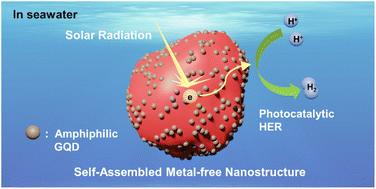
Developing efficient and stable metal-free photocatalysts for hydrogen evolution reaction (HER) in seawater is crucial for advancing sustainable hydrogen production. While the potential of graphene quantum dots (GQDs) as HER photocatalysts has been established, they face limitations such as inadequate spectral absorption in the visible light spectrum and the presence of electron trap sites. This study introduces a metal-free photocatalyst composed of hexylamine-functionalized graphene quantum dots (GQD-HA) in combination with the ionic organic dye TPATCS, specifically engineered to tackle the challenges associated with HER in seawater. The introduction of amphiphilic assembly between GQD-HA and TPATCS results in strong intermolecular interactions, forming a robust and stable nanostructure. This structure not only demonstrates superior hydrogen evolution rates in simulated seawater compared to standalone TPATCS but also maintains a stable zeta potential and consistent morphology under irradiation, highlighting its significant photostability. The amphiphilic assembly enhances the photocatalyst's performance by effectively passivating electron trapping sites through the formation of amide bonds between GQD and HA, which improves charge separation and transfer while restoring n-type conductivity. These features are critical for optimized HER activity. This approach showcases a promising strategy for developing efficient, stable, metal-free photocatalysts for seawater HER, offering new perspectives on the design of self-assembled dye-sensitized photocatalysts for sustainable energy solutions.
期刊介绍:
Sustainable Energy & Fuels will publish research that contributes to the development of sustainable energy technologies with a particular emphasis on new and next-generation technologies.



 京公网安备 11010802042870号
京ICP备2023020795号-1
京公网安备 11010802042870号
京ICP备2023020795号-1

 分享
分享
 求助内容:
求助内容: 应助结果提醒方式:
 扫码关注我们
