Richa Gupta, Nikhil George Mohan, John Bell, Ashok Kumar Nanjundan and Kothandaraman Ramanujam
{"title":"Fusion of nitro isomers of naphthoquinone enhances capacity and cyclability in Zn-ion batteries†","authors":"Richa Gupta, Nikhil George Mohan, John Bell, Ashok Kumar Nanjundan and Kothandaraman Ramanujam","doi":"10.1039/D4SE01542H","DOIUrl":null,"url":null,"abstract":"<p >Aqueous Zn-ion batteries (ZIBs) are promising alternatives to lithium-ion batteries because of their inherent safety, raw material abundance (<em>e.g.</em>, 10 million metric tons of available zinc in India, and Australia is the second largest zinc producer), and cost-effectiveness. This study focuses on utilising redox-active organic materials with quinone moieties, namely, 5- and 6-nitro 2,3-dichloro 1,4-naphthoquinone (5-DCNNQ) and (6-DCNNQ), and their mixtures in a 3 : 1 ratio as cathode materials for aqueous ZIBs. Although the introduction of the nitro group reduced the solubility of the active material in the electrolyte, the isomer mixture DCNNQmix cathode, with the high voltage characteristic of 5-DCNNQ and the high capacity characteristic of 6-DCNNQ, exhibited a higher capacity and cyclability than either material. The battery retained its capacity even after 9600 charge–discharge cycles.</p>","PeriodicalId":104,"journal":{"name":"Sustainable Energy & Fuels","volume":" 8","pages":" 2207-2216"},"PeriodicalIF":4.1000,"publicationDate":"2025-02-27","publicationTypes":"Journal Article","fieldsOfStudy":null,"isOpenAccess":false,"openAccessPdf":"","citationCount":"0","resultStr":null,"platform":"Semanticscholar","paperid":null,"PeriodicalName":"Sustainable Energy & Fuels","FirstCategoryId":"88","ListUrlMain":"https://pubs.rsc.org/en/content/articlelanding/2025/se/d4se01542h","RegionNum":3,"RegionCategory":"材料科学","ArticlePicture":[],"TitleCN":null,"AbstractTextCN":null,"PMCID":null,"EPubDate":"","PubModel":"","JCR":"Q2","JCRName":"CHEMISTRY, PHYSICAL","Score":null,"Total":0}
引用次数: 0
Abstract
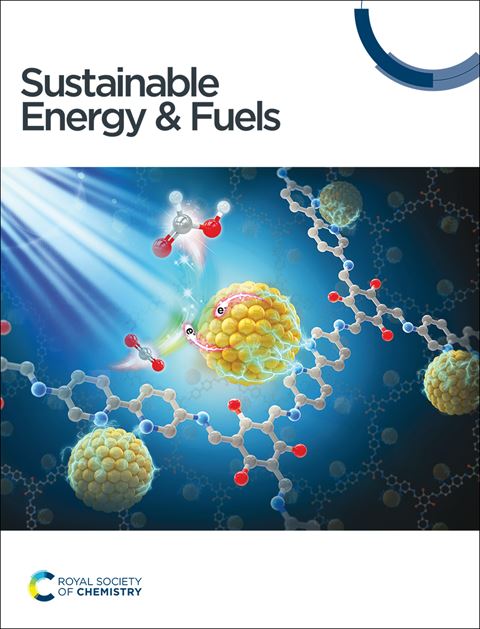
Aqueous Zn-ion batteries (ZIBs) are promising alternatives to lithium-ion batteries because of their inherent safety, raw material abundance (e.g., 10 million metric tons of available zinc in India, and Australia is the second largest zinc producer), and cost-effectiveness. This study focuses on utilising redox-active organic materials with quinone moieties, namely, 5- and 6-nitro 2,3-dichloro 1,4-naphthoquinone (5-DCNNQ) and (6-DCNNQ), and their mixtures in a 3 : 1 ratio as cathode materials for aqueous ZIBs. Although the introduction of the nitro group reduced the solubility of the active material in the electrolyte, the isomer mixture DCNNQmix cathode, with the high voltage characteristic of 5-DCNNQ and the high capacity characteristic of 6-DCNNQ, exhibited a higher capacity and cyclability than either material. The battery retained its capacity even after 9600 charge–discharge cycles.
期刊介绍:
Sustainable Energy & Fuels will publish research that contributes to the development of sustainable energy technologies with a particular emphasis on new and next-generation technologies.





 京公网安备 11010802042870号
京ICP备2023020795号-1
京公网安备 11010802042870号
京ICP备2023020795号-1

 分享
分享
 求助内容:
求助内容: 应助结果提醒方式:
 扫码关注我们
