Sarah L. Addison, Zhen-Zhen Yan, Tom Carlin, Megan A. Rúa, Simeon J. Smaill, Kaitlyn Daley, Brajesh K. Singh, Steve A. Wakelin
{"title":"Unravelling Changes in the Pinus radiata Root and Soil Microbiomes as a Function of Aridity","authors":"Sarah L. Addison, Zhen-Zhen Yan, Tom Carlin, Megan A. Rúa, Simeon J. Smaill, Kaitlyn Daley, Brajesh K. Singh, Steve A. Wakelin","doi":"10.1111/gcb.70165","DOIUrl":null,"url":null,"abstract":"<p>Increased aridity is emerging as a key impact of climate change in terrestrial ecosystems globally. Forest biomes are particularly vulnerable to the impacts of changing environmental conditions due to their long-lived and sessile nature. Microbiomes have coevolved with plants under changing environmental conditions with shared fitness outcomes. However, both the movement of plants via domestication and rapid pace of environmental change may impact the ability of plants to recruit microbial symbionts that support environmental stress tolerance. This study investigates the effects of aridity on tree-root microbiome symbiosis, focusing on the widely planted <i>Pinus radiata</i>. By sampling a broad geographic range and diverse environmental gradients, we reveal how aridity, soil and climatic variables shape microbial communities in <i>P. radiata</i> roots and soils. Our findings highlight that while aridity significantly predicts microbial community assembly, other environmental variables such as soil pH and organic carbon, strongly influence bacterial diversity. Groups of both bacterial and fungal taxa were identified as conditionally present with aridity, underscoring their importance in <i>P. radiata</i> resilience under increasingly environmental stress. Based on the transition of current mesic ecosystems to arid conditions under climate change, we found these arid associated taxa vary in their frequency in bulk soils projected to become arid. These results highlight the risk that these taxa will need to be recruited by other means. Ecological filtering by the host and environmental conditions fosters a “friends with benefits” relationship, wherein certain microbial taxa provide key benefits, such as extension of phenotypic tolerance to water limitation, to the host. Both bacterial and fungal communities are shaped more by stochastic than deterministic assembly processes, suggesting a complex interplay of host and environmental factors in community structure formation. The insights gained have implications for understanding the resilience of tree species and the ecosystem services they provide under future climate scenarios.</p>","PeriodicalId":175,"journal":{"name":"Global Change Biology","volume":"31 4","pages":""},"PeriodicalIF":12.0000,"publicationDate":"2025-04-08","publicationTypes":"Journal Article","fieldsOfStudy":null,"isOpenAccess":false,"openAccessPdf":"https://onlinelibrary.wiley.com/doi/epdf/10.1111/gcb.70165","citationCount":"0","resultStr":null,"platform":"Semanticscholar","paperid":null,"PeriodicalName":"Global Change Biology","FirstCategoryId":"93","ListUrlMain":"https://onlinelibrary.wiley.com/doi/10.1111/gcb.70165","RegionNum":1,"RegionCategory":"环境科学与生态学","ArticlePicture":[],"TitleCN":null,"AbstractTextCN":null,"PMCID":null,"EPubDate":"","PubModel":"","JCR":"Q1","JCRName":"BIODIVERSITY CONSERVATION","Score":null,"Total":0}
引用次数: 0
Abstract
Increased aridity is emerging as a key impact of climate change in terrestrial ecosystems globally. Forest biomes are particularly vulnerable to the impacts of changing environmental conditions due to their long-lived and sessile nature. Microbiomes have coevolved with plants under changing environmental conditions with shared fitness outcomes. However, both the movement of plants via domestication and rapid pace of environmental change may impact the ability of plants to recruit microbial symbionts that support environmental stress tolerance. This study investigates the effects of aridity on tree-root microbiome symbiosis, focusing on the widely planted Pinus radiata. By sampling a broad geographic range and diverse environmental gradients, we reveal how aridity, soil and climatic variables shape microbial communities in P. radiata roots and soils. Our findings highlight that while aridity significantly predicts microbial community assembly, other environmental variables such as soil pH and organic carbon, strongly influence bacterial diversity. Groups of both bacterial and fungal taxa were identified as conditionally present with aridity, underscoring their importance in P. radiata resilience under increasingly environmental stress. Based on the transition of current mesic ecosystems to arid conditions under climate change, we found these arid associated taxa vary in their frequency in bulk soils projected to become arid. These results highlight the risk that these taxa will need to be recruited by other means. Ecological filtering by the host and environmental conditions fosters a “friends with benefits” relationship, wherein certain microbial taxa provide key benefits, such as extension of phenotypic tolerance to water limitation, to the host. Both bacterial and fungal communities are shaped more by stochastic than deterministic assembly processes, suggesting a complex interplay of host and environmental factors in community structure formation. The insights gained have implications for understanding the resilience of tree species and the ecosystem services they provide under future climate scenarios.
期刊介绍:
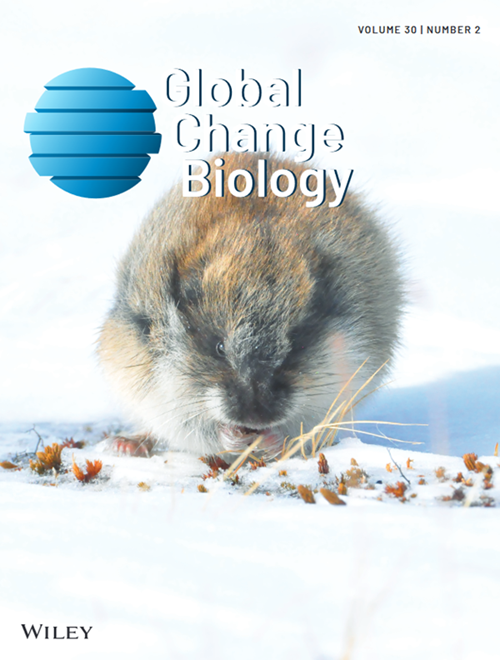
Global Change Biology is an environmental change journal committed to shaping the future and addressing the world's most pressing challenges, including sustainability, climate change, environmental protection, food and water safety, and global health.
Dedicated to fostering a profound understanding of the impacts of global change on biological systems and offering innovative solutions, the journal publishes a diverse range of content, including primary research articles, technical advances, research reviews, reports, opinions, perspectives, commentaries, and letters. Starting with the 2024 volume, Global Change Biology will transition to an online-only format, enhancing accessibility and contributing to the evolution of scholarly communication.




 京公网安备 11010802042870号
京ICP备2023020795号-1
京公网安备 11010802042870号
京ICP备2023020795号-1

 分享
分享
 求助内容:
求助内容: 应助结果提醒方式:
 扫码关注我们
